
Unlocking Climate Clues from Tiny Fossils
There are fossils, found in ancient marine sediments and made up of no more than a few magnetic nanoparticles, that can tell us a whole lot about the climate of the past, especially episodes of abrupt global warming. Now, researchers including doctoral student Courtney Wagner and associate professor Peter Lippert from the University of Utah, have found a way to glean the valuable information in those fossils without having to crush the scarce samples into a fine powder. Their results are published in Proceedings of the National Academy of Sciences.
“It’s so fun to be a part of a discovery like this, something that can be used by other researchers studying magnetofossils and intervals of planetary change,” Wagner says. “This work can be used by many other scientists, within and outside our specialized community. This is very exciting and fulfilling.”
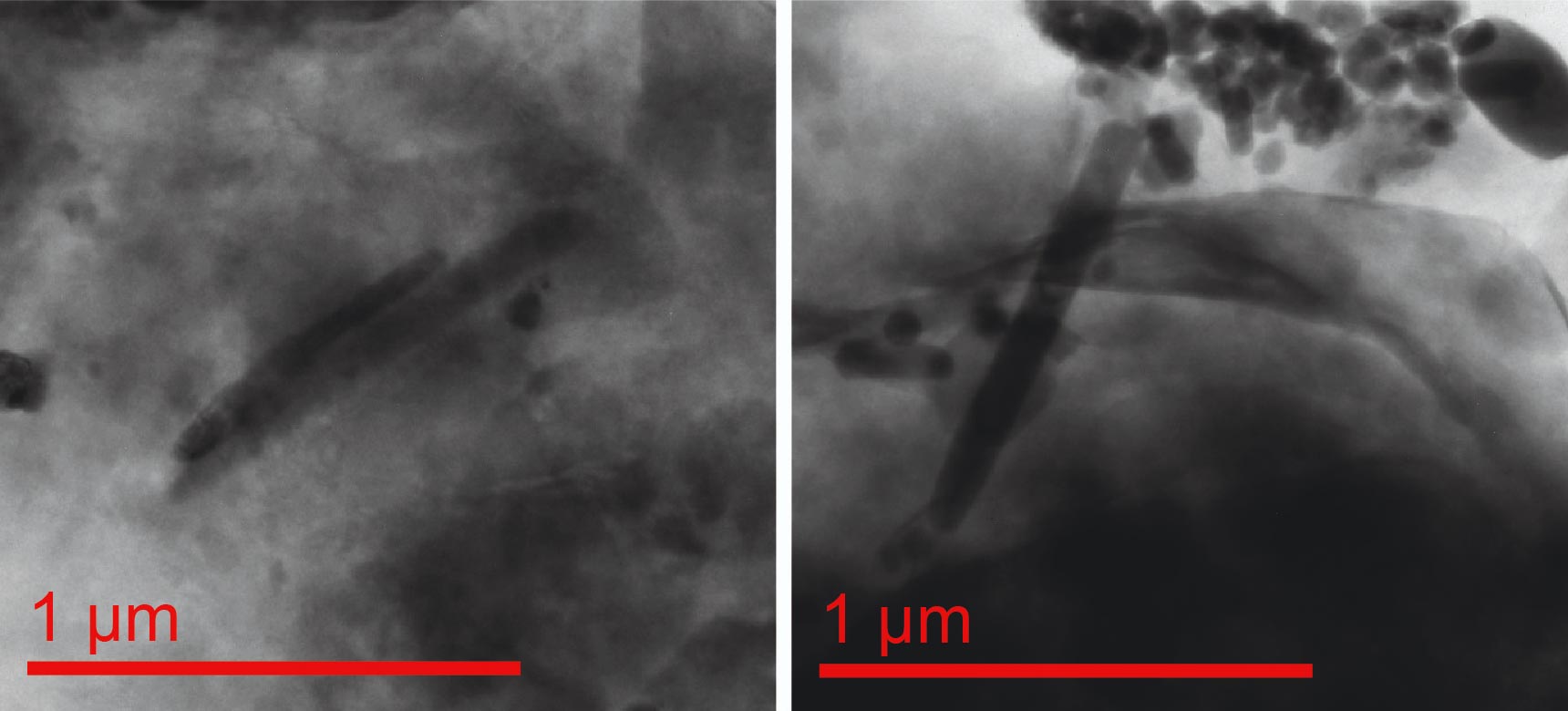
The name “magnetofossil” may bring to mind images of the X-Men, but the reality is that magnetofossils are microscopic bacterial iron fossils. Some bacteria make magnetic particles 1/1000 the width of a hair that, when assembled into a chain within the cell, act like a nano-scale compass. The bacteria, called “magnetotactic bacteria,” can then use this compass to align themselves to the Earth’s magnetic field and travel efficiently to their favorite chemical conditions within the water.
Ancient Warming and Giant Magnetofossils
During a few periods in the Earth’s past, at the beginning and middle of the Eocene epoch from 56 to 34 million years ago, some of these biologically-produced magnets grew to “giant” sizes, about 20 times larger than typical magnetofossils, and into exotic shapes such as needles, spindles, spearheads and giant bullets. Because the bacteria used their magnetic supersense to find their preferred levels of nutrients and oxygen in the ocean water, and because the giant magnetofossils are associated with periods of rapid climate change and elevated global temperature, they can tell us a lot about the conditions of the ocean during that rapid warming, and especially how those conditions changed over time.
Previously, extraction and analysis of these fossils required crushing the samples into a fine powder for electron microscopy imaging. “The extraction process can be time-consuming and unsuccessful, electron microscopy can be costly, and the destruction of samples means that they are no longer useful for most other experiments,” Wagner says. “Collection and storage of these samples require specialized personnel, equipment and planning, so we want to preserve as much material for additional studies as we can.”
A Magnetic New Approach: FORC Measurements
So Wagner, Lippert and colleagues including Ramon Egli from the Central Institute for Meteorology and Geodynamics and Ioan Lascu at the National Museum of Natural History, found another way. Using sediment samples collected in New Jersey, they designed a new way of conducting an analysis called FORC (first order reversal curve) measurements. With these high-resolution magnetic measurements, they found that the magnetic signature of giant magnetofossils was distinctive–enough that the technique could be used in other samples to identify the presence of the fossils. “FORC measurements probe the reaction of magnetic particles to externally applied magnetic fields, enabling to discriminate among different types of iron oxide particles without actually seeing them,” says Egli.
“The ability to rapidly find giant magnetofossil assemblages in the geologic record will help to identify the origin of these unusual magnetofossils,” the researchers write, as well as the ecology of the organisms that formed them. This is important, Wagner says, because no known living organisms form giant magnetofossils today, and we still don’t know what organisms formed them in the past. “The organisms that produced these giant magnetofossils are utterly mysterious, but this leaves exciting research avenues open for the future” adds Lascu.
Beyond that, though, the information contained in magnetofossils helps scientists understand how oceans responded to past climate changes–and how our current ocean might respond to ongoing warming.
Reference: “In situ magnetic identification of giant, needle-shaped magnetofossils in Paleocene–Eocene Thermal Maximum sediments” by Courtney L. Wagner, Ramon Egli, Ioan Lascu, Peter C. Lippert, Kenneth J. T. Livi and Helen B. Sears, 9 February 2021, Proceedings of the National Academy of Sciences.
DOI: 10.1073/pnas.2018169118
Never miss a breakthrough: Join the SciTechDaily newsletter.
Follow us on Google and Google News.
3 Comments
“… no known living organisms form giant magnetofossils today …”
James Hutton was famous for coining the phrase, “The present is the key to the past.” If there are no known modern analogues that produce ‘large’ magnetic spindles, how can we be sure that what are being examined aren’t abiotic?
https://scitechdaily.com/organic-biomorphs-experiments-show-the-record-of-early-life-could-be-full-of-false-positives/
Very nice information.Thanks.
..oO the proton decayed residues from the long buried structural steel left over from the last great civilization on earth? Only magnetic residue remains.