
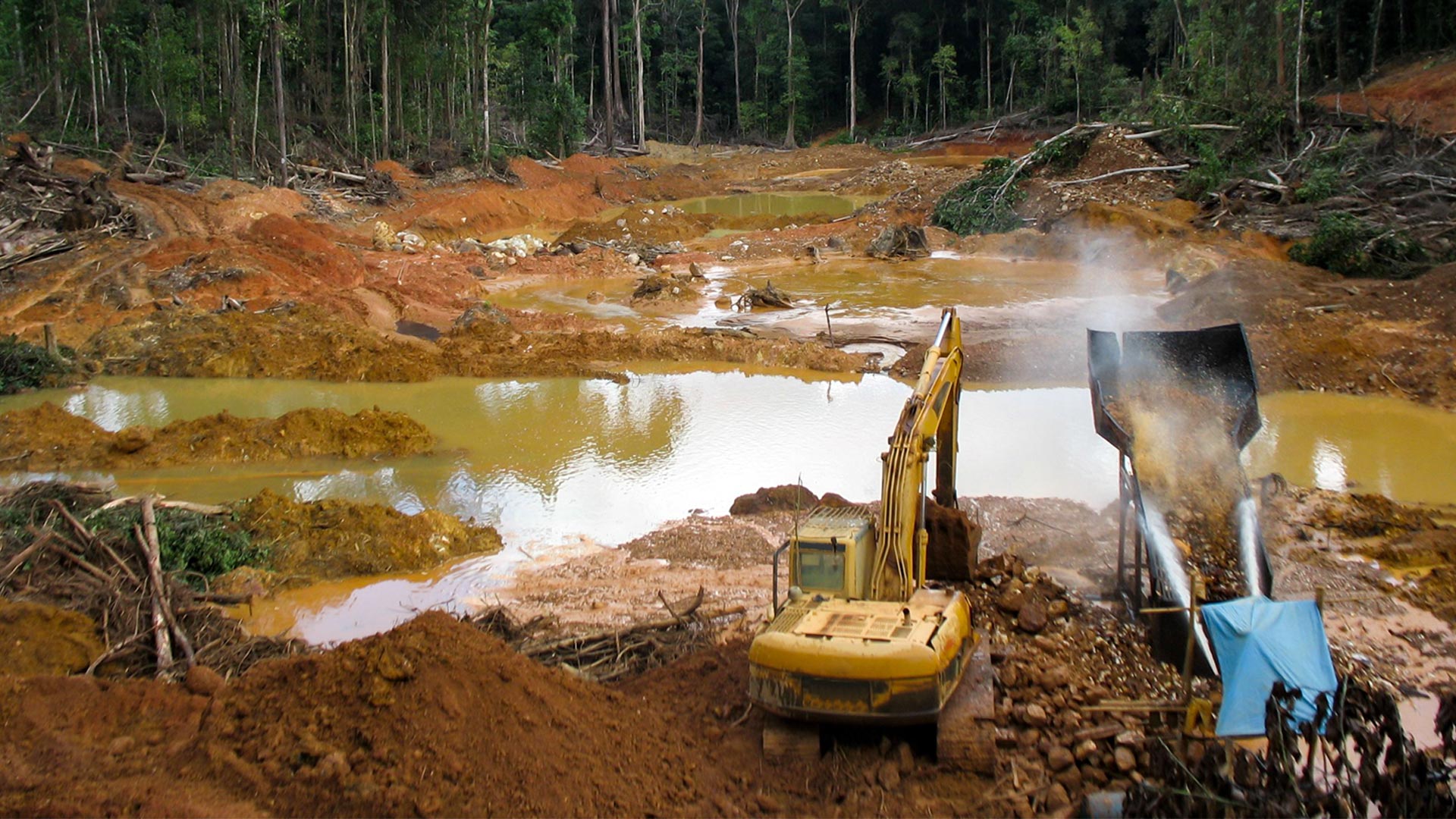
Gold mining in Peru’s Amazon is now destroying carbon-storing peatlands at an alarming rate.
In just two years, over half of all recorded peatland destruction has occurred, releasing vast amounts of carbon into the atmosphere. Researchers warn that if the trend continues, emissions could skyrocket, worsening climate change.
Gold Mining’s Hidden Threat to the Amazon
New research published in Environmental Research Letters reveals that small-scale gold mining in the southern Peruvian Amazon has destroyed more carbon-rich peatlands in the past two years than in the previous three decades combined. This rapid loss poses a major threat to both the environment and climate.
For decades, artisanal gold mining has flourished along the rivers of the Madre de Dios region, where gold is commonly found in the soil. While the deforestation caused by mining has long been a concern, scientists have now uncovered an even deeper level of damage — both literally and figuratively.
Satellite Data Reveals Rapid Peatland Loss
Using more than 35 years of satellite data from NASA’s Landsat program, researchers tracked the expansion of mining into Amazonian peatlands, which store vast amounts of carbon underground. Their findings are alarming: over 550 hectares of peatland have been destroyed, releasing an estimated 0.2 to 0.7 million tons of carbon into the atmosphere. Even more concerning, more than 55% of this destruction has occurred in just the last two years — exceeding the cumulative damage of the previous 30 years.
Peatlands are vital because they hold carbon more densely than forests. In fact, the peatlands in this region store as much carbon as forests would on an area seven times larger. This means that even small areas of peatland loss can have a big impact on greenhouse gas emissions.
A Growing Crisis: Mining’s Expanding Reach
Mining in peatlands currently makes up about 9% of all mining activity in the region, but it’s growing fast. If the trend continues, peatland mining could account for 25% of total mining by 2027. Already, 63 out of 219 peatland areas have been affected, putting over 10,000 hectares at immediate risk. This could lead to the release of up to 14.5 million tons of carbon — equivalent to the annual emissions of millions of cars.
It was not until 2012 that these peatlands in southern Peru were known to science. Only a decade later, the very same group of scientists that provided the original description of these peats are now describing the beginning of their demise. The data paints a discouraging picture for the future.
A Race Against Time to Save the Peatlands
Dr. John Householder, corresponding author of the study, explains, “Mining is spreading fast into these fragile areas because it has become easier to reach these remote mining spots, and there just isn’t enough law enforcement to protect the area. If we don’t slow down the destruction, the damage to the Amazon’s peatlands could be permanent, with serious environmental, social, and economic impacts down the line.”
He adds, “There are many other sites where considerable amounts of peat are suspected, but the ground data to test these suspicions is simply unavailable. What our paper shows is that even within a human generation, it is quite possible that large peat deposits can disappear from the landscape, before science has had a chance to describe them. For those peat deposits that are already known, these research findings are a wakeup call to protect them.”
Reference: “Surge of peatland destruction by an advancing front of artisanal gold mining in Amazonia” by Natalie Daichendt, John P Janovec, Mathias W Tobler, Florian Wittmann, Edgardo M Latrubesse, Adam Hastie, Natalia Morandeira and J Ethan Householder, 11 March 2025, Environmental Research Letters.
DOI: 10.1088/1748-9326/adb868
Never miss a breakthrough: Join the SciTechDaily newsletter.
Follow us on Google and Google News.
2 Comments
The photo does not show what is claimed to be peat lands. Peat is typically black to dark brown and is almost entirely organic, lacking the boulders shown in the photo.
Ah, woman’s lust for gold will cook the Earth.