
Close Menu
    Facebook X (Twitter) Instagram
    SciTechDaily
    • Biology
    • Chemistry
    • Earth
    • Health
    • Physics
    • Science
    • Space
    • Technology
    Facebook X (Twitter) Pinterest YouTube RSS
    SciTechDaily
    Home»Technology»“Goldilocks Ion” – UCLA Physicists Develop World’s Best Quantum Bits
    Technology

    “Goldilocks Ion” – UCLA Physicists Develop World’s Best Quantum Bits

    By University of California - Los AngelesJune 13, 2020No Comments3 Mins Read
    Facebook Twitter Pinterest Telegram LinkedIn WhatsApp Email Reddit
    Share
    Facebook Twitter LinkedIn Pinterest Telegram Email Reddit
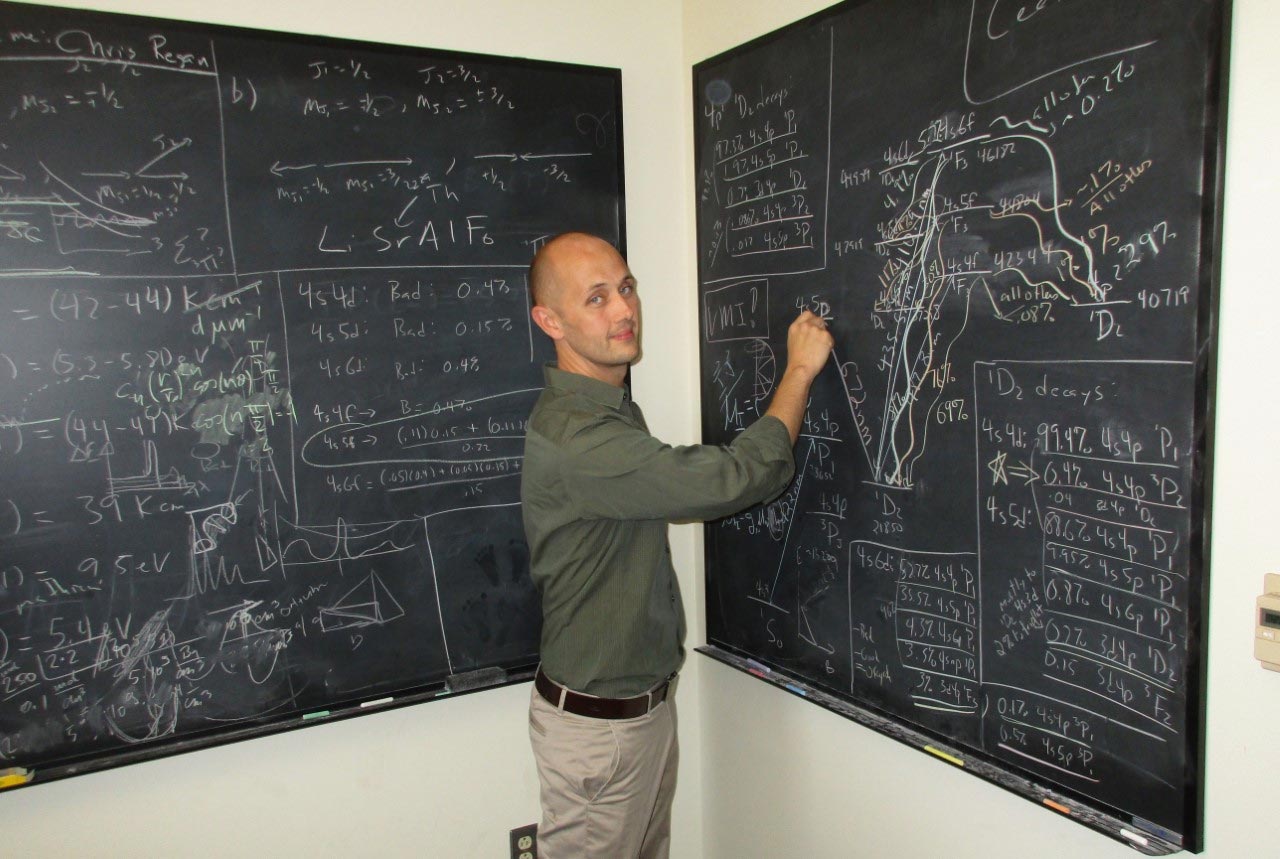
    Eric Hudson, UCLA
    This is Eric Hudson, UCLA professor of physics and astronomy. Credit: Stuart Wolpert

    A team of researchers at UCLA has set a new record for preparing and measuring the quantum bits, or qubits, inside of a quantum computer without error. The techniques they have developed make it easier to build quantum computers that outperform classical computers for important tasks, including the design of new materials and pharmaceuticals. The research is published in the peer-reviewed, online open-access journal, npj Quantum Information, published by Nature and including the exceptional research on quantum information and quantum computing.

    Currently, the most powerful quantum computers are “noisy intermediate-scale quantum” (NISQ) devices and are very sensitive to errors. Error in preparation and measurement of qubits is particularly onerous: for 100 qubits, a 1% measurement error means a NISQ device will produce an incorrect answer about 63% of the time, said senior author Eric Hudson, a UCLA professor of physics and astronomy.

    Wesley Campbell, UCLA
    Assistant Professor Wesley Campbell, UCLA Physics & Astronomy. Credit: UCLA

    To address this major challenge, Hudson and UCLA colleagues recently developed a new qubit hosted in a laser-cooled, radioactive barium ion. This “goldilocks ion” has nearly ideal properties for realizing ultra-low error rate quantum devices, allowing the UCLA group to achieve a preparation and measurement error rate of about 0.03%, lower than any other quantum technology to date, said co-senior author Wesley Campbell, also a UCLA professor of physics and astronomy.

    The development of this exciting new qubit at UCLA should impact almost every area of quantum information science, Hudson said. This radioactive ion has been identified as a promising system in quantum networking, sensing, timing, simulation, and computation, and the researchers’ paper paves the way for large-scale NISQ devices.

    Reference: “High-fidelity manipulation of a qubit enabled by a manufactured nucleus” by Justin E. Christensen, David Hucul, Wesley C. Campbell and Eric R. Hudson, 14 April 2020, npj Quantum Information.
    DOI: 10.1038/s41534-020-0265-5

    Co-authors are lead author Justin Christensen, a postdoctoral scholar in Hudson’s laboratory, and David Hucul, a former postdoctoral scholar in Hudson and Campbell’s laboratories, who is now a physicist at the U.S. Air Force Research Laboratory.

    The research is funded by the U.S. Army Research Office.

    Campbell and Hudson are primary investigators of a major $2.7 million U.S. Department of Energy Quantum Information Science Research project to lay the foundation for the next generation of computing and information processing, as well as many other innovative technologies.

    Never miss a breakthrough: Join the SciTechDaily newsletter.
    Follow us on Google and Google News.

    Quantum Computing Quantum Information Science UCLA
    Share. Facebook Twitter Pinterest LinkedIn Email Reddit

    Related Articles

    Quantum Programming Breakthrough: First Intuitive Language for Quantum Computers

    MIT System “Recruits” Defects for Easier Scaling of Quantum Devices

    Solving Vexing Problem in Building Quantum Computers With Particle Accelerator Technology

    MIT Devises More Efficient Error Correction for Quantum Devices

    Artificial Atoms in Silicon “Quantum Dot” Create Stable Qubits for Quantum Computing

    New Method to Verify That Quantum Chips Accurately Performed Complex Computations

    Quantum Supremacy Achieved by NASA and Google

    Blanket of Entangled Light Pulses for Larger and More Powerful Quantum Computers

    Quantum Internet Is One Step Closer to Reality With U.S. Army Research Breakthrough

    Leave A Reply Cancel Reply

    • Facebook
    • Twitter
    • Pinterest
    • YouTube

    Don't Miss a Discovery

    Subscribe for the Latest in Science & Tech!

    Trending News

    Largest-Ever Study Finds Medicinal Cannabis Ineffective for Anxiety, Depression, PTSD

    250-Million-Year-Old Egg Solves One of Evolution’s Biggest Mysteries

    Living With Roommates Might Be Changing Your Gut Microbiome Without You Knowing

    Century-Old Cleaning Chemical Linked to 500% Increased Risk of Parkinson’s Disease

    What if Your Memories Never Happened? Physicists Take a New Look at the Boltzmann Brain Paradox

    One of the Universe’s Largest Stars May Be Getting Ready To Explode

    Scientists Discover Enzyme That Could Supercharge Ozempic-Like Weight Loss Drugs

    Popular Sweetener Linked to DNA Damage – “It’s Something You Should Not Be Eating”

    Follow SciTechDaily
    • Facebook
    • Twitter
    • YouTube
    • Pinterest
    • Newsletter
    • RSS
    SciTech News
    • Biology News
    • Chemistry News
    • Earth News
    • Health News
    • Physics News
    • Science News
    • Space News
    • Technology News
    Recent Posts
    • Scientists Prove There Are Just Six Degrees of Separation in a Social Network
    • Bee Bacteria Could Fix a Major Flaw in Plant-Based Milk
    • Scientists Discover a Surprising Way To Make Bread Healthier and More Nutritious
    • Natural Compounds Boost Bone Implant Success While Killing Bacteria and Cancer Cells
    • After 60 Years, Scientists Uncover Unexpected Brain Effects of Popular Diabetes Drug Metformin
    Copyright © 1998 - 2026 SciTechDaily. All Rights Reserved.
    • Science News
    • About
    • Contact
    • Editorial Board
    • Privacy Policy
    • Terms of Use

    Type above and press Enter to search. Press Esc to cancel.