
Close Menu
    Facebook X (Twitter) Instagram
    SciTechDaily
    • Biology
    • Chemistry
    • Earth
    • Health
    • Physics
    • Science
    • Space
    • Technology
    Facebook X (Twitter) Pinterest YouTube RSS
    SciTechDaily
    Home»Health»H5N1 Work Will Probably Continue
    Health

    H5N1 Work Will Probably Continue

    By SciTechDailyDecember 20, 2012No Comments2 Mins Read
    Facebook Twitter Pinterest Telegram LinkedIn WhatsApp Email Reddit
    Share
    Facebook Twitter LinkedIn Pinterest Telegram Email Reddit
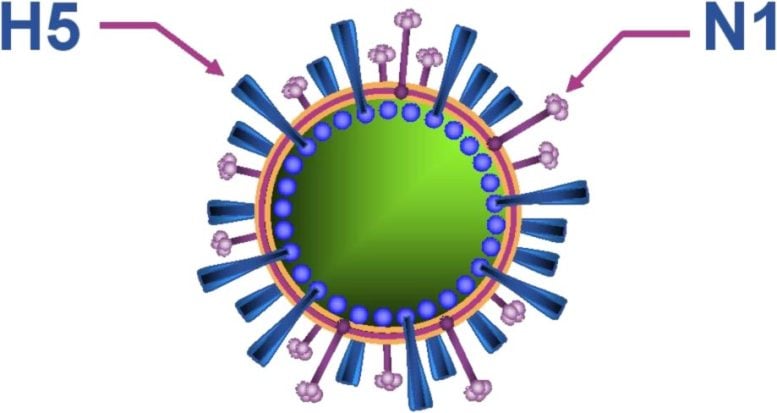
    H5N1 Virus Illustration
    H5N1 Virus Illustration Credit: Y-T Wu, Academia Sinica

    After a high-level meeting this week, work on the avian influenza H5N1 virus will probably continue by people who are not NIH funded. This is in the wake of a global debate about the risks and benefits of such research and a voluntary moratorium on the experiments lasting nearly a year.

    Experts met on Monday and Tuesday of this week at the NIH in Bethesda, Maryland to discuss the future of such work, so-called gain-of-function experiments, which entails changing the virus’ properties to make it more transmissible and infectious in humans in order to investigate the possible natural evolution of the virus.

    While the meeting didn’t reconcile the differences of opinion over the risks, or address the moratorium, it appears that non-NIH funded investigations might resume in H5N1 work. The meeting was also set to discuss a new framework for overseeing such work in US funded research. It will add an extra layer that will be managed by the US Department of Health and Human Services (HHS) on top of peer review and other standard safety as well as ethical reviews.

    This review could result in the research not being funded, or possibly being recommended to another branch of government to be handled as classified. The intention of the workshop was to road test the framework on some hypothetical case studies to identify its strengths and weaknesses.

    Some scientists complained about the vague terms used in the framework. According to the draft of the framework, it would target most gain-of-function experiments. 75% of the studies in the H5N1 research portfolio would trigger a review, swamping the system and reducing the interest in such work.

    One solution entailed focusing only on studies that would enhance the ability of H5N1 to transmit between mammals by air through respiratory droplets. The moratorium cannot be lifted for NIH-funded researchers until this process is complete.

    Never miss a breakthrough: Join the SciTechDaily newsletter.
    Follow us on Google and Google News.

    Disease Epidemiology H5N1 Influenza Virology
    Share. Facebook Twitter Pinterest LinkedIn Email Reddit

    Related Articles

    Drug Resistant Tuberculosis On The Rise

    Epidemiologists Trying to Track Down Novel Coronavirus

    Cases of New Coronavirus Announced By WHO

    Crystal Meth Could Reduce Susceptibility to the Common Flu

    Whole-Genome Analysis Identifies the Source of a Recent MRSA Outbreak

    Hepatitis E Vaccine Debuts Thanks to Chinese Biotech Partnership

    FDA States Deadly Meningitis Outbreak Tied to More Drugs

    New Coronavirus Could Infect Millions During Hajj in Saudi Arabia

    West Nile Virus Might Be Linked to Kidney Problems

    Leave A Reply Cancel Reply

    • Facebook
    • Twitter
    • Pinterest
    • YouTube

    Don't Miss a Discovery

    Subscribe for the Latest in Science & Tech!

    Trending News

    Aging’s “Zombie Cell” Problem May Have a Solution, Scientists Discover

    Scientists Discover a Surprising Dental Benefit of Cranberry Juice

    Scientists Discover That Eating Peanuts Every Day May Help Protect the Aging Brain

    Scientists Discover Mysterious 150,000-Year-Old Bone From an Extinct Human Relative in Chinese Cave

    Why Do We Have Necks? Scientists Uncover a 380-Million-Year-Old Evolutionary Twist

    “Strangest of Its Kind”: Scientists Uncover a Bizarre Bacterial Self-Destruct Switch

    Scientists Reverse 60 Years of Aging in Human Cells, Turning 80-Year-Old Cells Into 20-Year-Olds

    A Solar Storm Heading Toward Earth Suddenly Changed in Ways Scientists Didn’t Predict

    Follow SciTechDaily
    • Facebook
    • Twitter
    • YouTube
    • Pinterest
    • Newsletter
    • RSS
    SciTech News
    • Biology News
    • Chemistry News
    • Earth News
    • Health News
    • Physics News
    • Science News
    • Space News
    • Technology News
    Recent Posts
    • Scientists Uncover Why Breast Cancer Becomes Deadlier As We Age
    • Scientists Discover a Surprising New Target for Treating Type 2 Diabetes
    • Eating a Handful of Peanuts Could Change Your Blood in a Surprising Way, Study Finds
    • Scientists Use Light To Build a New Generation of Drug Molecules
    • Scientists Unlock a 1,000-Year-Old Mystery Buried Inside Ancient Melon Seeds
    Copyright © 1998 - 2026 SciTechDaily. All Rights Reserved.
    • Science News
    • About
    • Contact
    • Editorial Board
    • Privacy Policy
    • Terms of Use

    Type above and press Enter to search. Press Esc to cancel.