
Close Menu
    Facebook X (Twitter) Instagram
    SciTechDaily
    • Biology
    • Chemistry
    • Earth
    • Health
    • Physics
    • Science
    • Space
    • Technology
    Facebook X (Twitter) Pinterest YouTube RSS
    SciTechDaily
    Home»Space»Gravitational Wave Scientists Pioneer New Laser Mode Sensor With Unprecedented Precision
    Space

    Gravitational Wave Scientists Pioneer New Laser Mode Sensor With Unprecedented Precision

    By Dr. Aaron Jones, OzGravMay 10, 2022No Comments3 Mins Read
    Facebook Twitter Pinterest Telegram LinkedIn WhatsApp Email Reddit
    Share
    Facebook Twitter LinkedIn Pinterest Telegram Email Reddit
    Gravitational Waves Illustration
    Artist’s illustration of gravitational waves.

    A new metasurface-based method enhances laser eigenmode measurement, improving gravitational wave detector precision for studying neutron stars.

    Lasers support certain structures of light known as “eigenmodes.” An international collaboration of experts in gravitational waves, metasurfaces, and photonics has pioneered a new method to measure the amount of these eigenmodes with unprecedented sensitivity.

    In gravitational wave detectors, several pairs of mirrors are used to increase the amount of laser light stored along the massive arms of the detector. However, each of these pairs has tiny distortions that scatter light away from the perfect shape of the laser beam. This scattering can cause excess noise in the detector, limiting sensitivity, and ultimately forcing the instrument to shut down.
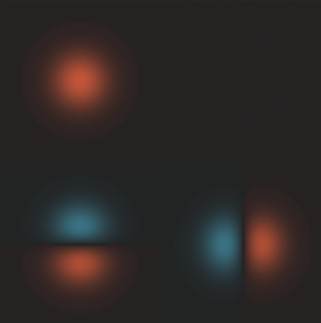
    Laser Eigenmodes Gravitational Wave Sensor
    Figure 1: False color image of laser eigenmodes that were tested. The color indicates the phase of the light. Red is 0 degrees, blue is 180 degrees. Credit: OzGrav

    From the recently submitted study, Professor Andreas Freise (from Vrije Universiteit Amsterdam) says: “Gravitational wave detectors like LIGO, Virgo, and KAGRA store an enormous amount of optical power – in this work, we wanted to test an idea that would let us zoom in on the laser beam and look for the small wiggles in power that can limit the detectors’ sensitivity.”

    A similar problem is encountered in the telecoms industry where scientists want to use multiple eigenmodes to transport more data down optical fibers. OzGrav researcher and lead author Dr. Aaron Jones (The University of Western Australia) explains: “Telecoms scientists have developed a way to measure the eigenmodes using a simple apparatus, but it’s not sensitive enough for our purposes. We had the idea to use a metasurface and reached out to collaborators who could help us fabricate one.”

    Laser Gravitational Wave Sensor Schematic
    Figure 2: A schematic of the apparatus used by the researchers. f is the focal length of the lens. Credit: OzGrav

    In the study, the proof-of-concept setup the team developed was over 1000x more sensitive than the original method developed by the telecoms scientists. The researchers will now look to translate this work into gravitational wave detectors, where the additional precision will be used to probe the interiors of neutron stars and test the fundamental limits of general relativity.

    OzGrav Chief Investigator, Prof Zhao (from the University of Western Australia) says: “Solving the mode sensing problem in future gravitational wave detectors is essential, if we are to understand the insides of neutron stars.”

    Written by Dr. Aaron Jones (The University of Western Australia).

    Reference: “Metasurface Enhanced Spatial Mode Decomposition” by Aaron W. Jones, Mengyao Wang, Xuecai Zhang, Samuel J. Cooper, Shumei Chen, Conor M. Mow-Lowry and Andreas Freise, 26 May 2022, Physical Review A.
    DOI: 10.1103/PhysRevA.105.053523
    arXiv:2109.04663

    Never miss a breakthrough: Join the SciTechDaily newsletter.
    Follow us on Google and Google News.

    Astrophysics Gravitational Waves OzGrav University of Western Australia
    Share. Facebook Twitter Pinterest LinkedIn Email Reddit

    Related Articles

    New Laser Breakthrough for Gravitational Waves Will Test the Fundamental Limits of General Relativity

    A New Approach To Rapidly Localize Gravitational Waves To Coordinate Prompt Follow-Up Observations

    Dancing Stars and Black Holes in a Cosmic Cloud of Gas: Investigating the “Common Envelope Phase”

    Massive, Never-Before-Seen Star System Puzzles Scientists

    Supercomputer Simulations of Core-Collapse Supernovae Reveal Complicated Physics of Exploding Massive Stars

    New Possible Explanation of Strange Black Hole Merger Revealed

    Future Gravitational Wave Detectors to Detect Millions of Black Holes & the Evolution of the Universe

    Radio and Gravitational Wave Signatures of Double Neutron Stars – Accurate Clocks to Test Einstein’s Theory of General Relativity

    Supersensitive Detectors to Aid in the Discovery of Gravitational Waves

    Leave A Reply Cancel Reply

    • Facebook
    • Twitter
    • Pinterest
    • YouTube

    Don't Miss a Discovery

    Subscribe for the Latest in Science & Tech!

    Trending News

    New Study Reveals Why Ozempic Works Better for Some People Than Others

    Climate Change Is Altering a Key Greenhouse Gas in a Way Scientists Didn’t Expect

    New Study Suggests Gravitational Waves May Have Created Dark Matter

    Scientists Discover Why the Brain Gets Stuck in Schizophrenia

    Scientists Engineer “Tumor-Eating” Bacteria That Devour Cancer From Within

    Even “Failed” Diets May Deliver Long-Term Health Gains, Study Finds

    NIH Scientists Discover Powerful New Opioid That Relieves Pain Without Dangerous Side Effects

    Collapsing Plasma May Hold the Key to Cosmic Magnetism

    Follow SciTechDaily
    • Facebook
    • Twitter
    • YouTube
    • Pinterest
    • Newsletter
    • RSS
    SciTech News
    • Biology News
    • Chemistry News
    • Earth News
    • Health News
    • Physics News
    • Science News
    • Space News
    • Technology News
    Recent Posts
    • This 15,000-Year-Old Discovery Changes What We Know About Early Human Creativity
    • 35-Million-Year-Old Mystery: Strange Arachnid Discovered Preserved in Amber
    • Revolutionary Gas Turbine Generates Power Without Air Compression
    • Is AI Really Just a Tool? It Could Be Altering How You See Reality
    • JWST Reveals a “Forbidden” Planet With a Baffling Composition
    Copyright © 1998 - 2026 SciTechDaily. All Rights Reserved.
    • Science News
    • About
    • Contact
    • Editorial Board
    • Privacy Policy
    • Terms of Use

    Type above and press Enter to search. Press Esc to cancel.