
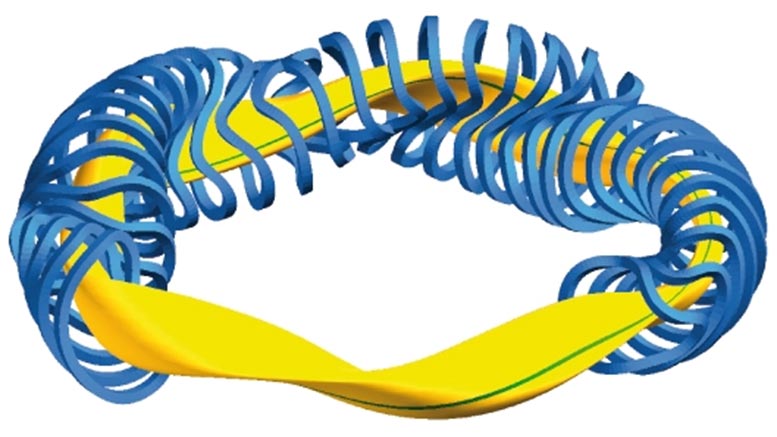
W7-X stellarator proves fusion promise with record heat confinement and optimized magnetic design.
Stellarators, twisty magnetic devices that aim to harness on Earth the fusion energy that powers the sun and stars, have long played second fiddle to more widely used doughnut-shaped facilities known as tokamaks. The complex twisted stellarator magnets have been difficult to design and have previously allowed greater leakage of the superhigh heat from fusion reactions.
Now scientists at the Max Planck Institute for Plasma Physics (IPP), working in collaboration with researchers that include the U.S. Department of Energy’s (DOE) Princeton Plasma Physics Laboratory (PPPL), have shown that the Wendelstein 7-X (W7-X) device in Greifswald, Germany, the largest and most advanced stellarator in the world, is capable of confining heat that reaches temperatures twice as great as the core of the sun.
Key Indicator
A diagnostic instrument called the XICS, chiefly designed, built, and operated by PPPL physicist Novimir Pablant in collaboration with IPP physicist Andreas Langenberg, is a key indicator of a sharp reduction of a type of heat loss called “neoclassical transport” that has historically been greater in classical stellarators than in tokamaks. Causing the troublesome transport are frequent collisions that knock heated particles out of their orbits as they swirl around the magnetic field lines that confine them. Contributing to the transport are drifts in the particle orbits.

A recent report on W7-X findings in Nature magazine confirms the success of the efforts of designers to shape the intricately twisted stellarator magnets to reduce neoclassical transport. First author of the paper was physicist Craig Beidler of the IPP Theory Division. “It’s really exciting news for fusion that this design has been successful,” said Pablant, a coauthor along with Langenberg of the paper. “It clearly shows that this kind of optimization can be done.”
David Gates, head of the Advanced Projects Department at PPPL that oversees the laboratory’s stellarator work, was also highly enthused. “It’s been very exciting for us, at PPPL and all the other U.S. collaborating institutions, to be part of this really exciting experiment,” Gates said. “Novi’s work has been right at the center of this amazing experimental team’s effort. I am very grateful to our German colleagues for so graciously enabling our participation.”
Carbon-Free Power
The fusion that scientists seek to produce combines light elements in the form of plasma — the hot, charged state of matter composed of free electrons and atomic nuclei, or ions, that makes up 99 percent of the visible universe — to generate massive amounts of energy. Producing controlled fusion on Earth would create a virtually inexhaustible supply of safe, clean, and carbon-free source of power to generate electricity for humanity and serve as a major contributor to the transition away from fossil fuels.

Stellarators, first constructed in the 1950s under PPPL founder Lyman Spitzer, can operate in a steady state with little risk of the plasma disruptions that tokamaks face. However, their complexity and history of relatively poor heat confinement has held them back. A major goal of the optimized design of W7-X, which produced its first plasma in 2015, has been to demonstrate the appropriateness of an optimized stellarator as an eventual fusion power plant.
Results obtained by the XICS demonstrate hot ion temperatures that could not have been achieved without a sharp reduction in neoclassical transport. These measurements were also made by the CXRS diagnostic built and operated by IPP, which were thought to be a little more accurate but could not be made in all conditions. The final temperature profiles in the Nature report were taken from CXRS and supported by measurements with XICS in similar plasmas.
“Extremely Valuable”
“Without the XICS we probably would not have discovered this [good confinement] regime,” said Robert Wolf, head of the W7-X heating and operation division and a co-author of the paper. “We needed a readily available ion temperature measurement and this was extremely valuable.”
Researchers conducted a thought experiment to check the role that optimization played in the confinement results. The experiment found that in a non-optimized stellarator large neoclassical transport would have made the high temperatures recorded on W7-X for the given heating power impossible. “This showed that the optimized shape of W7-X reduced the neoclassical transport and was necessary for the performance seen in W7-X experiments,” Pablant said. “It was a way of showing how important the optimization was.”
The results mark a step toward enabling stellarators based on the W7-X design to lead to a practical fusion reactor, he added. “But reducing neoclassical transport isn’t the only thing you have to do. There are a whole bunch of other goals that have to be shown, including running steady and reducing the turbulent transport.” Producing turbulent transport are ripples and eddies that run through the plasma as the second main source of heat loss.
The W7-X will reopen in 2022 following a three-year upgrade to install a water-cooling system that will lengthen fusion experiments and an improved divertor that will exhaust high-performance heat. The upgrades will enable the next step in the investigation by W7-X researchers of the worthiness of optimized stellarators to become blueprints for power plants.
Support for this work comes from the Euratom research and training program and the DOE Office of Science.
Never miss a breakthrough: Join the SciTechDaily newsletter.
Follow us on Google and Google News.
2 Comments
Hello dear friends 🌹💐🌷
Thanks for your attention and your subjects.
Great and Perfect Subjects 🌹💐🌷
Have a great and nice times in the all times in the world 🌎🌍🌎🌍🌹💐🌷⛓️
Ridiculous article. No mention of input/output, just boiler plate bull like all other fusion articles.