
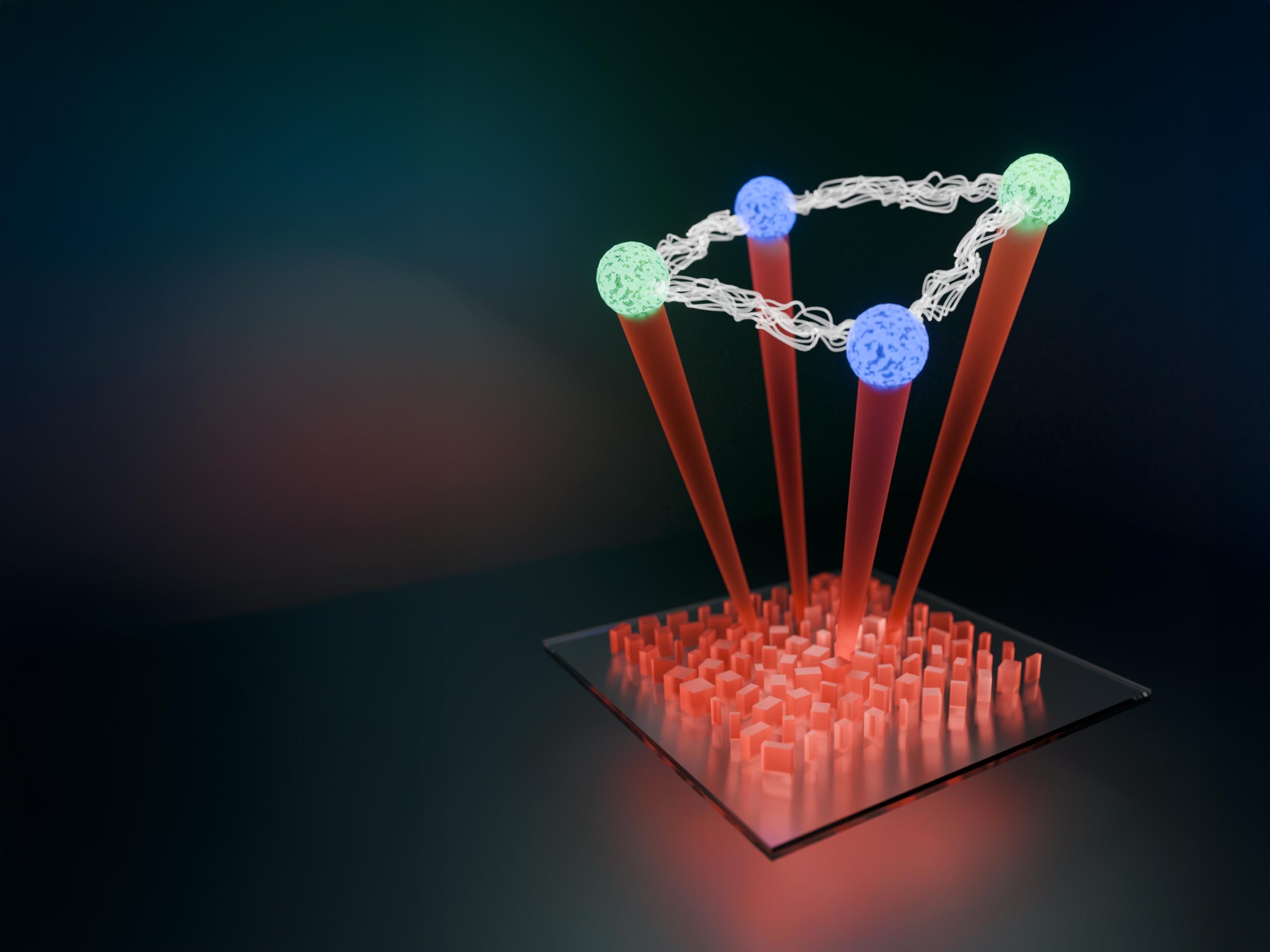
Harvard engineers have built a chip-thin metasurface that replaces entire quantum optical setups.
- New research reveals that metasurfaces can act as powerful building blocks for quantum optical networks
- This breakthrough could replace bulky components like waveguides, mirrors, and beam splitters with a single flat device
- Researchers used graph theory to design and control the complex quantum behaviors directly on the metasurface
Photon Power: The Quest for Scalable Quantum Devices
As researchers work to make quantum computers and networks more practical, photons—the basic particles that make up light—are emerging as promising candidates for moving information quickly, even at room temperature. Typically, guiding photons into the right quantum states involves complex arrangements of waveguides on large microchips, or clunky setups built with lenses, mirrors, and beam splitters. These components allow photons to become entangled, a key quantum process that lets them carry and process information in parallel. However, building and maintaining such intricate systems is challenging because they rely on large numbers of delicate parts, making it hard to scale.
What if all those components could be replaced by a single, ultra-thin surface that manipulates light in exactly the same way—while using far fewer fabricated elements?
Harvard’s Breakthrough in Flat Quantum Optics
A research team at the Harvard John A. Paulson School of Engineering and Applied Sciences (SEAS) achieved just that. Led by Federico Capasso, the Robert L. Wallace Professor of Applied Physics and Vinton Hayes Senior Research Fellow in Electrical Engineering, the group developed specialized metasurfaces. These flat devices are engraved with nanoscale patterns that control light and serve as compact replacements for traditional quantum-optical hardware.
The study was published in Science and received funding support from the Air Force Office of Scientific Research (AFOSR).
Scaling Quantum Systems with Simplicity
The team demonstrated that a metasurface can generate entangled photon states and perform complex quantum operations—just like larger optical systems that use many separate components.
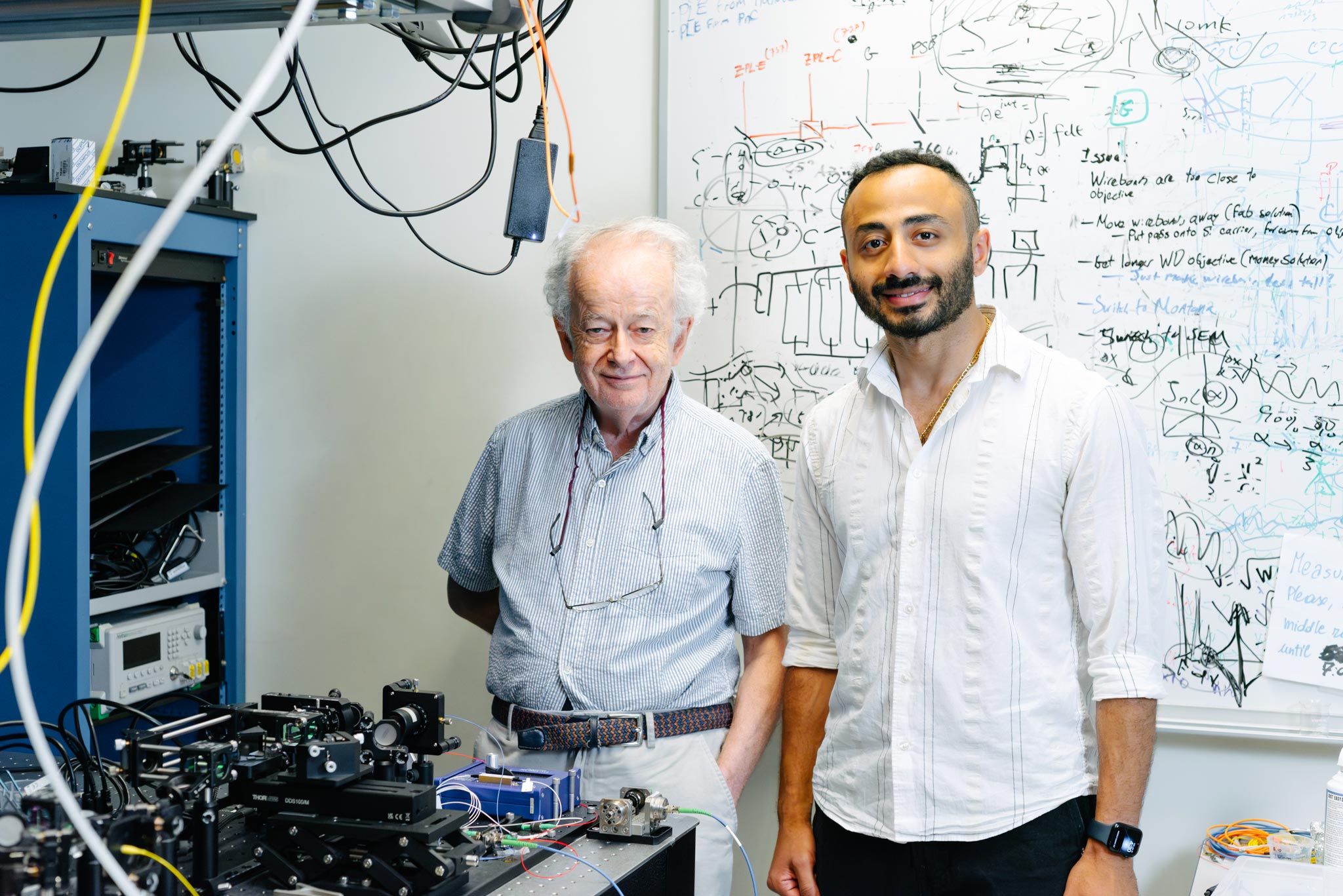
“We’re introducing a major technological advantage when it comes to solving the scalability problem,” said graduate student and first author Kerolos M.A. Yousef. “Now we can miniaturize an entire optical setup into a single metasurface that is very stable and robust.”
Why Metasurfaces Are a Game-Changer
Their results hint at the possibility of paradigm-shifting optical quantum devices based not on conventional, difficult-to-scale components like waveguides and beam splitters, or even extended optical microchips, but instead on error-resistant metasurfaces that offer a host of advantages: designs that don’t require intricate alignments, robustness to perturbations, cost-effectiveness, simplicity of fabrication, and low optical loss. Broadly speaking, the work embodies metasurface-based quantum optics, which, beyond carving a path toward room-temperature quantum computers and networks, could also benefit quantum sensing or offer “lab-on-a-chip” capabilities for fundamental science
Designing a single metasurface that can finely control properties like brightness, phase, and polarization presented unique challenges because of the mathematical complexity that arises once the number of photons and, therefore, the number of qubits begins to increase. Every additional photon introduces many new interference pathways, which in a conventional setup would require a rapidly growing number of beam splitters and output ports.
Graph Theory: The Secret Weapon
To bring order to the complexity, the researchers leaned on a branch of mathematics called graph theory, which uses points and lines to represent connections and relationships. By representing entangled photon states as many connected lines and points, they were able to visually determine how photons interfere with each other, and to predict their effects in experiments. Graph theory is also used in certain types of quantum computing and quantum error correction, but is not typically considered in the context of metasurfaces, including their design and operation.
Unified Design for Light and Logic
The resulting paper was a collaboration with the lab of Marko Lončar, whose team specializes in quantum optics and integrated photonics and provided needed expertise and equipment.
“I’m excited about this approach, because it could efficiently scale optical quantum computers and networks — which has long been their biggest challenge compared to other platforms like superconductors or atoms,” said research scientist Neal Sinclair. “It also offers fresh insight into the understanding, design, and application of metasurfaces, especially for generating and controlling quantum light. With the graph approach, in a way, metasurface design and the optical quantum state become two sides of the same coin.”
Reference: “Metasurface quantum graphs for generalized Hong-Ou-Mandel interference” by Kerolos M. A. Yousef, Marco D’Alessandro, Matthew Yeh, Neil Sinclair, Marko Loncar and Federico Capasso, 24 July 2025, Science.
DOI: 10.1126/science.adw8404
The research received support from federal sources including the AFOSR under award No. FA9550-21-1-0312. The work was performed at the Harvard University Center for Nanoscale Systems, which is supported under National Science Foundation award No. ECCS-2025158.
Never miss a breakthrough: Join the SciTechDaily newsletter.
Follow us on Google and Google News.