
Researchers have created a smart wound dressing that can sense when harmful bacteria are present and respond by releasing antibiotics only when needed.
Biomedical engineers at Brown University have created a wound dressing that releases antibiotics only when harmful bacteria are detected. In a new study, the team found that the material may quickly eliminate wound infections and speed healing while cutting back on unnecessary antibiotic use. Overuse of antibiotics is a key factor behind antibiotic resistance and difficult-to-treat “superbug” infections, which kill tens of thousands of people worldwide each year.
The material is a smart hydrogel packed with antibiotics and designed to be applied directly to a wound beneath a bandage. It responds to an enzyme made by many harmful bacteria. When that enzyme is present, the hydrogel begins to break down and releases the antibiotics stored inside. If harmful bacteria are absent, the hydrogel remains intact and keeps the medication sealed away.
“Antimicrobial resistance is a major problem worldwide, so we need better approaches for how we use antibiotics,” said Anita Shukla, a professor in Brown’s School of Engineering who led the development of the smart hydrogel. “We’ve developed a material that releases antibiotics only when harmful bacteria are present, so it limits exposure to antibiotics when they’re not needed but still provides these important medications when they are needed.”
In the study, published in Science Advances, the researchers tested the hydrogel and found that it was highly selective for enzymes produced by common bacteria that cause wound infections. The findings also suggest that the material may clear infections and support wound healing more effectively than a hydrogel dressing currently used in clinical care.
How the Antibiotic-Releasing Hydrogel Works
Hydrogels are Jell-O-like materials made mostly of water and long polymer molecules. Smaller molecules called crosslinkers hold those polymers together and help the hydrogel keep its structure. For this material, the team used a crosslinker that breaks down when it encounters enzymes known as beta-lactamases, which are produced by many types of bacteria. Once that breakdown begins, the hydrogel falls apart and releases the antibiotics inside.
In petri dish tests, the material broke down only when harmful bacteria that produce beta-lactamases were present. When exposed only to harmless bacteria that do not make these enzymes, the hydrogel stayed intact and did not promote antibiotic resistance during long-term exposure to the dressing.
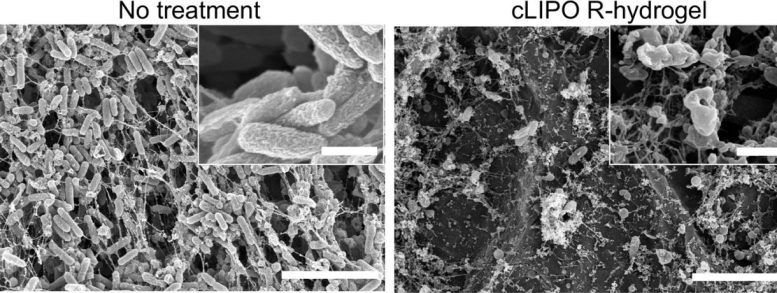
The researchers said this beta-lactamase sensitivity is important because it helps ensure that antibiotics are released only when infection-causing bacteria are present. That could greatly reduce exposure among the healthy microbes that normally live on the skin.
The study also found that the material tightly retains its antibiotic cargo until breakdown is triggered. “This really is a very stable formulation that doesn’t allow the drug to leach out,” Shukla said. “It’s truly trapped in there until there is a significant amount of beta-lactamase production that can cause hydrogel degradation.”
Mouse Studies Show Superior Infection Clearance
In mouse experiments, the researchers found that one application of the hydrogel completely eliminated bacterial infection in an abrasion wound. The new dressing also performed better than a widely used antimicrobial dressing in both bacterial clearance and wound healing.
Overall, the findings point to a potential new strategy for treating wound infections while preserving the effectiveness of important antibiotics. Studies suggest that antibiotic-resistant infections kill more than 1 million people worldwide each year. Without efforts to reduce antibiotic overuse, antimicrobial resistance could be associated with nearly 10 million deaths annually by 2050.
“Our findings suggest that these bacterial enzyme-responsive smart hydrogels have the potential to provide targeted, on-demand infection eradication while minimizing unnecessary exposure to antibiotics,” the researchers conclude. “By releasing the antibiotic only in the presence of beta-lactamase-producing bacteria, our hydrogel system provides effective treatment while minimizing susceptibility to antibiotic resistance.”
The team has patented the material and is continuing to develop the technology for possible future commercialization.
Reference: “Bacterial enzyme-responsive hydrogels for triggered delivery of antibiotics to infected wounds” by Akram Abbasi, Alec McCall, Zhaowei Jiang, Brian W. LeBlanc and Anita Shukla, 20 March 2026, Science Advances.
DOI: 10.1126/sciadv.adz0786
The work was supported by the Dr. Ralph and Marian Falk Medical Research Trust.
Never miss a breakthrough: Join the SciTechDaily newsletter.
Follow us on Google and Google News.