
Harvard scientists have built a silicon chip that writes DNA using electricity and water, pointing toward a cleaner future for DNA manufacturing and biotechnology.
Silicon chips have driven the computing revolution for more than 50 years. Now, researchers are finding new ways to use them in biology, including monitoring large groups of neurons, sequencing DNA, and even manufacturing DNA itself.
A Harvard-led research team has developed a silicon chip that can synthesize 64 different DNA sequences at the same time. The work, published in Nature Electronics, replaces the solvent-heavy chemistry commonly used in custom DNA production with a water-based enzymatic method.
Rather than controlling DNA synthesis with conventional laboratory equipment, the chip uses precisely regulated electric currents to activate chemical reactions at individual locations across its surface. The research was led by Donhee Ham, the John A. and Elizabeth S. Armstrong Professor of Engineering and Applied Sciences at the John A. Paulson School of Engineering and Applied Sciences (SEAS).
A Chip That Writes DNA in Water
Synthetic DNA plays a central role in many areas of modern science and medicine, including diagnostics, genome engineering, and cancer research.
Most synthetic DNA is currently produced through phosphoramidite chemistry. This well-established process can create millions of sequences in parallel, but it relies on hazardous organic solvents and is usually carried out in large, centralized facilities.
Enzymatic DNA synthesis offers a gentler alternative. It takes place in water and more closely resembles the way living cells naturally assemble DNA. In the future, this approach could make DNA-writing devices smaller, safer, and easier to use.
Until now, however, enzymatic methods have lagged far behind conventional chemistry in the number of DNA sequences they can produce simultaneously. Previous systems had created no more than about a dozen sequences at once.
The Harvard team raised that number to 64 distinct sequences, with each one reaching a length of up to 39 nucleotides. The result establishes a new benchmark for parallel enzymatic DNA synthesis.
How the Chip Controls DNA Growth
DNA is built one nucleotide at a time. After each nucleotide is added, a temporary blocking group prevents the strand from continuing to grow. Before the next nucleotide can be attached, that blocking group must be removed.
This removal process is known as deprotection. In water, it can be initiated by creating an acidic environment with a low pH.
The difficulty in parallel DNA synthesis is controlling exactly where and when that acidity appears. During each cycle, only the sites that are ready for the next nucleotide should experience a drop in pH.
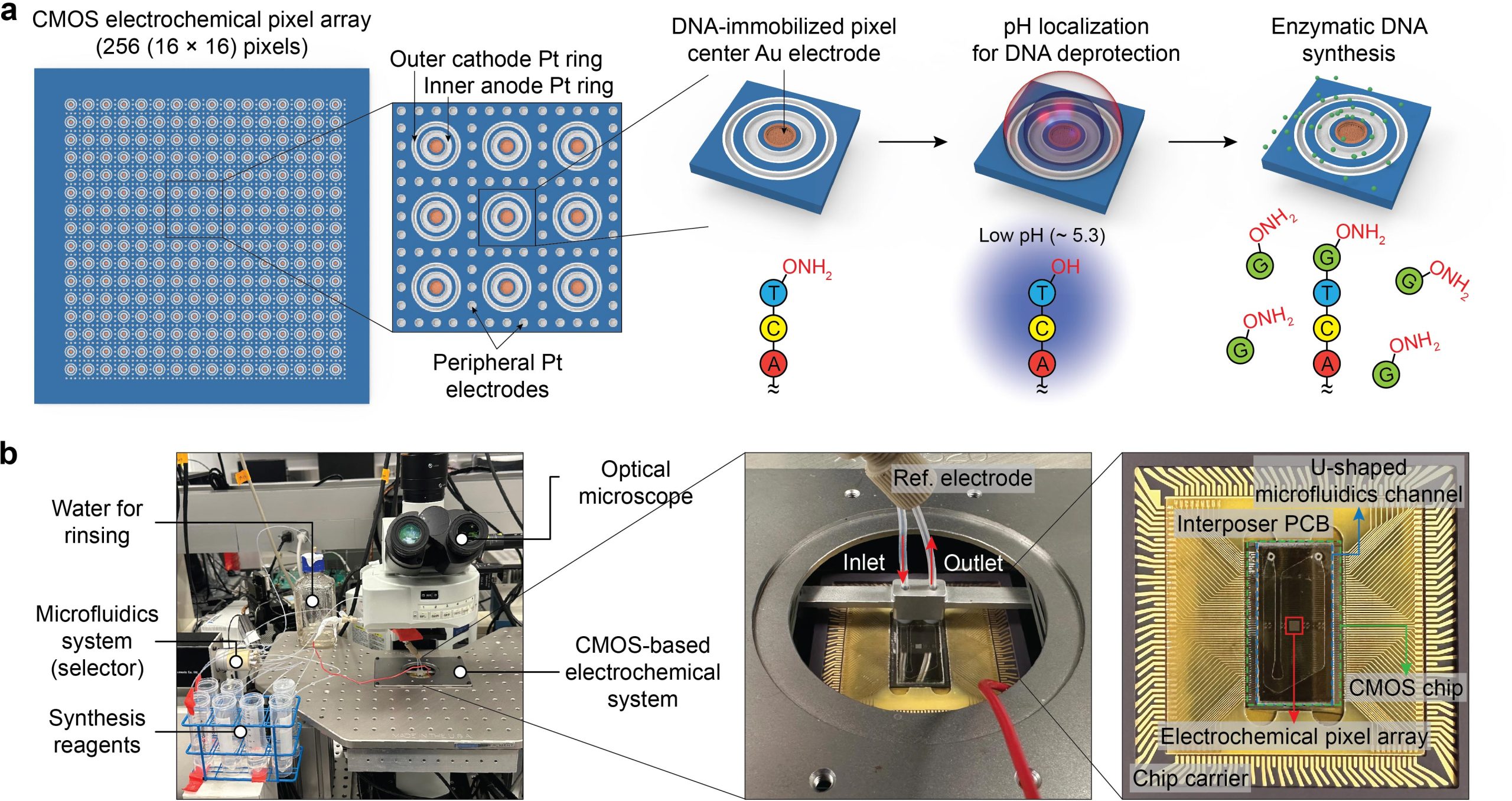
The Harvard chip solves this problem using electricity. Its surface contains 64 DNA synthesis sites, each equipped with two concentric ring electrodes surrounding DNA strands fixed at the center.
When a particular site needs to receive a nucleotide, the chip sends current into the inner ring. This produces protons and lowers the pH immediately around the DNA strands, allowing enzymatic growth to continue.
At the same time, the outer ring draws current in the opposite direction and consumes protons that begin to spread away from the site. This prevents the acidic region from reaching neighboring DNA strands.
By activating different sites during each synthesis cycle, the chip creates a changing pattern of low-pH zones. Over repeated cycles, those localized reactions build 64 separate DNA sequences.
From Recording Neurons to Manufacturing DNA
The silicon chip was originally developed in Ham’s laboratory by former PhD student Jeffrey Abbott for large-scale intracellular recording from neurons.
Researchers initially used the system to record activity from thousands of neurons and map hundreds of synaptic connections. Later versions captured tens of thousands of connections.
By redesigning the electrodes on the chip’s surface, Ham’s team adapted the same electronic foundation for an entirely different purpose: directing DNA synthesis.
“A defining feature of the chip was precision current injection, which we used to permeabilize neuronal membranes for intracellular access,” Ham said. “At a certain point, we wondered whether that same current control could be redirected from cells to molecules – replacing the neuron-facing electrodes with ring-electrode pairs that could localize pH for DNA synthesis. It worked.”
A Possible Route to DNA Data Storage
The technology could eventually have applications in synthetic biology and medical diagnostics. The researchers also demonstrated a more futuristic possibility by using the 64 DNA sequences to encode a 169-byte text.
That experiment provided a small-scale example of DNA-based data storage, a concept in which digital information is stored within DNA molecules.
DNA storage remains a long-term goal because it would require the production of enormous quantities of DNA. Yet that demand could make water-based enzymatic synthesis especially valuable.
As the volume of manufactured DNA increases, the environmental impact of solvents and other chemical waste becomes a greater concern.
“DNA data storage asks DNA synthesis to operate at a scale far beyond today’s needs,” said Woo-Bin Jung, co-first author of the study and now an assistant professor of chemical engineering at the Pohang University of Science and Technology (POSTECH), who carried out the work as a postdoctoral researcher in Ham’s lab. “That is why enzymatic synthesis in water can matter. If far more than 64 sequences can be synthesized in parallel, it could offer an environmentally friendly route toward writing DNA at very large scale.”
Chemistry Becomes the Next Obstacle
After demonstrating 64-sequence synthesis, the researchers wanted to determine whether the technology could support even more DNA strands packed into a smaller area.
They fabricated more closely spaced synthesis sites on the same silicon chip, but the denser design did not work as intended. Although the experiment failed, it revealed one of the study’s most important conclusions.
At first, the researchers were confused because the electronics were successfully keeping the low-pH regions confined to the selected sites.
Further experiments showed that the problem came from the deprotection chemistry rather than the chip.
Low pH does not directly remove the blocking group from the growing DNA strand. Instead, the acidic conditions produce intermediate molecules that carry out the deprotection step.
Those molecules can drift into nearby synthesis sites. As a result, they escape the tightly controlled pH zones and cause reactions to spread beyond their intended boundaries.
“The chip did what we asked it to do: it localized low pH at selected sites,” said Han Sae Jung, co-first author of the study and a former graduate student and current postdoctoral researcher at Harvard. “The limitation came from the deprotection chemistry, not from the silicon. That leaves a clear next step for the field — develop a more direct acid-driven deprotection chemistry that can keep pace with the chip.”
Reference: “Parallel enzymatic DNA synthesis using a semiconductor chip” by Woo-Bin Jung, Han Sae Jung, Jun Wang, Henry Hinton, Seok Joo Kim, Yuchang Zhang, Suyue Chen, Young-Ha Hwang, Maxime Fournier, Manon Boul, Kevin Grosselin, Adrian Horgan, Xavier Godron, Robert Nicol and Donhee Ham, 17 June 2026, Nature Electronics.
DOI: 10.1038/s41928-026-01662-9
The project brought together researchers from Harvard, the Broad Institute, DNA Script, and later POSTECH.
Harvard’s Office of Technology Development has filed intellectual property related to the platform.
This research is based upon work supported in part by the Office of the Director of National Intelligence (ODNI), Intelligence Advanced Research Projects Activity (IARPA), via 2019-19081900002, Horizon Europe, Hyperion project ID: 101115253, and Samsung Research Funding & Incubation Center for Future Technology of Samsung Electronics under Project Number SRFC-IT2402-09.
Never miss a breakthrough: Join the SciTechDaily newsletter.
Follow us on Google and Google News.