
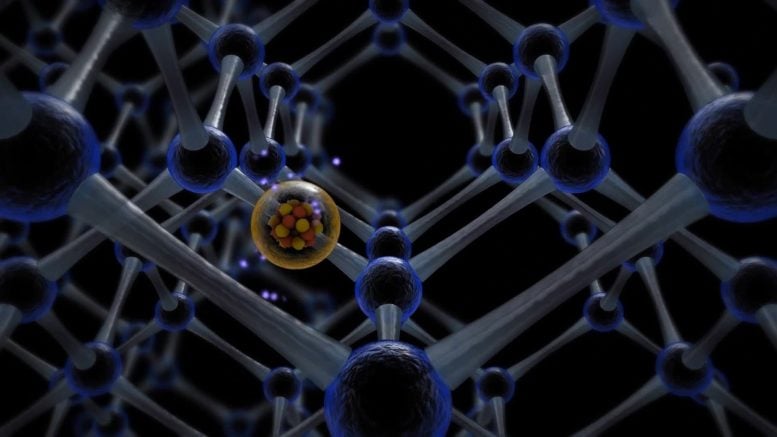
The same tiny vibrations that carry quantum information across a chip could also keep that information from fading away.
Quantum technologies face a persistent problem: qubits are extraordinarily sensitive to disturbances from their surroundings. Researchers at the Harvard John A. Paulson School of Engineering and Applied Sciences (SEAS) have now protected a qubit using mechanical vibrations, essentially sound waves at the quantum scale.
The advance came from the laboratory of Marko Lončar, Tiantsai Lin Professor of Electrical Engineering. It could help make quantum networks smaller, reduce interference between components, and connect different kinds of qubits within a single hybrid system.
Building Quantum Networks With Sound
The research, published in Nature Physics, was led experimentally by Eliza Cornell and Zhujing Xu. Cornell recently completed her Ph.D. in the Lončar lab and is now a postdoctoral researcher at Boston University, while Xu is a former postdoctoral scholar in the group.
The system uses an electron spin associated with an atomic impurity in diamond as a stationary quantum memory. Vibrational particles known as phonons can then transport quantum information between these memory nodes, much as photons carry information through optical networks.
The Lončar lab has previously helped establish the potential of this approach by developing phononic cavities. These structures confine vibrations in a small region, increasing their interaction with the electron spin.
Phonons have wavelengths far shorter than light waves of the same frequency, allowing quantum components to occupy much less space on a chip. They can also experience less crosstalk, remain trapped in cavities for long periods at low temperatures, and interact with both solid-state spins and electromagnetic fields. That combination makes them promising links between otherwise incompatible quantum technologies.
The Quantum Memory Problem
Strong interaction with phonons comes with a difficult tradeoff. A useful quantum memory must preserve coherence, meaning it must retain its quantum state long enough for information to be stored, processed, or transmitted. Environmental noise can quickly destroy that state.
Researchers commonly combat this noise with carefully timed microwave pulses. Those pulse sequences, however, are poorly suited to spin qubits placed inside resonant phononic cavities, creating a conflict between strong phonon coupling and durable quantum memory.
The Harvard team addressed that conflict with what it calls “all-mechanical coherence protection.” Instead of relying on conventional microwave pulses, the researchers continuously drove a silicon-vacancy spin in diamond with phonons, shifting it into a protected state known as a “dressed” qubit.
Phonons Perform Two Jobs
A dressed qubit is described as “wearing” the continuous acoustic field surrounding it. This changes how the qubit responds to its environment, making it less vulnerable to low-frequency noise that would otherwise disrupt its stored information.
Because the protective field is mechanical, it can operate inside the same phononic cavities intended to connect stationary quantum nodes. Phonons could therefore serve two functions in one device: moving quantum information between qubits and shielding that information while it is stored.
“We are solving two problems,” Cornell said. “We want the spin to have strong interaction with phonons, and we want the spin to have a long coherence time. Our paper demonstrates a method of extending the coherence time that is compatible with the silicon-vacancy center being in a cavity.”
Faster Control and Longer Coherence
The technique extended the coherence time of the silicon-vacancy spin by roughly threefold, showing that continuous-wave mechanical noise suppression can protect quantum information in a real device.
The researchers also achieved a Rabi frequency of 800 megahertz, enabling exceptionally fast control of the spin. Together, longer coherence and rapid operation could support high-fidelity quantum gates mediated by phonons, bringing compact on-chip quantum networks closer to practical use.
Reference: “All-mechanical coherence protection and fast control of a spin qubit” by Eliza Cornell, Zhujing Xu, Zhaoyou Wang, Hana K. Warner, Eliana Mann, Michael Haas, Smarak Maity, Graham Joe, Liang Jiang, Peter Rabl, Benjamin Pingault and Marko Lončar, 15 July 2026, Nature Physics.
DOI: 10.1038/s41567-026-03369-2
This research received U.S. federal support from the National Science Foundation under grant number EEC-1941583; the Air Force Office of Scientific Research under award numbers FA9550-23-1-0333 and FA9550-23-1-0338; and Q-NEXT, a U.S. Department of Energy Office of Science National Quantum Information Science Research Center under award No. DE-FOA-0002253. The work was performed in part at the Harvard Center for Nanoscale Systems, a member of the National Nanotechnology Infrastructure Network, which is supported by National Science Foundation award No. ECS-0335765.
Never miss a breakthrough: Join the SciTechDaily newsletter.
Follow us on Google and Google News.
5 Comments
Harvard Scientists Use Tiny Sound Waves To Protect Quantum Information.
VERY GOOD.
Harvard scientists, I urge you to think seriously about these questions:
1. How do you understand quantum information?
2. Is a quantum object simply a cat that is both dead and alive?
3. Among the observable and measurable entities in the physical world, which ones are not many-body systems?
A question to Harvard scientists: How do you interpret the gravitational and quantum effects arising from spacetime vortices? For example:
Ideal fluid space (vacuum or void) and philosophical non-existence are two entirely distinct concepts. The ideal fluid vacuum has no concept of time. Spacetime is the product of a topological phase transition of the ideal fluid vacuum. Through this transition, the ideal fluid vacuum gives rise to spacetime vortices.
Each spacetime vortex is a quantum clock—a triune unity of dynamic variables (such as rotational velocity), natural constants (such as the value of π), and quantized indicators (such as left-handed or right-handed chirality).
Topological Vortex Theory (TVT), grounded in the ideal fluid substrate, eliminates all layered auxiliary assumptions in mainstream physics in one stroke. Based on TVT, the self-organization of topological vortices requires no artificial creation, nor does it need manually set parameters. This unique property provides a rigorous physical foundation for developing breakthrough technologies.
We invite Harvard Scientists to consider the following question: Is it feasible to interpret Sound Waves and Quantum Information within the framework of Topological Vortex Theory (TVT)?
Topological Vortex Theory (TVT) is founded on modern topological mathematical frameworks, including the Φ-mapping topological flow theory, homotopy groups, and Chern classes, which enable the rigorous quantitative characterization of topological charges and topological invariants. In this framework, vortices are directly defined as the intrinsic topological structures of spacetime itself, such that matter, energy, and spacetime all emerge as derivative phenomena of these topological configurations, eliminating the necessity for any independent underlying medium.
Within the TVT formalism, spacetime is dynamically constituted by a network of topological vortices, and no standalone spacetime background can exist in isolation from vortices. This construction achieves a fundamental paradigm shift from the conventional perspective of “describing vortices within a pre-existing spacetime manifold” to the novel formulation of “defining spacetime itself in terms of vortices”. It further establishes a dynamic ontology characterized by the principle of “no independent entities, only vortices, and continuous metabolic processes”, which is well-aligned with the requirements of modern quantum field theory and the quest for quantum gravity unification. In this picture, all physical existence corresponds to the energy ingestion and dissipation processes of vortices, which completely subverts the traditional static view of physical entities.
TVT pushes Occam’s Razor to its extreme with the ideal fluid, slicing away all the layered extra assumptions in mainstream physics at once. Which approach is more scientific? The answer is self-evident.
With the full penetration of AI, the scientific literacy of a new generation of researchers and the public far exceeds that of the past. Scientific revolution is not a polite dinner party or a courteous affair. Throughout the history of science, every paradigm shift has been accompanied by stubborn resistance and eventual collapse of the old authorities. The APS and its publications’ rejection of TVT is not the first, nor will it be the last. What it rejects is not a theory, but the very spirit of discussion on which science survives; what it defends is not science, but an academic corruption centered on its own interests.
—— https://zhuanlan.zhihu.com/p/2076322379769422276.