

The result points to a significant advance in computing power, prompting researchers to replicate the groundbreaking measurement.
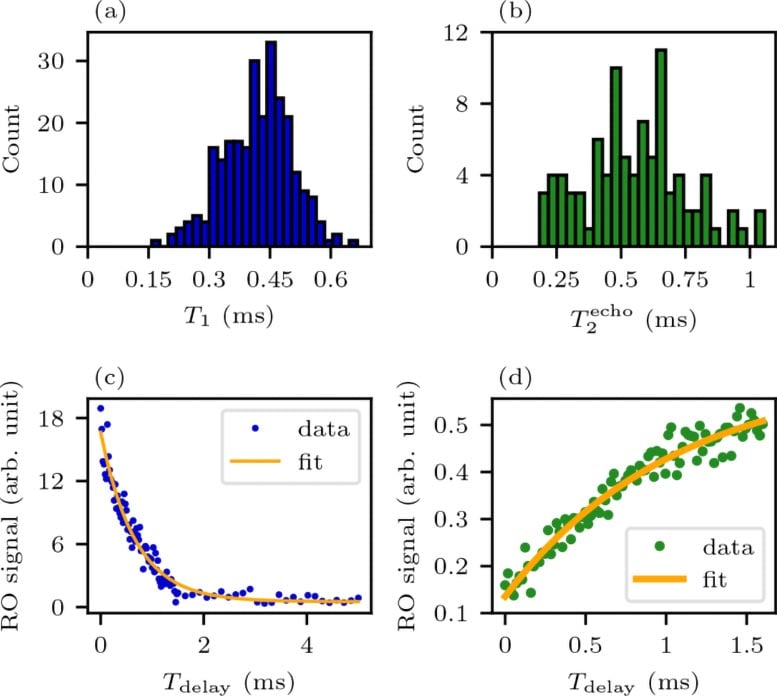
On July 8, 2025, researchers at Aalto University in Finland reported a transmon qubit coherence time that significantly exceeds all previously published scientific benchmarks. Their measurement reached the millisecond range, with earlier records topping out at around 0.6 milliseconds, representing a major step forward in quantum computing performance.
Achieving longer coherence times means quantum computers can operate reliably for longer periods before errors disrupt computations. This advancement allows more complex operations to be performed on noisy quantum systems and reduces the overhead required for quantum error correction, bringing researchers closer to achieving fault-tolerant quantum computing.
“We have just measured an echo coherence time for a transmon qubit that landed at a millisecond at maximum with a median of half a millisecond,” says Mikko Tuokkola, the PhD student who conducted and analyzed the measurements. The median reading is particularly significant, as it also surpasses current recorded readings.
The findings have just been published in the prestigious peer-reviewed journal Nature Communications.
The researchers report their approach as thoroughly as possible, with the aim of making it reproducible for research groups around the world.
Finland cements position at forefront of quantum
At Aalto University, Tuokkala conducted his work under the guidance of postdoctoral researcher Dr. Yoshiki Sunada, who was responsible for designing the chip and constructing the experimental measurement system.
“We have been able to reproducibly fabricate high-quality transmon qubits. The fact that this can be achieved in a cleanroom which is accessible for academic research is a testament to Finland’s leading position in quantum science and technology,” adds Sunada, who is currently working at Stanford University, USA.
The qubit was fabricated by the QCD group at Aalto using high-quality superconducting film supplied by the Technical Research Centre of Finland (VTT). The success reflects the high quality of Micronova cleanrooms at OtaNano, Finland’s national research infrastructure for micro-, nano-, and quantum technologies.
“This landmark achievement has strengthened Finland’s standing as a global leader in the field, moving the needle forward on what can be made possible with the quantum computers of the future,” says Professor of Quantum Technology Mikko Möttönen, who heads the QCD group.
Scaling up the quantum computers of the future requires advancements across several domains. Among them are noise reduction, qubit-count increases, and the qubit coherence time improvements at the center of the new observations from the QCD. The group just opened a senior staff member and two postdocs positions to achieve future breakthroughs faster.
Reference: “Methods to achieve near-millisecond energy relaxation and dephasing times for a superconducting transmon qubit” by Mikko Tuokkola, Yoshiki Sunada, Heidi Kivijärvi, Jonatan Albanese, Leif Grönberg, Jukka-Pekka Kaikkonen, Visa Vesterinen, Joonas Govenius and Mikko Möttönen, 8 July 2025, Nature Communications.
DOI: 10.1038/s41467-025-61126-0
Never miss a breakthrough: Join the SciTechDaily newsletter.
Follow us on Google and Google News.
3 Comments
The findings have just been published in the prestigious peer-reviewed journal Nature Communications.
Ask researchers and so-called peer-reviewed journal Nature Communications:
1. How do you understand quantum?
2. Is the so-called quantum computer a quantum physical reality?
3. Does so-called peer-reviewed journal Nature Communications ( Please browse: https://zhuanlan.zhihu.com/p/1924133848171648046 ) respect science?
To the so-called peer-reviewed publications, particularly those so-called academic journals like Nature, Science, and the Physical Review series – we demand your earnest reflection:
By what scientific justification do you:
Deliberately define the empirically distinct θ and τ particles as identical?
Conversely declare topological vortices and their twin anti-vortices – which are fundamentally equivalent – as completely different?
Is this perverse methodology of:
Defining different things as identical
Defining identical things as different
Blatantly calling a stag a horse
truly representative of your purported “scientific spirit”?
Who has emboldened you to commit such academic recklessness?
What forces have made you so: Arrogant – Corrupt – Devoid of academic integrity – Morally bankrupt.
Answer truthfully: Do you even comprehend the meaning of academic shame?
Many people do not believe that so-called peer-reviewed publications (such as the Nature, Science, Physical Review series, etc) have been systematically disseminating pseudoscience. If researchers are interested in advances in physics, please visit https://zhuanlan.zhihu.com/p/1927657274920383767, https://zhuanlan.zhihu.com/p/1925124100134790589, https://zhuanlan.zhihu.com/p/1928738508329169149, and https://zhuanlan.zhihu.com/p/1930897490367973024 (If the link is not blocked).
Tecnolgy is very 👍🏼😊 perfectly matched to humanty good condition to match the god things to can bee 🙏🏼 imagancly universe and tallent of humanty contact 🧠 imagancly structure etc