
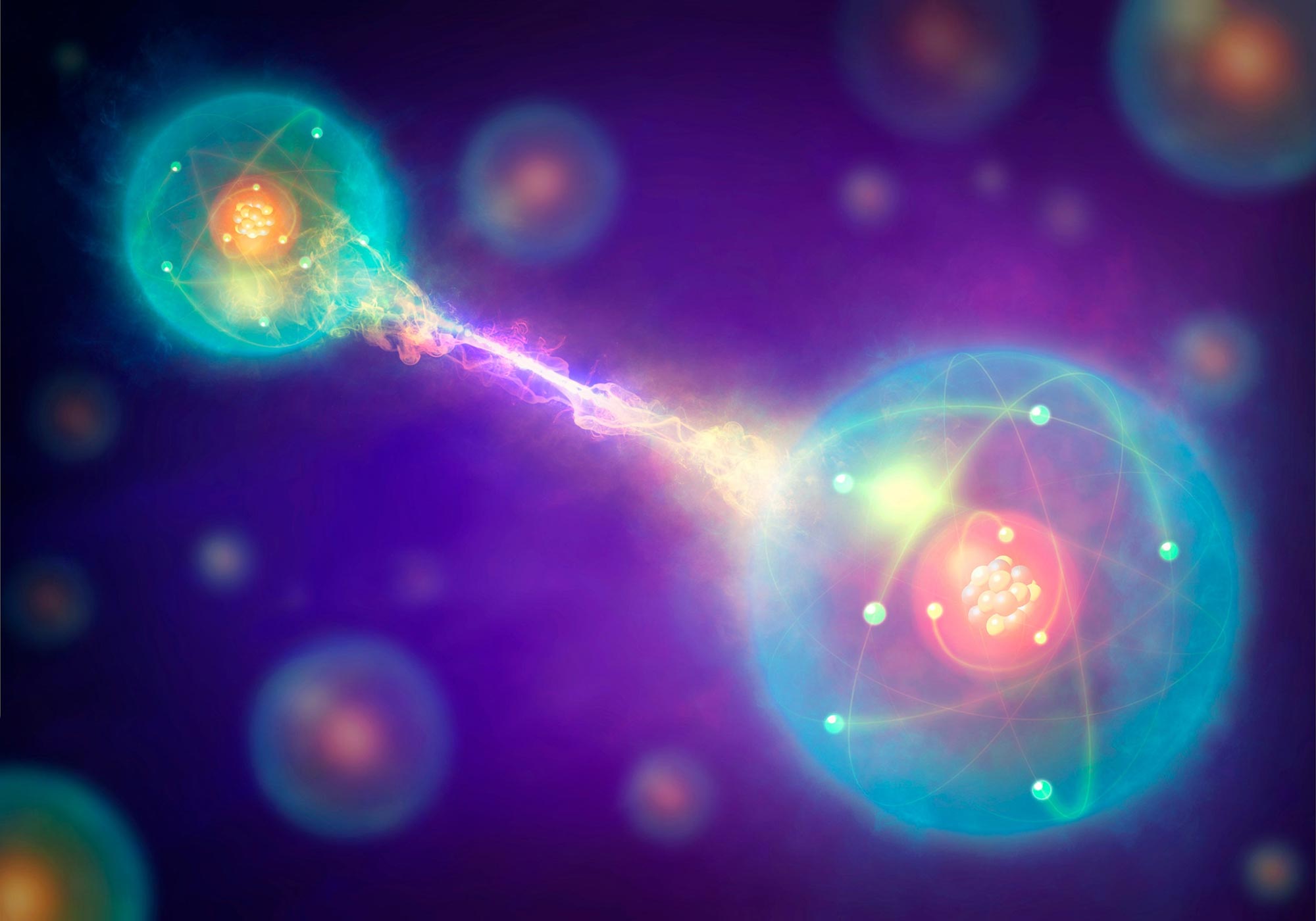
Recent research has advanced the development of electron-on-solid-neon qubits, revealing key insights that improve quantum computing by extending qubit coherence times and optimizing their design.
Quantum computers have the potential to be revolutionary tools for their ability to perform calculations that would take classical computers many years to resolve.
But to make an effective quantum computer, you need a reliable quantum bit, or qubit, that can exist in a simultaneous 0 or 1 state for a sufficiently long period, known as its coherence time.
One promising approach is trapping a single electron on a solid neon surface, called an electron-on-solid-neon qubit. A study led by FAMU-FSU College of Engineering Professor Wei Guo that was published in Physical Review Letters shows new insight into the quantum state that describes the condition of electrons on such a qubit, information that can help engineers build this innovative technology.

Quantum State Dynamics and Qubit Design
Guo’s team found that small bumps on the surface of solid neon in the qubit can naturally bind electrons, which creates ring-shaped quantum states of these electrons. The quantum state refers to the various properties of an electron, such as position, momentum, and other characteristics, before they are measured. When the bumps are a certain size, the electron’s transition energy — the amount of energy required for an electron to move from one quantum ring state to another — aligns with the energy of microwave photons, another elementary particle.

This alignment allows for controlled manipulation of the electron, which is needed for quantum computing.
“This work significantly advances our understanding of the electron-trapping mechanism on a promising quantum computing platform,” Guo said. “It not only clarifies puzzling experimental observations but also delivers crucial insights for the design, optimization, and control of electron-on-solid-neon qubits.”
Previous work by Guo and collaborators demonstrated the viability of a solid-state single-electron qubit platform using electrons trapped on solid neon. Recent research showed coherence times as great as 0.1 milliseconds, or 100 times longer than typical coherence times of 1 microsecond for conventional semiconductor-based and superconductor-based charge qubits.
Coherence time determines how long a quantum system can maintain a superposition state — the ability of the system to be in multiple states at the same time until it is measured, which is one characteristic that gives quantum computers their unique abilities.
Optimizing Qubit Performance
The extended coherence time of the electron-on-solid-neon qubit can be attributed to the inertness and purity of solid neon. This qubit system also addresses the issue of liquid surface vibrations, a problem inherent in the more extensively studied electron-on-liquid-helium qubit. The current research offers crucial insights into optimizing the electron-on-solid-neon qubit further.
A crucial part of that optimization is creating qubits that are smooth through most of the solid neon surface but have bumps of the right size where they are needed. Designers want minimal naturally occurring bumps on the surface that attract disruptive background electrical charge. At the same time, intentionally fabricating bumps of the correct size within the microwave resonator on the qubit improves the ability to trap electrons.
“This research underscores the critical need for further study of how different conditions affect neon qubit manufacturing,” Guo said. “Neon injection temperatures and pressure influence the final qubit product. The more control we have over this process, the more precise we can build, and the closer we move to quantum computing that can solve currently unmanageable calculations.”
Reference: “Single-Electron Qubits Based on Quantum Ring States on Solid Neon Surface” by Toshiaki Kanai, Dafei Jin and Wei Guo, 18 June 2024, Physical Review Letters.
DOI: 10.1103/PhysRevLett.132.250603
Co-authors on this paper were Toshiaki Kanai, a former graduate research student in the FSU Department of Physics, and Dafei Jin, an associate professor at the University of Notre Dame.
The research was supported by the National Science Foundation, the Gordon and Betty Moore Foundation, and the Air Force Office of Scientific Research.
Never miss a breakthrough: Join the SciTechDaily newsletter.
Follow us on Google and Google News.
2 Comments
Quantum Riddle Solved?
Please ask researchers to think deeply:
1. What is the so-called quantum?
2. Topological vortices are point defects in two-dimensional spacetime. Point defects do not onlyare also central to kinetic processes, but impact the thermodynamic properties. Can topological vortices self-organize into complex space-time structures via superposition, deflection, and twisting?
The Physical Review Letters firmly believes that two sets of high-dimensional spacetime objects (such as two sets of cobalt-60) can rotate in reverse and form two objects that mirror each other. This blatant dirtiness and ugliness is unprecedented in the history of scientific and humanistic development in human society. Publishing articles in such a publication is not worth showing off, it should be more of a shame.
If researchers are really interested in science and physics, you can browse https://zhuanlan.zhihu.com/p/693933588, and https://zhuanlan.zhihu.com/p/595280873, and https://zhuanlan.zhihu.com/p/701032654.
A minimal error or deviation may result in wide divergence. Scientific research guided by correct theories can help humanity avoid detours and failures.
Topological vortices do not only are central to kinetic processes, but also impact the thermodynamic properties.(https://zhuanlan.zhihu.com/p/684863580)