
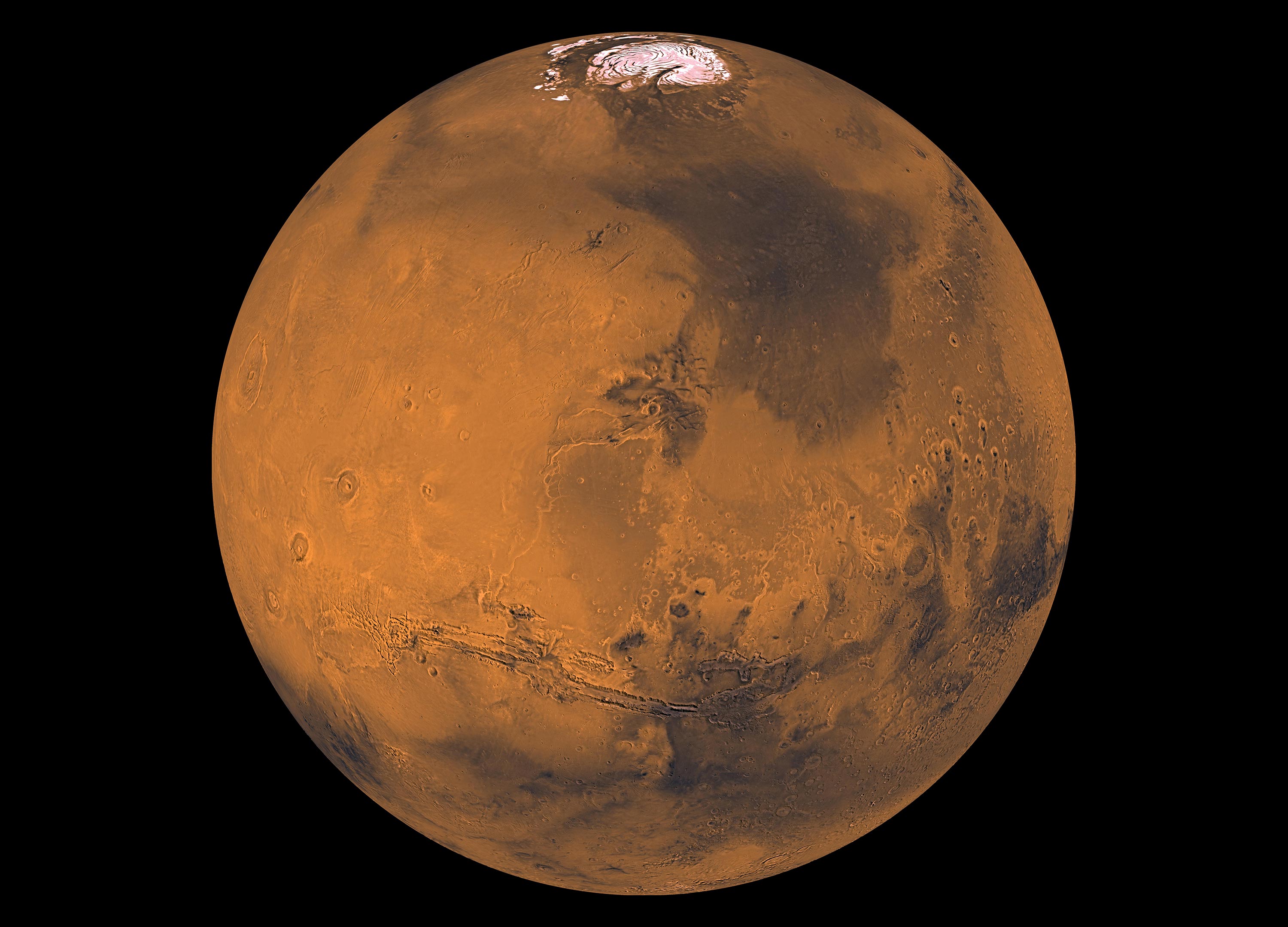
For centuries, the Red Planet’s signature hue has fascinated scientists, but the real reason behind its color may be different than we once thought.
A groundbreaking study suggests that Mars’ redness isn’t due to dry, rust-like hematite, as previously believed, but rather to ferrihydrite—an iron-rich mineral that forms in water. This revelation reshapes our understanding of Mars’ history, hinting at a past that was once wet and possibly habitable.
Why Is Mars Red? A Long-Standing Mystery
For centuries, Mars has fascinated both scientists and the public, largely because of its striking red color. This distinctive hue has earned it the well-known nickname, the “Red Planet.” But what actually gives Mars its iconic color? Scientists have debated this question for as long as they’ve studied the planet. Now, new research may provide a definitive answer — one that connects Mars’ color to its watery past.
A New Theory Challenges the Rust Hypothesis
A recent study published in Nature Communications, led by researchers from Brown University and the University of Bern, suggests that Mars’ red dust comes primarily from ferrihydrite, a water-rich iron mineral. This challenges the long-standing belief that the planet’s color is due to hematite, a dry, rust-like mineral. By analyzing data from Mars orbiters, rovers, and laboratory simulations, the researchers present compelling evidence that ferrihydrite, rather than hematite, is responsible for Mars’ signature red appearance.
“The fundamental question of why Mars is red has been thought of for hundreds if not for 1000s of years,” said Adomas (Adam) Valantinas, a postdoctoral fellow at Brown who started this work as a Ph.D. student at the University of Bern. “From our analysis, we believe ferrihydrite is everywhere in the dust and also probably in the rock formations, as well. We’re not the first to consider ferrihydrite as the reason for why Mars is red, but it has never been proven the way we proved it now using observational data and novel laboratory methods to essentially make a Martian dust in the lab.”
Ferrihydrite: A Water-Rich Iron Mineral
Ferrihydrite is an iron oxide mineral that forms in water-rich environments. On Earth, it is commonly associated with processes like the weathering of volcanic rocks and ash. Until now, its role in Mars’ surface composition was not well understood, but this new research suggests that it could be an important part of the dust that blankets the planet’s surface.
The finding offers a tantalizing clue to Mars’ wetter and potentially more habitable past because unlike hematite, which typically forms under warmer, drier conditions, ferrihydrite forms in the presence of cool water. This suggests that Mars may have had an environment capable of sustaining liquid water — an essential ingredient for life — and that it transitioned from a wet to a dry environment billions of years ago.
Clues in Martian Climate and Habitability
“What we want to understand is the ancient Martian climate, the chemical processes on Mars — not only ancient — but also present,” said Valantinas, who is working in the lab of Brown planetary scientist Jack Mustard, a senior author on the study.
“Then there’s the habitability question: Was there ever life? To understand that, you need to understand the conditions that were present during the time of this mineral formation.
“What we know from this study is the evidence points to ferrihydrite forming, and for that to happen there must have been conditions where oxygen, from air or other sources, and water could react with iron. Those conditions were very different from today’s dry, cold environment. As Martian winds spread this dust everywhere, it created the planet’s iconic red appearance.”
Cutting-Edge Techniques Reveal Hidden Secrets
The researchers analyzed data from multiple Mars missions, combining orbital observations from NASA’s Mars Reconnaissance Orbiter and the European Space Agency’s Mars Express and Trace Gas Orbiter with ground-level measurements from rovers like Curiosity, Pathfinder and Opportunity.
Instruments on the orbiters and rovers provided detailed spectral data of the planet’s dusty surface. These findings were then compared to laboratory experiments, where the team tested how light interacts with ferrihydrite particles and other minerals under simulated Martian conditions.
Simulating Martian Dust in the Lab
“Martian dust is very small in size, so to conduct realistic and accurate measurements we simulated the particle sizes of our mixtures to fit the ones on Mars,” Valantinas said. “We used an advanced grinder machine which reduced the size of our ferrihydrite and basalt to submicron sizes. The final size was 1/100th of a human hair and the reflected light spectra of these mixtures provide a good match to the observations from orbit and the red surface on Mars.”
Awaiting the Ultimate Proof: Mars Sample Return
As exciting as these new findings are, the researchers are well aware none of it can be confirmed until samples from Mars are brought back to Earth, leaving the mystery of the Red Planet’s past just out of reach.
“The study is a door opening opportunity,” Mustard said. “It gives us a better chance to apply principles of mineral formation and conditions to tap back in time. What’s even more important though is the return of the samples from Mars that are being collected right now by the Perseverance rover. When we get those back, we can actually check and see if this is right.”
Explore Further: New Discovery Rewrites the Red Planet’s History
Reference: “Detection of ferrihydrite in Martian red dust records ancient cold and wet conditions on Mars” by Adomas Valantinas, John F. Mustard, Vincent Chevrier, Nicolas Mangold, Janice L. Bishop, Antoine Pommerol, Pierre Beck, Olivier Poch, Daniel M. Applin, Edward A. Cloutis, Takahiro Hiroi, Kevin Robertson, Sebastian Pérez-López, Rafael Ottersberg, Geronimo L. Villanueva, Aurélien Stcherbinine, Manish R. Patel and Nicolas Thomas, 25 February 2025, Nature Communications.
DOI: 10.1038/s41467-025-56970-z
Never miss a breakthrough: Join the SciTechDaily newsletter.
Follow us on Google and Google News.
1 Comment
Yes, Mars is, in fact, just red because it’s blushing from all the attention it gets.