

An ancient crater lake in the southern highlands of Mars appears to have been fed by glacial runoff, bolstering the idea that the Red Planet had a cold and icy past.
Researchers from Brown University have discovered a previously unknown type of ancient crater lake on Mars that could reveal clues about the planet’s early climate.
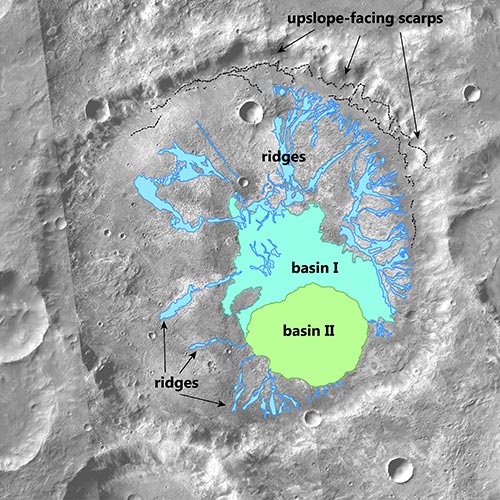
In a study published in Planetary Science Journal, a research team led by Brown Ph.D. student Ben Boatwright describes an as-yet unnamed crater with some puzzling characteristics. The crater’s floor has unmistakable geologic evidence of ancient stream beds and ponds, yet there’s no evidence of inlet channels where water could have entered the crater from outside, and no evidence of groundwater activity where it could have bubbled up from below.
So where did the water come from?
The researchers conclude that the system was likely fed by runoff from a long-lost Martian glacier. Water flowed into the crater atop the glacier, which meant it didn’t leave behind a valley as it would have had it flowed directly on the ground. The water eventually emptied into the low-lying crater floor, where it left its geological mark on the bare Martian soil.
The type of lake described in this study differs starkly from other Martian crater lakes, like those at Gale and Jezero craters where NASA rovers are currently exploring.
“This is a previously unrecognized type of hydrological system on Mars,” Boatwright said. “In lake systems characterized so far, we see evidence of drainage coming from outside the crater, breaching the crater wall and in some cases flowing out the other side. But that’s not what is happening here. Everything is happening inside the crater, and that’s very different than what’s been characterized before.”
Clues to Mars’ Ancient Climate
Importantly, Boatwright says, the crater provides key clues about the early climate of Mars. There’s little doubt that the Martian climate was once warmer and wetter than the frozen desert the planet is today. What’s less clear, however, is whether Mars had an Earthlike climate with continually flowing water for millennia, or whether it was mostly cold and icy with fleeting periods of warmth and melting. Climate simulations for early Mars suggest temperatures rarely peaking above freezing, but geological evidence for cold and icy conditions has been sparse, Boatwright says. This new evidence of ancient glaciation could change that.
“The cold and icy scenario has been largely theoretical — something that arises from climate models,” Boatwright said. “But the evidence for glaciation we see here helps to bridge the gap between theory and observation. I think that’s really the big takeaway here.”
But without any sign of an inlet channel where water entered the crater, “the question becomes ‘how did these get here?”’ Boatwright said.
Signs of Ancient Glacial Debris
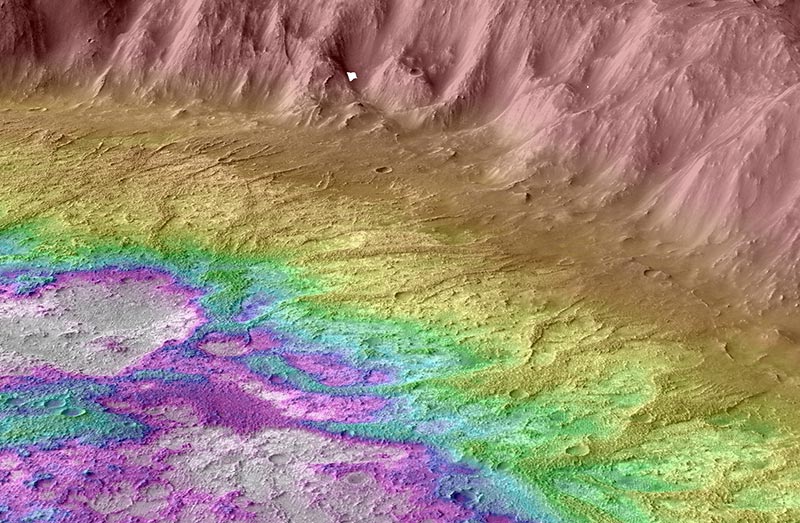
To figure it out, Boatwright worked with Jim Head, his advisor and a research professor at Brown. They ruled out groundwater activity, as the crater lacked telltale sapping channels that form in groundwater systems. These channels usually appear as short, stubby channels that lack tributaries — completely opposite from the dense, branching networks of inverted channels observed in the crater. A careful examination of the crater wall also revealed a distinct set of ridges that face upward toward the crater wall. The features are consistent with ridges formed where a glacier terminates and deposits mounds of rocky debris. Taken together, the evidence points to a glacier-fed system, the researchers concluded.
Subsequent research has shown that this crater isn’t the only one of its kind. At this month’s Lunar and Planetary Science Conference, Boatwright presented research revealing more than 40 additional craters that appear to have related features.
Head says that these new findings could be critical in understanding the climate of early Mars.
“We have these models telling us that early Mars would have been cold and icy, and now we have some really compelling geological evidence to go with it,” Head said. “Not only that, but this crater provides the criteria we need to start looking for even more evidence to test this hypothesis, which is really exciting.”
Reference: “A Noachian Proglacial Paleolake on Mars: Fluvial Activity and Lake Formation within a Closed-source Drainage Basin Crater and Implications for Early Mars Climate” by Benjamin D. Boatwright and James W. Head, 12 March 2021, Planetary Science Journal.
DOI: 10.3847/PSJ/abe773
Never miss a breakthrough: Join the SciTechDaily newsletter.
Follow us on Google and Google News.