
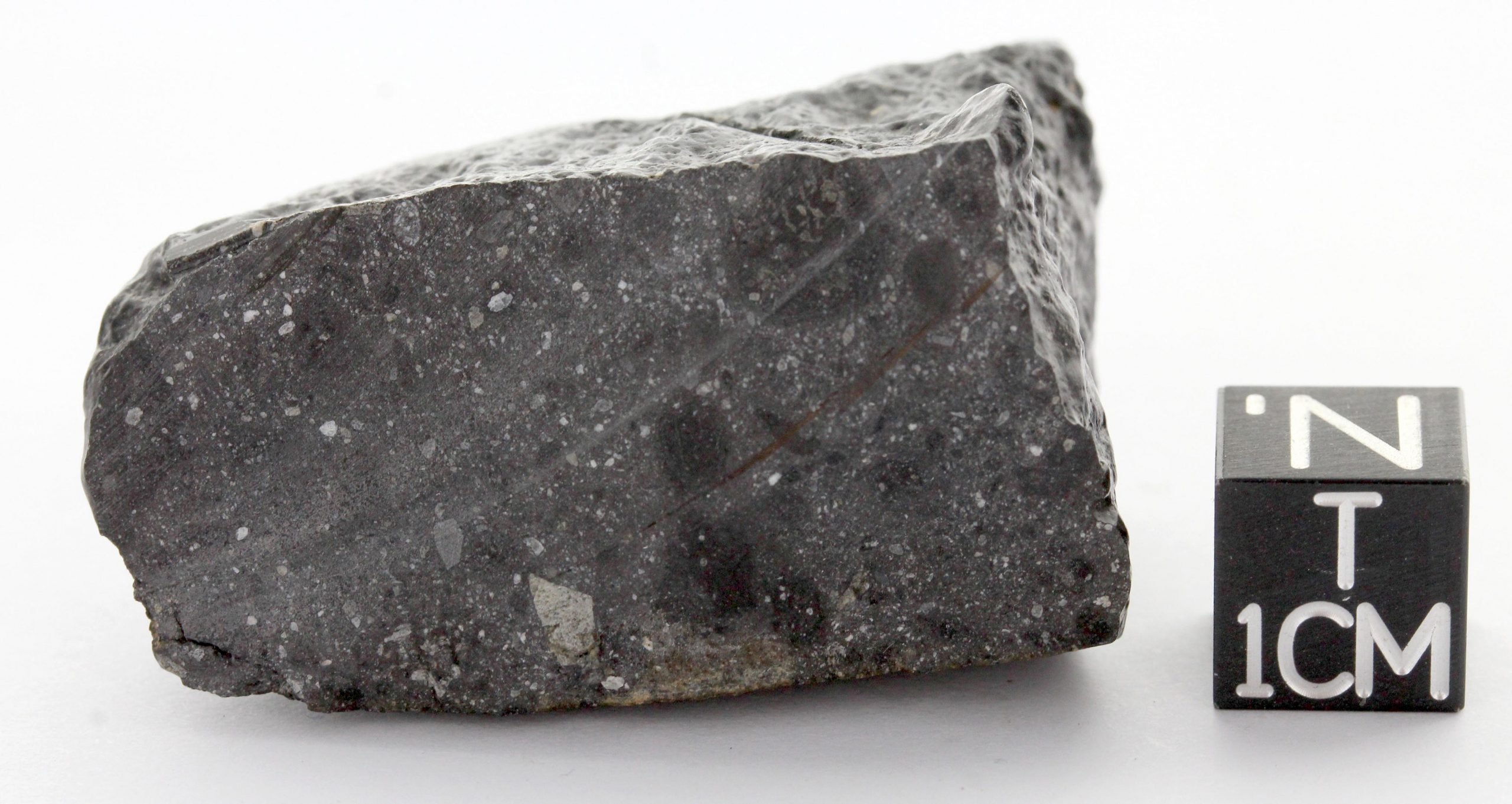
A meteorite that originated on Mars billions of years ago reveals details of ancient impact events on the red planet. Certain minerals from the Martian crust in the meteorite are oxidized, suggesting the presence of water during the impact that created the meteorite. The finding helps to fill some gaps in knowledge about the role of water in planet formation.
There’s a long-standing question in planetary science about the origin of water on Earth, Mars, and other large bodies such as the moon. One hypothesis says that it came from asteroids and comets post-formation. But some planetary researchers think that water might just be one of many substances that occur naturally during the formation of planets. A new analysis of an ancient Martian meteorite adds support for this second hypothesis.
Several years ago, a pair of dark meteorites were discovered in the Sahara Desert. They were dubbed NWA 7034 and NWA 7533, where NWA stands for North West Africa and the number is the order in which meteorites are officially approved by the Meteoritical Society, an international planetary science organization. Analysis showed these meteorites are new types of Martian meteorites and are mixtures of different rock fragments.
The earliest fragments formed on Mars 4.4 billion years ago, making them the oldest known Martian meteorites. Rocks like this are rare and can fetch up to $10,000 per gram. But recently 50 grams of NWA 7533 were acquired for analysis by the international team in which Professor Takashi Mikouchi at the University of Tokyo was participating. The project was led by then-graduate student Zhengbin Deng at the Université de Paris and currently assistant professor at the University of Copenhagen. This research was a collaboration of Université de Paris, Université de Lorraine, University of Copenhagen, Université de Bretagne Occidentale, and the University of Tokyo.
“I study minerals in Martian meteorites to understand how Mars formed and its crust and mantle evolved. This is the first time I have investigated this particular meteorite, nicknamed Black Beauty for its dark color,” said Mikouchi. “Our samples of NWA 7533 were subjected to four different kinds of spectroscopic analysis, ways of detecting chemical fingerprints. The results led our team to draw some exciting conclusions.”
It’s well known to planetary scientists that there has been water on Mars for at least 3.7 billion years. But from the mineral composition of the meteorite, Mikouchi and his team deduced it’s likely there was water present much earlier, at around 4.4 billion years ago.
“Igneous clasts, or fragmented rock, in the meteorite are formed from magma and are commonly caused by impacts and oxidation,” said Mikouchi. “This oxidation could have occurred if there was water present on or in the Martian crust 4.4 billion years ago during an impact that melted part of the crust. Our analysis also suggests such an impact would have released a lot of hydrogen, which would have contributed to planetary warming at a time when Mars already had a thick insulating atmosphere of carbon dioxide.”
If there was water on Mars earlier than thought, that suggests water is possibly a natural byproduct of some process early on in planet formation. This finding could help researchers answer the question of where water comes from, which in turn could impact theories on the origins of life and the exploration for life beyond Earth.
Reference: “Early oxidation of the martian crust triggered by impacts” by Zhengbin Deng, Frédéric Moynier, Johan Villeneuve, Ninna K. Jensen, Deze Liu, Pierre Cartigny, Takashi Mikouchi, Julien Siebert, Arnaud Agranier, Marc Chaussidon and Martin Bizzarro, 30 October 2020, Science Advances.
DOI: 10.1126/sciadv.abc4941
Never miss a breakthrough: Join the SciTechDaily newsletter.
Follow us on Google and Google News.
1 Comment
There is no good reason why both theories can’t be true. The question would then become what proportion of water currently present on Earth (or Mars) was provided by the two processes?