
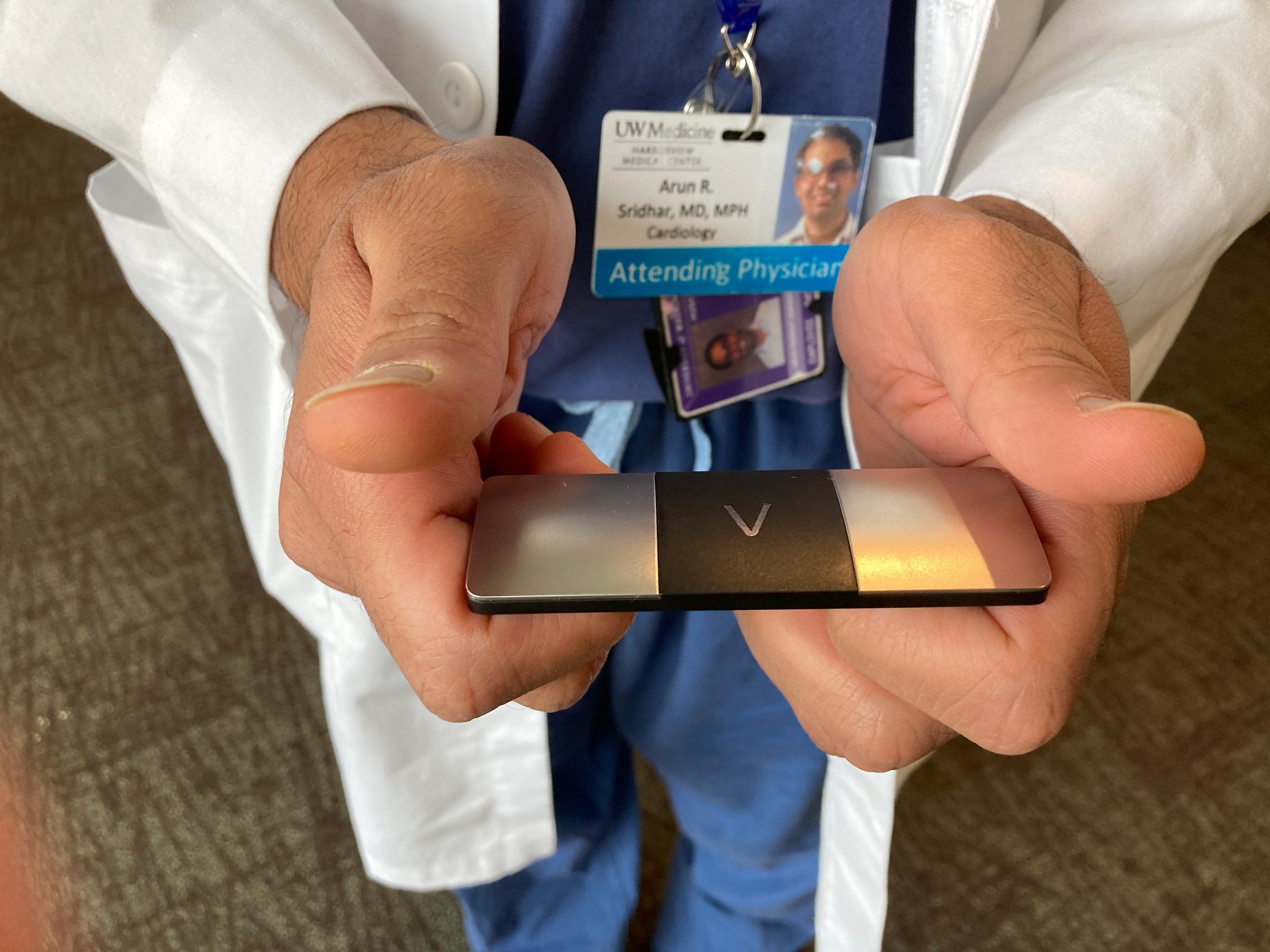
Researchers show that study participants can be safely, effectively monitored at home for drugs’ potential arrhythmic effects.
A clinical trial in which two test drugs failed to help patients with mild COVID-19 nevertheless had a silver lining: It proved the viability of a study model in which a medication’s potential arrhythmic side effects are safely, effectively monitored without the participants ever setting foot in a hospital or clinic.
The findings are reported today (December 20, 2021) in the journal Communications Medicine. They also suggest that remote studies can expand clinical research to broader populations and greatly reduce participants’ burdens of time, travel, and cost, said Dr. Arun Sridhar, a senior author.
“This indicates we can reach people who are typically unable to participate in research, including those who live far from academic health centers and those with limited mobility,” said Sridhar, an assistant professor of cardiology at the University of Washington School of Medicine. “The digital age may help democratize clinical trials.”

The fully remote study was designed in the early spring of 2020 during COVID-19’s first wave. Researchers wanted to learn whether the inexpensive drugs hydroxychloroquine and azithromycin might speed the recoveries of patients who had tested positive for the SARS-CoV-2 virus and were self-treating at home. The investigators, however, were wary of the drugs’ potential to cause a type of heart rhythm disorder called a prolonged QT interval. If allowed to persist, long QT can cause cardiac arrest.
Monitoring Heart Rhythm Without Clinic Visits
Daily electrocardiograms (ECG) would be needed from participants, but COVID-19 concerns precluded the people from coming to the clinic for those tests.
Starting April 15, 2020, COVID-19 patients in five U.S. healthcare systems began trial enrollment by phone or email, with consent confirmed by secure video teleconference. Enrollees were sent a kit with 16 days’ worth of supplies with which to perform nasal swab tests and to obtain vital signs such as temperature and blood oxygen levels.
Also in the supplies: a handheld rhythm-monitoring device to transmit digital ECGs to the research team in real time.
“At the outset, all participants were taught how to use the device and how to download the corresponding smartphone app. They could transmit an ECG to the study site during each day of the study to ensure the QT interval was not increasing,” explained Dr. Christine Johnston, the trial’s principal investigator and a UW associate professor of medicine.
Some 218 patients were enrolled, initiated study medication, and transmitted ECG data into three randomized arms before the trial was terminated for lack of drug benefit. Collaborators at the Mayo Clinic processed the daily digital ECG readouts. All readings were forwarded to the trial coordinators and clinicians for review, typically within an hour. Participants whose QT interval was high above baseline were promptly asked for another ECG, and if that test confirmed the finding, the medication was discontinued. Twenty-eight participants experienced prolonged QT, two of whom needed to have the drugs discontinued for that reason. No fatal events were reported.
More importantly, though, 85% of enrollees followed the trial’s protocol to submit one ECG per day for the first 14 days, suggesting that remote self-monitoring for arrhythmia is feasible, Johnston said.
“Before COVID, there was no precedent for monitoring patients’ ECGs remotely,” she said. “These participants were highly motivated and did well in terms of adherence to the daily survey of symptoms, swab, and ECG requests.”
Remote Monitoring Could Save Costs and Time
Dozens of medications, including some for arrhythmias and cancer, require patients to have their heart rhythms monitored closely. In some cases, patients are admitted to the hospital for the first three days to undergo two ECGs per day before the medication is deemed safe enough to take at home.
“Remote monitoring could create a huge cost savings for healthcare systems and huge time savings for patients, who would not have to stay in the hospital for three days and miss work just to get six ECGs,” Sridhar said. “Another upside of remote trials is that it doesn’t require us to have a dedicated clinical space that serves only trial subjects.”
The researchers noted two main limitations seen with the trial: a lack of digital literacy among older trial participants and the potential for poor communication with non-English-speaking participants.
“Some older patients were not tech-savvy with smartphones and apps. It also was slightly more difficult to communicate with non-English speaking patients in the trial centers that did not have Spanish interpreters available. Sometimes younger family members were asked to help bridge the communication gap,” Sridhar said.
“I think these barriers are relatively easy to overcome with more rigorous education for the participants, which we simply did not have time for with the pandemic.”
Reference: “Implementation of a fully remote randomized clinical trial with cardiac monitoring” by Jacob J. Mayfield, Neal A. Chatterjee, Peter A. Noseworthy, Jeanne E. Poole, Michael J. Ackerman, Jenell Stewart, Patricia J. Kissinger, John Dwyer, Sybil Hosek, Temitope Oyedele, Michael K. Paasche-Orlow, Kristopher Paolino, Paul A. Friedman, Chloe Waters, Jessica Moreno, Hannah Leingang, Kate B. Heller, Susan A. Morrison, Meighan L. Krows, Ruanne V. Barnabas, Jared Baeten, Christine Johnston, COVID-19 Early Treatment Team and Arun R. Sridhar, 20 December 2021, Communications Medicine.
DOI: 10.1038/s43856-021-00052-w
The study was funded by the Bill & Melinda Gates Foundation.
Never miss a breakthrough: Join the SciTechDaily newsletter.
Follow us on Google and Google News.
2 Comments
The vaccines are causing the arrhythmia but covid-1984 will be blamed. My wife has been hospitalized twice in a month for this, never sick but triple jabbed. Oh, and of course it is sponsored/covered up by Bill and Melinda Gates!
I’ve got an idea, why don’t you test Ivermectin + Zinc picolinate on 5,000 “Cov19” patients and see if it works, actually your test to determine whether or not someone has “Cov19” does not detect Cov19, but that’s OK because Ivermectin + Zinc picolinate cure all colds, all flues and some cancers(PubMed)