
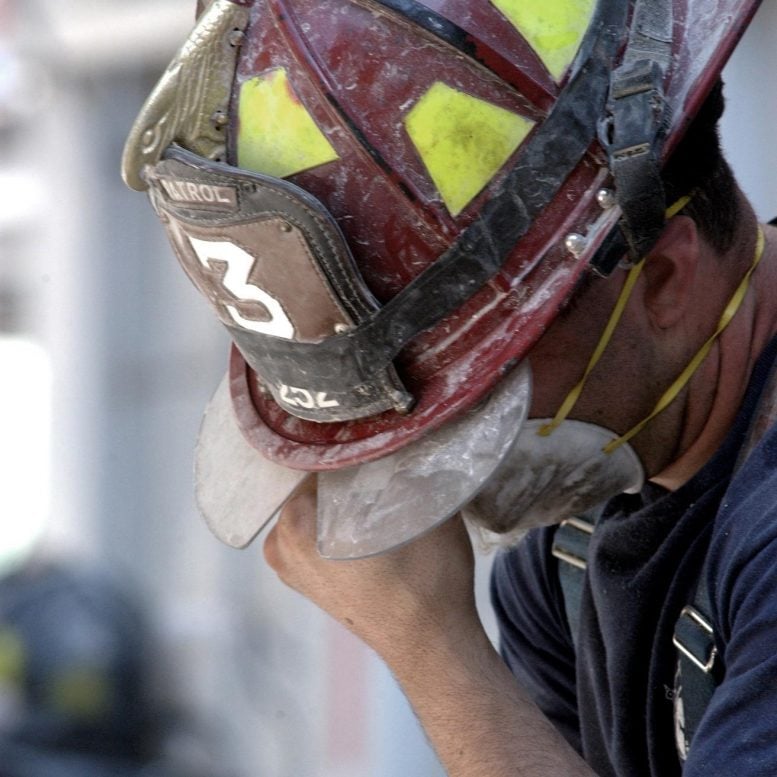
A new study of New York City firefighters has found that exposure to 9/11 World Trade Center (WTC) dust is associated with a significantly increased long-term risk of cardiovascular disease (CVD). The study, conducted by researchers at Albert Einstein College of Medicine, Montefiore Health System, and the Fire Department of the City of New York (FDNY), found that those who arrived first at the WTC site—when the air-borne dust was thickest—have a 44% increased risk of CVD compared to those who arrived later in the day. The study was published online today in JAMA Network Open.
“The increase in risk was significant, even taking into account known CVD risk factors such as age, hypertension, elevated cholesterol, diabetes, and smoking,” said study leader David J. Prezant, M.D., a professor of medicine at Einstein, a pulmonary disease specialist at Montefiore, and chief medical officer of the FDNY.
This study’s finding of an increased risk of CVD with WTC exposure—as well as the researchers’ earlier studies identifying an increased risk for autoimmune rheumatologic diseases and for a blood cancer precursor that can lead to the cancer multiple myeloma—“highlights the need to add these health conditions to the list of WTC-related diseases that are coverable under the James L. Zadroga 9/11 Health and Compensation Act,” Dr. Prezant added.
Studies have repeatedly shown that WTC exposure is associated with immediate and long-term risk of adverse health effects, including respiratory problems, post-traumatic stress disorder (PTSD), and several types of cancer. A few studies have examined the association between WTC exposure and CVD. However, the results were inconsistent for a variety of reasons, primarily because they relied on first responders’ self-reported health measures.
Assessing Cardiovascular Disease Risk
The current study involved 9,796 firefighters who worked at the WTC site. Most were never smokers (74%) and non-Hispanic white (94%), with an average age of 40 on September 11, 2001. All were men, since there were too few female firefighters at the WTC site to obtain meaningful data.
For this study, the firefighters were divided into four groups: (1) those who first arrived at the WTC site during the morning of 9/11 (who were believed to receive the highest dust exposure); (2) those who first arrived that afternoon; (3) those who first arrived on September 12; and (4) those who first arrived between days 3 and 14.
The researchers reviewed 16 years of medical records, physician examinations, and questionnaires to assess the participants for primary and secondary CVD events. (Primary CVD events were defined as myocardial infarction, stroke, unstable angina, coronary artery surgery or angioplasty, or CVD death; secondary events included transient ischemic attack, angina defined as either angina medication or cardiac catheterization without intervention, cardiomyopathy, and “other CVD”: aortic aneurysm, peripheral arterial vascular intervention, and carotid artery surgery.)
Firefighters who arrived during and immediately after the WTC collapse (group 1) had a 44% higher risk of experiencing primary and secondary CVD events compared with those who arrived on September 12 or later (groups 3 and 4 combined). Similarly, those who worked at the WTC site for six months or more were 30% more likely to have experienced a primary or secondary CVD event compared with those who worked less time at the site. These associations were statistically significant after taking into account age, race/ethnicity, and baseline assessments of body mass index, hypertension, elevated cholesterol, diabetes, smoking, and probable PTSD.
“An important message is that new chest pain in this group should not automatically be attributed to well-known WTC-related illnesses, such as acid reflux or obstructive airway disease. It might very well be associated with CVD,” said Dr. Prezant.
Monitoring Symptoms and Health
“Our results emphasize why it is crucial to monitor the long-term health of anyone exposed to massive environmental disasters, even many years after the event,” said co-lead author Rachel Zeig-Owens, Dr.P.H., a research assistant professor of epidemiology & population health at Einstein and an epidemiologist at Montefiore and FDNY. “By screening for and treating the other CVD risk factors—such as elevated cholesterol, hypertension, obesity, and smoking—we are able to lower the overall risk of CVD in those most exposed to the World Trade Center disaster.”
Our results emphasize why it is crucial to monitor the long-term health of anyone exposed to massive environmental disasters, even many years after the event. — Rachel Zeig-Owens, Dr.P.H.
Many other studies have linked both acute and prolonged exposure to air pollution to CVD. The researchers noted that exposure to dust and products of combustion could have triggered persistent disease processes involving chronic inflammation that increased the risk for CVD years later.
Reference: “Long-term Cardiovascular Disease Risk among Firefighters after the World Trade Center Disaster” by Hillel W. Cohen, DrPH, MPH; Rachel Zeig-Owens, DrPH, MPH; Cynthia Joe, MPH; Charles B. Hall, PhD; Mayris P. Webber, DrPH, MPH; Michael D. Weiden, MS, MD; Krystal L. Cleven, MD; Nadia Jaber, RPA-C; Molly Skerker, BA; Jennifer Yip, MPH; Theresa Schwartz, MS; David J. Prezant, MD; 6 September 2019, JAMA Network Open.
DOI:
This research was supported through the National Institute for Occupational Safety and Health (contract numbers 200-2011-39378, 200-2011-39383, 200-2017-93326, 200-2017-93426).
Never miss a breakthrough: Join the SciTechDaily newsletter.
Follow us on Google and Google News.
1 Comment
The only way that intense health issues may have been avoided by those working in the toxic environment of the burning and fallen towers would have been full hazmat suits c/w air tanks. The paper dust mask shown on the face of the firefighter in the picture is in no way appropriate to working in an environment where burning toxic materials are sending off poisonous gases which a paper mask is not intended to stop. It is not even efficient in fully stopping dust, and no fireman should have to work with less than full protection against both dust and toxic fumes, especially now, with so many plastics to combust in all burning environments. Why their unions do not insist on this is beyond my comprehension!