
Close Menu
    Facebook X (Twitter) Instagram
    SciTechDaily
    • Biology
    • Chemistry
    • Earth
    • Health
    • Physics
    • Science
    • Space
    • Technology
    Facebook X (Twitter) Pinterest YouTube RSS
    SciTechDaily
    Home»Space»High-Speed Impacts May Have Shaped Venus’ History – And Explain Why It Is Uninhabitable
    Space

    High-Speed Impacts May Have Shaped Venus’ History – And Explain Why It Is Uninhabitable

    By American Geophysical UnionDecember 29, 20211 Comment3 Mins Read
    Facebook Twitter Pinterest Telegram LinkedIn WhatsApp Email Reddit
    Share
    Facebook Twitter LinkedIn Pinterest Telegram Email Reddit
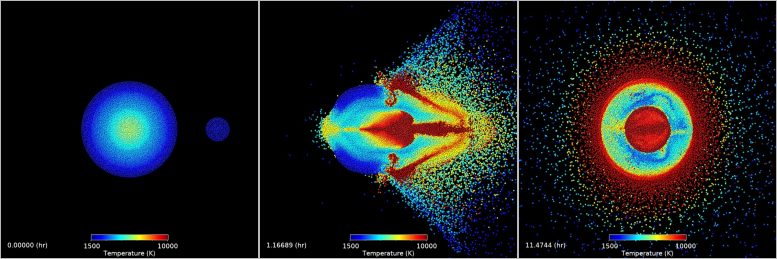
    High Speed Impacts Venus
    New modeling suggests fast collisions could explain why Earth is habitable while Venus is not. Credit: Southwest Research Institute/Simone Marchi & Raluca Rufu

    New modeling suggests fast collisions could explain why Earth is habitable while Venus is not.

    New modeling suggests large, high-speed impacts during Venus’ early history could reconcile the differences between Venus and its rocky sister planet, Earth.

    The two planets are alike in many ways. They have similar sizes, masses, and densities, and they are relatively similar distances from the Sun. Yet some key differences — such as habitability, atmospheric composition, and plate tectonics — have remain unexplained.

    High-speed impacts could help explain why Earth is habitable while Venus is not, according to new research being presented at the AGU Fall Meeting 2021.

    “Early on, in the beginning of the Solar System, the impactors would have been immense,” said Simone Marchi, a planetary scientist at Southwest Research Institute, who presented the study on Thursday, December 16, 2021. “If an early impactor was larger than, say, a few hundred kilometers in diameter, it could have affected the deep interior of a planet, along with its surface and atmosphere. These colossal collisions would basically affect everything about a planet.”

    Recent work from a different research group showed impactors during Venus’ late accretionary phase, around 4.5 to 4.0 billion years ago, could have hit the planet at much higher speeds, on average, than those colliding with Earth. More than one-quarter of collisions with Venus would have occurred at velocities of at least 30 kilometers per second (about 67,100 miles per hour).

    Mantle Melting and Planetary Resets

    The new research demonstrates the large, high-speed impacts on Venus lead to twice as much mantle melting than impact-induced melting on Earth. High-speed impactors hitting Venus at a shallow angle would have resulted in complete melting of the mantle, according to the new research.

    When even just one of these massive, high-velocity impactors hit Venus, it would have interrupted and essentially reset the planet’s evolution, according to Marchi. Venus could have gone from a solid rocky body to a molten mess in moments, altering the mineralogy and physical structure of the planet’s interior and surface. Any pre-existing atmosphere would have been largely blasted away and replaced by volatile gases emerging from the melt. A single high-speed impact could have ultimately determined whether or not tectonic plates formed, which is an important aspect of habitability.

    While large impacts likely pummeled both Earth and Venus, the latter could have undergone substantial more melting and disruption due to the high speed of its impacts, setting the planets on divergent evolutionary pathways. For both planets, and the Solar System as a whole, these early collisions had big consequences on their habitability — or lack thereof — today.

    “These collisions were responsible for shaping the Solar System. It’s not a stretch of the imagination to say that lacking these processes, we would live in a completely different environment, and perhaps we wouldn’t be here,” Marchi said. “We need to ask how much of the planet we live on today was shaped by these early, violent events.”

    Meeting: American Geophysical Union Fall Meeting 2021

    Never miss a breakthrough: Join the SciTechDaily newsletter.
    Follow us on Google and Google News.

    American Geophysical Union Geophysics Planets Popular Venus
    Share. Facebook Twitter Pinterest LinkedIn Email Reddit

    Related Articles

    Planet Resurfacing: Venus Volcanism Could Have Been Fueled by Ancient, High-Energy Impacts

    Massive Marsquake! Five Times Larger Than Previous Record Holder

    From Temperate World to Acidic Hothouse: How Massive Volcanism May Have Altered Venus’ Climate

    New Findings Suggest Venus Never Had Oceans, Conditions Needed for Life

    Evidence Pluto Started Out With Liquid Oceans That Have Been Slowly Freezing Over Time

    Spacecraft Reveals Venus’ Super-Rotation Maintained by Atmospheric Tidal Waves

    Venus’ Atmosphere Rotates Far Faster Than Its Surface Because of Thermal Tides

    Pluto’s Icy Heart Heart Beats Daily, Pumping Nitrogen Winds Around the Dwarf Planet

    Mysterious Holes in the Atmosphere of Venus

    1 Comment

    1. Mike on December 30, 2021 7:41 am

      The explanation for the Moons existence was, Earth was hit by a planet the size of Mars. Youd think thatd melt the mantle and probably blow away the atmosphere and likely any oceans either had. Hows that compare with Venus?

      Reply
    Leave A Reply Cancel Reply

    • Facebook
    • Twitter
    • Pinterest
    • YouTube

    Don't Miss a Discovery

    Subscribe for the Latest in Science & Tech!

    Trending News

    Millions of People Have Osteopenia Without Realizing It – Here’s What You Need To Know

    Researchers Discover Boosting a Single Protein Helps the Brain Fight Alzheimer’s

    World-First Study Reveals Human Hearts Can Regenerate After a Heart Attack

    Why Your Dreams Feel So Real Sometimes and So Strange Other Times

    This Simple Home Device May Boost Brain Power in Adults Over 40

    Enormous Prehistoric Insects Puzzle Scientists

    Scientists Develop Bioengineered Chewing Gum That Could Help Fight Oral Cancer

    After 37 Years, the World’s Longest-Running Soil Warming Experiment Uncovers a Startling Climate Secret

    Follow SciTechDaily
    • Facebook
    • Twitter
    • YouTube
    • Pinterest
    • Newsletter
    • RSS
    SciTech News
    • Biology News
    • Chemistry News
    • Earth News
    • Health News
    • Physics News
    • Science News
    • Space News
    • Technology News
    Recent Posts
    • After 100 Years, Scientists Uncover Hidden Rule Governing Cosmic Rays
    • The Milky Way Has a Hidden Edge and Scientists Finally Mapped It
    • Scientists Stunned by New Organic Molecules Found on Mars
    • Scientists Discover Evolution’s 120-Million-Year-Old “Cheat Sheet”
    • This New “Sound Laser” Could Measure Gravity With Stunning Precision
    Copyright © 1998 - 2026 SciTechDaily. All Rights Reserved.
    • Science News
    • About
    • Contact
    • Editorial Board
    • Privacy Policy
    • Terms of Use

    Type above and press Enter to search. Press Esc to cancel.