
In biological terms, gliding refers to the type of movement during which a cell moves along a surface without changing its shape. This form of movement is unique to parasites from the phylum Apicomplexa, such as Plasmodium and Toxoplasma. Both parasites, which are transmitted by mosquitoes and cats, have an enormous impact on global health. Plasmodium causes 228 million malaria infections and around 400,000 deaths per year. Toxoplasma, which infects even one-third of the human population, can cause severe symptoms in some people, and is particularly dangerous during pregnancy.
Gliding enables the Apicomplexa parasites to enter and move between host cells. For example, upon entering the human body through a mosquito bite, Plasmodium glides through human skin before crossing into human blood vessels. This type of motion relies on actin and myosin, which are the same proteins that enable muscle movement in humans and other vertebrates. Myosin has a form of molecular ‘legs’ that ‘march’ along actin filaments and thereby create movement.
In Apicomplexa, myosin interacts with several other proteins, which together form a complex called the glideosome. The exact mechanism by which the glideosome works is not well understood, among other reasons because the molecular structure of most glideosome proteins are unknown. Yet understanding this mechanism could aid the development of drugs that prevent the assembly of the glideosome and thereby stop the progression of diseases such as malaria and toxoplasmosis.
Molecular stilts facilitate gliding
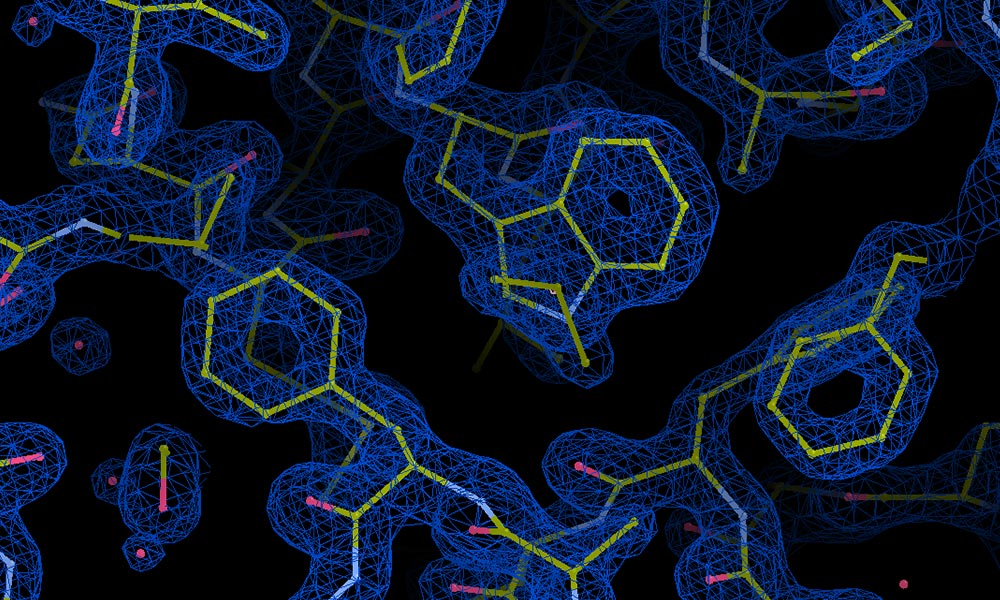
Scientists at EMBL Hamburg analyzed the molecular structure of essential light chains (ELCs), which are glideosome proteins that bind directly to myosin. It is known that they are necessary for gliding, but their exact structure and role were unknown until now. The researchers now obtained molecular structures of ELC bound to myosin A in Toxoplasma gondii and Plasmodium falciparum using X-ray crystallography and nuclear magnetic resonance (NMR).
Their study, published in Communications Biology, shows that ELCs work like ‘molecular stilts’ — upon binding myosin A, the ELCs become rigid, and start to act as its lever arm. This stiffening lets myosin makes longer steps, which likely accelerates the parasite’s gliding movements.
The researchers also investigated the role of calcium, a presumed gliding regulator, in the interaction between ELCs and myosin A. Surprisingly, they discovered that calcium does not influence the structure of ELCs. It does, however, increase the stability of the ELC-myosin A complex. This unexpected result shows that the glideosome architecture still hides many unknowns.
“This work has provided the first glimpse of how these organisms move around,” says Matthew Bowler, an EMBL Grenoble researcher not involved in this study, who investigates Toxoplasma’s strategies to control the immune system after invading cells.
“It is fascinating to see new molecular details emerge on how these parasites work outside of the host cell. The beautiful structures show how the motor that drives this motion is put together, and could provide a basis to develop new medicines to treat these diseases,” continues Bowler.
Maria Bernabeu, who leads research on vascular dysfunction in cerebral malaria at the EMBL site in Barcelona, adds: “Plasmodium passage through the skin is the first stage of human infection. The advantage of targeting Plasmodium at that stage is that only about a hundred parasites are present. Understanding the parasite’s gliding motility might help to develop drugs or vaccines that target Plasmodium before it multiplies.”
Interdisciplinary collaboration
The work is a result of interdisciplinary collaboration between structural biologists (Löw group) and parasitologists (Gilberger group) from the European Molecular Biology Laboratory in Hamburg and Centre for Structural Systems Biology (CSSB), as well as scientists from the Bernhard Nocht Institute for Tropical Medicine, University of Hamburg and Martin-Luther-University Halle-Wittenberg. It demonstrates the potential of interdisciplinary collaborations in contributing to our understanding of biological processes and possible future strategies to combat parasitic diseases.
“Entering malaria research has been an exciting endeavor — regular exchange with experts and the interdisciplinary environment helped us to explore the field of parasitology,” says Christian Löw.
Reference: “Structural role of essential light chains in the apicomplexan glideosome” by Samuel Pazicky, Karthikeyan Dhamotharan, Karol Kaszuba, Haydyn D. T. Mertens, Tim Gilberger, Dmitri Svergun, Jan Kosinski, Ulrich Weininger and Christian Löw, 13 October 2020, Communications Biology.
DOI: 10.1038/s42003-020-01283-8
EMBL is dedicated to advancing interdisciplinary infection biology research. This is reflected by projects across EMBL sites, including work on malaria by Maria Bernabeu and on Toxoplasma by Matthew Bowler, and collaborative projects like those looking at malaria or tuberculosis led by Matthias Wilmanns at EMBL Hamburg.
Never miss a breakthrough: Join the SciTechDaily newsletter.
Follow us on Google and Google News.
1 Comment
“Toxoplasma, which infects even one third of the human population,”
I have suspicions about the correctness of this sentence’s grammatical structure; does anyone proof read your material?