
Optical metrology has long relied on interference principles, but a recent review highlights how orbital angular momentum (OAM) is redefining the field.
By integrating OAM into metrological tools, researchers are now capable of tracking motion in all directions, including rotational dynamics.
Advancing Optical Metrology with Orbital Angular Momentum
Metrology is the foundation of modern industry, providing the essential standards for measuring the world around us. Optical metrology, in particular, has long relied on the principle of interference — a concept largely unchanged since Thomas Young’s groundbreaking experiments over 200 years ago. But what if this concept could be expanded to explore entirely new dimensions of measurement?
In a recent study published in Light: Science & Applications, a research team led by Prof. Lixin Guo from Xidian University examines the evolution and future potential of optical metrology using orbital angular momentum (OAM). The paper highlights fundamental principles, key applications, and major advancements in the field. The researchers showcase how twisted light carrying OAM can unlock innovative measurement techniques, such as 3D particle tracking, by leveraging a modern interpretation of the Doppler effect, which accounts for frequency shifts influenced by both OAM and polarization.
Revolutionizing Dynamic Systems with Twisted Light
“The original Doppler effect could only track movement toward or away from the observer, but the incorporation of orbital angular momentum in both scalar and vector light allows motion tracking in all directions, including rotational movement,” says Prof. Andrew Forbes, a corresponding author from South Africa. “This advancement has revolutionized the metrology of dynamic systems.”
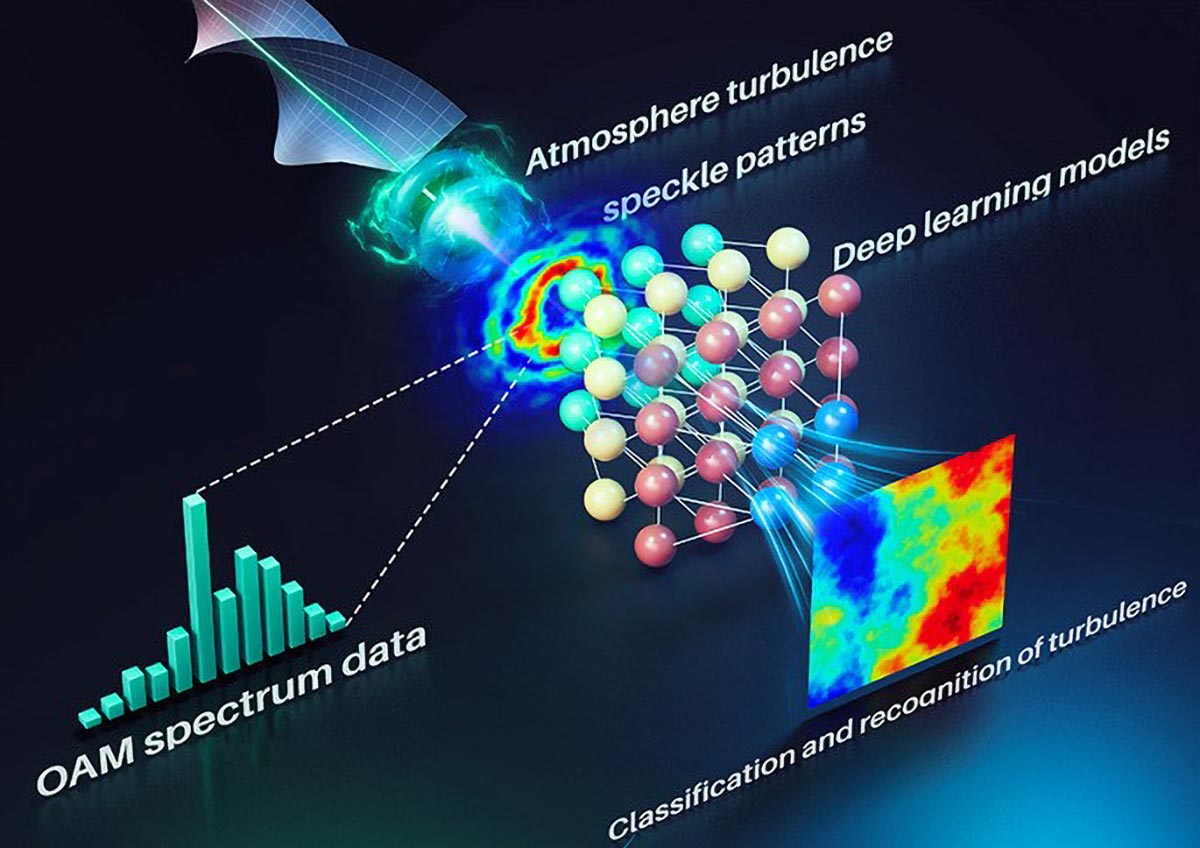
It is not only the shift in paradigm for existing tools but also the invention of completely new instruments that is propelling the field forward. One such example is the concept of an OAM spectrum serving as the ‘signature’ of a system: when OAM light passes through a complex medium, its OAM is altered, resulting in changes to the shape of the OAM spectrum (see Figure 1).
Machine Learning and AI in OAM Spectrum Analysis
“This OAM fingerprint of the medium contains a wealth of information that can be harnessed,” says Dr. Mingjian Cheng, the lead author. As the review highlights, if the OAM spectrum is interpreted by machine learning and AI, it opens the door to real-time analysis and recognition of complex media, with OAM light serving as a probe, a topic that is gaining traction very fast.
The review not only covers metrology with classical light but also utilizing OAM in quantum entangled superpositions and single-photon states. Transitioning into the quantum domain holds the potential to reduce noise and enhance accuracy and precision with fewer measurements. However, this aspect of the field remains in its early stages of development.
“Quantum metrology using OAM is still an emerging field with numerous untapped opportunities,” says Prof. Andrew Forbes.
Applications from the Microscopic to the Cosmic Scale
The comprehensive review spans a wide range of applications, from nano-sensing at the microscopic scale to measuring black holes at the cosmic scale. It provides an authoritative overview that will prove invaluable to both entry level and experienced researchers alike.
Reference: “Metrology with a twist: probing and sensing with vortex light” by Mingjian Cheng, Wenjie Jiang, Lixin Guo, Jiangting Li and Andrew Forbes, 1 January 2025, Light: Science & Applications.
DOI: 10.1038/s41377-024-01665-1
Never miss a breakthrough: Join the SciTechDaily newsletter.
Follow us on Google and Google News.
11 Comments
Well, that really is nice; it reaffirms my belief that what goes on in the quantum world (though it was never mentioned) doesn’t stay in the quantum world; that the so-called classical universe isn’t just an average of all possible probabilities, but rather, that it should be possible to manipulate quantum physics beyond the bounds of the quantum world and into the world which we experience, and this is an example of that; although, of course, we could just say that it has nothing more to do with anything other than the angular momentum of a spinning bicycle wheel.
How Twisted Light Is Unlocking Hidden Dimensions in Precision Science.
GOOD!
Ask the researchers:
1. Why does light twisted?
2. Is absolutely space viscid?
3. Where should the viscosity of absolutely space theoretically come from?
Scientific research guided by correct theories can enable researchers to think more.
According to the Topological Vortex Theory (TVT), spins create everything, spins shape the world. There are substantial distinctions between Topological Vortex Theory (TVT) and traditional physical theories. Grounded in the inviscid and absolutely incompressible spaces, TVT introduces the concept of topological phase transitions and employs topological principles to elucidate the formation and evolution of matter in the universe, as well as the impact of interactions between topological vortices and anti-vortices on spacetime dynamics and thermodynamics.
Within TVT, low-dimensional spacetime matter serves as the foundation for high-dimensional spacetime matter, and the hierarchical structure of matter and its interaction mechanisms challenge conventional macroscopic and microscopic interpretations. The conflict between Quantum Physics and Classical Physics can be attributed to their differing focuses: Quantum Physics emphasizes low-dimensional spacetime matter, whereas Classical Physics centers on high-dimensional spacetime matter.
Subatomic particles in the quantum world often defy the familiar rules of the physical world. The fact repeatedly suggests that the familiar rules of the physical world are pseudoscience. In the familiar rules of the physical world, two sets of cobalt-60 can form the mirror image of each other by rotating in opposite directions, and can receive heavy rewards.
Please witness the grand performance of physics today. https://scitechdaily.com/microscope-spacecrafts-most-precise-test-of-key-component-of-the-theory-of-general-relativity/#comment-854286.
If the researchers are truly interested in science, please read: The Application of Inviscid and Absolutely Incompressible Spaces in Engineering Simulation (https://scitechdaily.com/microscope-spacecrafts-most-precise-test-of-key-component-of-the-theory-of-general-relativity/#comment-870077).
Ask the researchers:
1. If something does not exist, what is the value and significance to research it?
2. Are non-existent things scientific and verifiable?
3. What is the difference between non-existent things and the God or Devil repeatedly touted in physics today?
Liz, there’s only one reality. The same formulas apply and the same effects exist for both the ‘quantum world’ and the ‘classical world’. Only that the ‘quantum effects’ are more prominent in faster, lighter particles – like, say, an electron whizzing by – than in slower, heavier objects – like, say, a train engine rolling along.
Same with relativity. We age slower on a jet plane, but the effects are immeasurably small since planes are relatively slow. The effects do show up in more accurate atomic clocks.
You has fallen victim to pseudoscientific misinformation,
Certain so-called high-impact journals such as Physical Review Letters (PRL), Nature, and Science should been severe criticized for the insistence on maintaining and promoting pseudoscientific content.
These so-called academic publications (such as PRL, Nature, and Science) do not show adequate respect to authors, readers, and science.
We urge continued scrutiny of these so-called academic publications and their adherents based on factual evidence. Please witness the grand collaborative performance of them. https://scitechdaily.com/microscope-spacecrafts-most-precise-test-of-key-component-of-the-theory-of-general-relativity/#comment-854286.
You has fallen victim to pseudoscientific misinformation
If the researchers are truly interested in science, please read: The Challenge of Topological Vortex Theory (TVT) to Traditional Time Concepts (https://scitechdaily.com/microscope-spacecrafts-most-precise-test-of-key-component-of-the-theory-of-general-relativity/#comment-869260).
You has fallen victim to pseudoscientific misinformation,
Ask the researchers:
What is the spacetime background of Twisted Light?
The inviscid and incompressible spacee implies that it exhibits ideal fluid-like physical properties. Through topological phase transitions, spacetime vortices can emerge within space. These vortices and their associated fractal structures may interact and achieve equilibrium, possibly leading to more complex spacetime configurations. This observation highlights the role of space as the fundamental material foundation for the dynamics and thermodynamics of spacetime in the physical universe.
Everything should be made as simple as possible, but no simpler.