
Close Menu
    Facebook X (Twitter) Instagram
    SciTechDaily
    • Biology
    • Chemistry
    • Earth
    • Health
    • Physics
    • Science
    • Space
    • Technology
    Facebook X (Twitter) Pinterest YouTube RSS
    SciTechDaily
    Home»Space»Hubble Captures Brilliant Cosmic Fireworks
    Space

    Hubble Captures Brilliant Cosmic Fireworks

    By ESA/HubbleNovember 1, 20212 Comments2 Mins Read
    Facebook Twitter Pinterest Telegram LinkedIn WhatsApp Email Reddit
    Share
    Facebook Twitter LinkedIn Pinterest Telegram Email Reddit
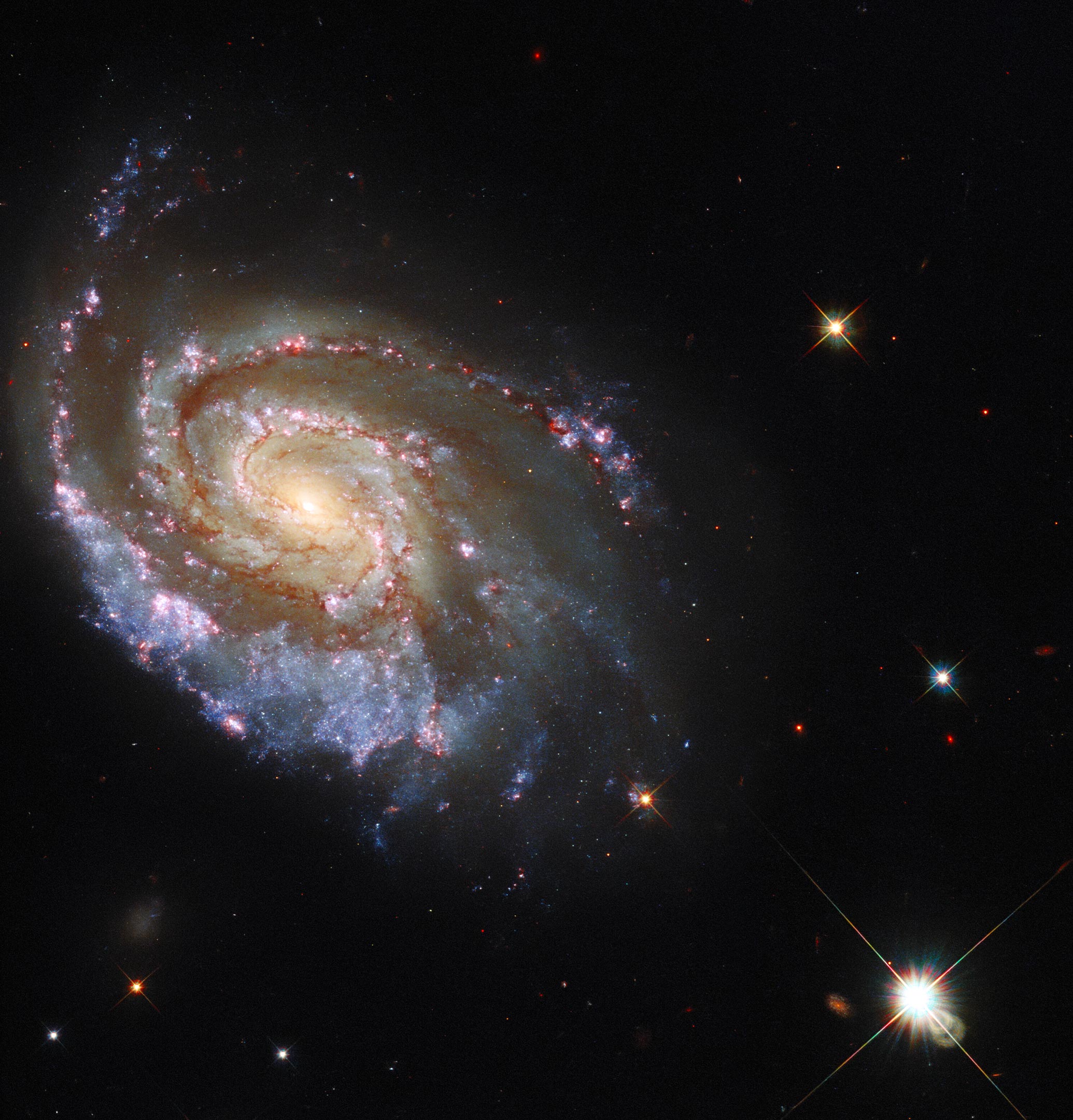
    Galaxy NGC 6984
    Galaxy NGC 6984, an elegant spiral galaxy in the constellation Indus roughly 200 million light-years away from Earth, captured by the Hubble Space Telescope. Credit: ESA/Hubble & NASA, D. Milisavljevic

    NGC 6984 hosted two rare, nearly simultaneous supernovae. Hubble’s new data helps probe their origins and adds stunning detail to past images.

    This NASA/ESA Hubble Space Telescope Picture of the Week features the galaxy NGC 6984, an elegant spiral galaxy in the constellation Indus roughly 200 million light-years away from Earth. The galaxy is a familiar sight for Hubble, having already been captured in 2013. The sweeping spiral arms are threaded through with a delicate tracery of dark lanes of gas and dust, and studded with bright stars and luminous star-forming regions.

    These new observations were made following an extremely rare astronomical event — a double supernova in NGC 6984. Supernovae are unimaginably violent explosions on a truly vast scale, precipitated by the deaths of massive stars. These events are powerful but rare and fleeting — a single supernova can outshine its host galaxy for a brief time. The discovery of two supernovae at virtually the same time and location (in astronomical terms) prompted speculation from astronomers that the two supernovae may somehow be physically linked. Using optical and ultraviolet observations from Hubble’s Wide Field Camera 3, astronomers sought to get a better look at the site of the two supernovae, hopefully allowing them to discover if the two supernova explosions were indeed linked. Their findings could give astronomers important clues into the lives of binary stars.

    As well as helping to unravel an astronomical mystery, these new observations added more data to the 2013 observations, and allowed this striking new image to be created. The observations — each of which covers only a narrow range of wavelengths — add new details and a greater range of colors to the image.

    Never miss a breakthrough: Join the SciTechDaily newsletter.
    Follow us on Google and Google News.

    Astronomy European Space Agency Hubble Space Telescope NASA
    Share. Facebook Twitter Pinterest LinkedIn Email Reddit

    Related Articles

    Hubble’s Newest Discovery Isn’t a Star, It’s a Window Into the Dark Universe

    This Nearby Galaxy Shows How Frozen Clouds Ignite Into Stars

    This Chaotic Spiral Galaxy Is Still Recovering From a Cosmic Collision

    This Strange Spiral Galaxy Is Hiding a Massive Black Hole

    Hubble Zooms In on a Galaxy That Maps the Universe’s Expansion

    Hubble Captures a Dazzling Spiral Galaxy Alive With Birth and Destruction

    Hubble Spots a Glowing “Ring of Fire” in a Distant Spiral Galaxy

    Dust, Light & Ancient Collisions: The Sombrero Galaxy Like You’ve Never Seen It

    Star Formation in Motion: Hubble Reveals Spiraling Stars and Sculpted Nebulae

    2 Comments

    1. mullach abu on November 1, 2021 5:35 am

      its the black hole at the very centre
      do you see it
      well stretch your eyes 55,000 light years out to the edge of the spiral arm tracery
      now tell me
      have you ever witnessed such a force before
      the ability of the centre core a few astronomical units wide to move all those spiral arms
      all five of them to move them forward counterclockwise
      what strength what power what force what ability it leaves the hulk to shame
      and believe it or not its not warping space
      just moving its arms around like a ballerina in swan lake doing a pirohette
      and notice how the motion occurs as per the inverse square law
      and not by the normal pathetic explanation
      that as the ballerina arms get closer and closer to her body
      that she moves faster and faster
      what a load of ducklings
      you see the force is constant and moves equal stars through equal space at the same rate
      thus creating no warp in space
      its shock and awe the power the strength the pushing force
      its 65978 in its starlight corner of the universe

      Reply
    2. Ramana on November 1, 2021 10:17 am

      Where is the you so called said double supernovae, did you ever see it or just like that boasting ?. When you say that show the proof where is that, you are only showing a spiral galaxy that’s all, any normal person also tell you that, it’s just a normal spiral galaxy that’s all, shut your mouth and show clearly where is the double supernovae, show me the proof

      Reply
    Leave A Reply Cancel Reply

    • Facebook
    • Twitter
    • Pinterest
    • YouTube

    Don't Miss a Discovery

    Subscribe for the Latest in Science & Tech!

    Trending News

    Scientists Recreate a Nuclear Fireball and Uncover Fallout’s Hidden Chemistry

    These Tiny Gut Particles Could Be Accelerating Aging Throughout the Body

    Doctors Changed One Thing and Weight Gain Stopped

    Magnetic Fields May Solve a Longstanding Binary Star Mystery

    The Probiotic Breakthrough for Natural Anxiety Relief and Better Mental Health

    Animal vs. Plant Protein: Scientists Found a Surprising Nutritional Difference

    According to Scientists, This Simple Dietary Change Is Linked to Lower Depression Scores

    Researchers Discover a Hidden Vitamin D Problem That Persists Year-Round

    Follow SciTechDaily
    • Facebook
    • Twitter
    • YouTube
    • Pinterest
    • Newsletter
    • RSS
    SciTech News
    • Biology News
    • Chemistry News
    • Earth News
    • Health News
    • Physics News
    • Science News
    • Space News
    • Technology News
    Recent Posts
    • Scientists Uncover Why Walking Gets Slower and More Exhausting As We Age
    • 24 Hours Without Sleep Changes Your Saliva in Measurable Ways
    • A Major Update Just Hit Cholesterol Guidelines – Here’s What Every Adult Needs To Know
    • Scientists Tracked 4,500 Animals During COVID – What They Discovered Was Surprising
    • Hidden Phase of Matter Finally Captured After Decades of Predictions
    Copyright © 1998 - 2026 SciTechDaily. All Rights Reserved.
    • Science News
    • About
    • Contact
    • Editorial Board
    • Privacy Policy
    • Terms of Use

    Type above and press Enter to search. Press Esc to cancel.