
Close Menu
    Facebook X (Twitter) Instagram
    SciTechDaily
    • Biology
    • Chemistry
    • Earth
    • Health
    • Physics
    • Science
    • Space
    • Technology
    Facebook X (Twitter) Pinterest YouTube RSS
    SciTechDaily
    Home»Space»Hubble Captures Panoramic View of the Fire and Fury of Star Birth
    Space

    Hubble Captures Panoramic View of the Fire and Fury of Star Birth

    By Ann Jenkins / Ray Villard, Space Telescope Science InstituteAugust 17, 2018No Comments5 Mins Read
    Facebook Twitter Pinterest Telegram LinkedIn WhatsApp Email Reddit
    Share
    Facebook Twitter LinkedIn Pinterest Telegram Email Reddit

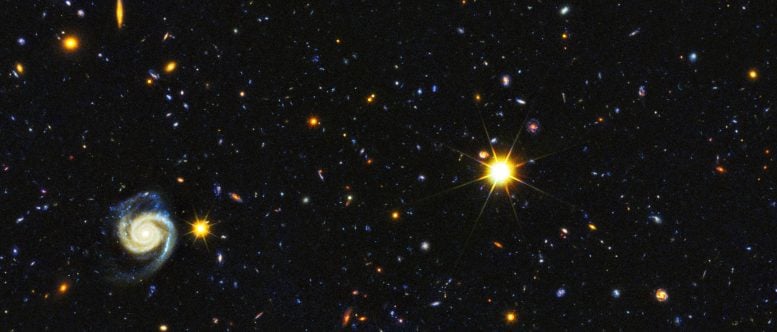
    HDUV GOODS North Field Crop

    Ultraviolet Light Adds Missing Piece to Cosmic Puzzle

    Astronomers have just assembled one of the most comprehensive portraits yet of the universe’s evolutionary history, based on a broad spectrum of observations by the Hubble Space Telescope and other space and ground-based telescopes. In particular, Hubble’s ultraviolet vision opens a new window on the evolving universe, tracking the birth of stars over the last 11 billion years back to the cosmos’ busiest star-forming period, about 3 billion years after the big bang. This photo encompasses a sea of approximately 15,000 galaxies — 12,000 of which are star-forming — widely distributed in time and space.
    Panoramic View of the Fire and Fury of Star Birth
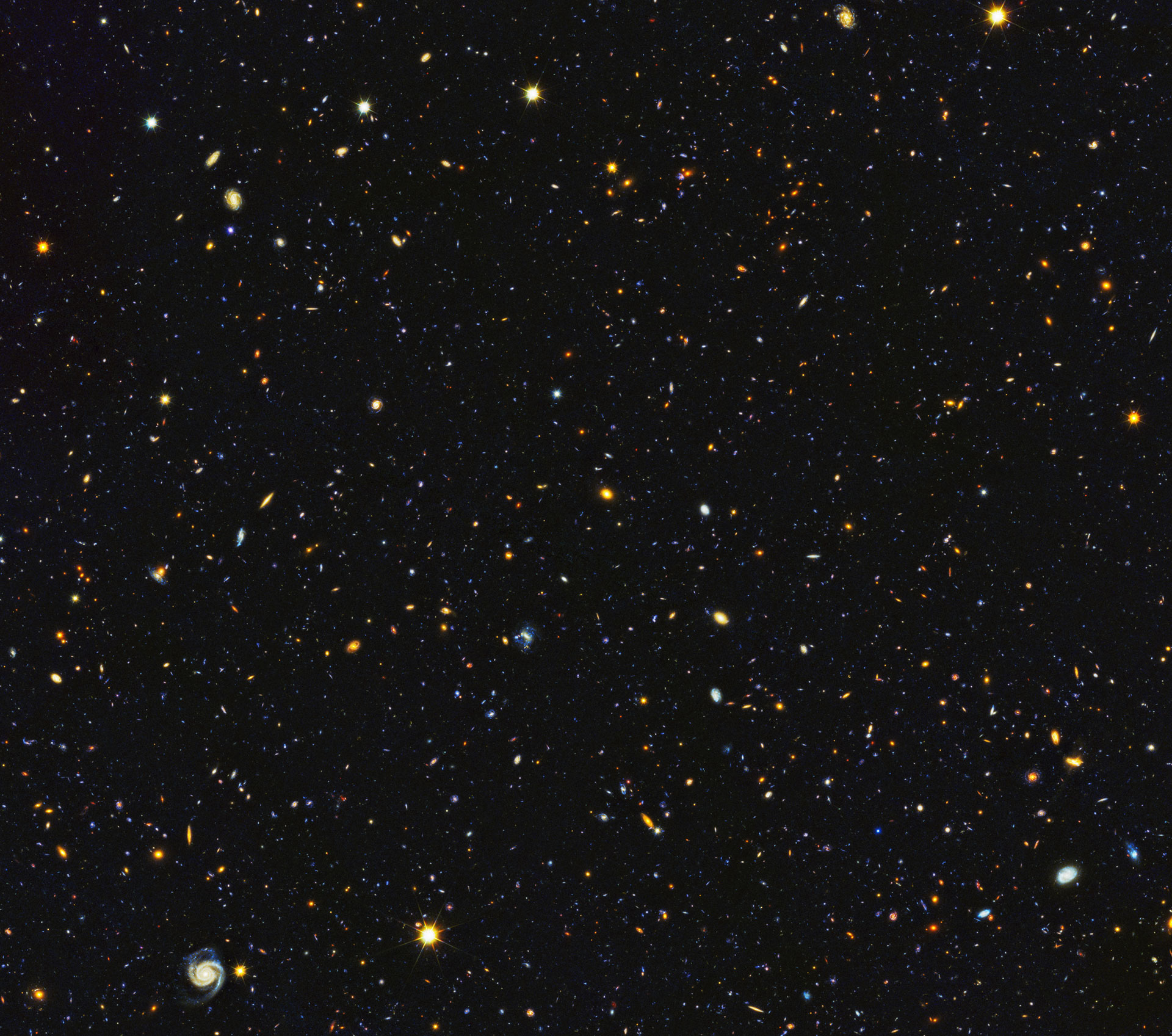
    Astronomers have just assembled one of the most comprehensive portraits yet of the universe’s evolutionary history, based on a broad spectrum of observations by the Hubble Space Telescope and other space and ground-based telescopes. In particular, Hubble’s ultraviolet vision opens a new window on the evolving universe, tracking the birth of stars over the last 11 billion years back to the cosmos’ busiest star-forming period, about 3 billion years after the big bang. This photo encompasses a sea of approximately 15,000 galaxies — 12,000 of which are star-forming — widely distributed in time and space. This mosaic is 14 times the area of the Hubble Ultra Violet Ultra Deep Field released in 2014. This image is a portion of the GOODS-North field, which is located in the northern constellation Ursa Major. Credit: NASA, ESA, P. Oesch (University of Geneva), and M. Montes (University of New South Wales)

    Astronomers using the ultraviolet vision of NASA’s Hubble Space Telescope have captured one of the largest panoramic views of the fire and fury of star birth in the distant universe. The field features approximately 15,000 galaxies, about 12,000 of which are forming stars. Hubble’s ultraviolet vision opens a new window on the evolving universe, tracking the birth of stars over the last 11 billion years back to the cosmos’ busiest star-forming period, which happened about 3 billion years after the big bang.

    Ultraviolet light has been the missing piece to the cosmic puzzle. Now, combined with infrared and visible-light data from Hubble and other space and ground-based telescopes, astronomers have assembled one of the most comprehensive portraits yet of the universe’s evolutionary history.

    The image straddles the gap between the very distant galaxies, which can only be viewed in infrared light, and closer galaxies, which can be seen across a broad spectrum. The light from distant star-forming regions in remote galaxies started out as ultraviolet. However, the expansion of the universe has shifted the light into infrared wavelengths. By comparing images of star formation in the distant and nearby universe, astronomers glean a better understanding of how nearby galaxies grew from small clumps of hot, young stars long ago.
     HDUV GOODS-South Field
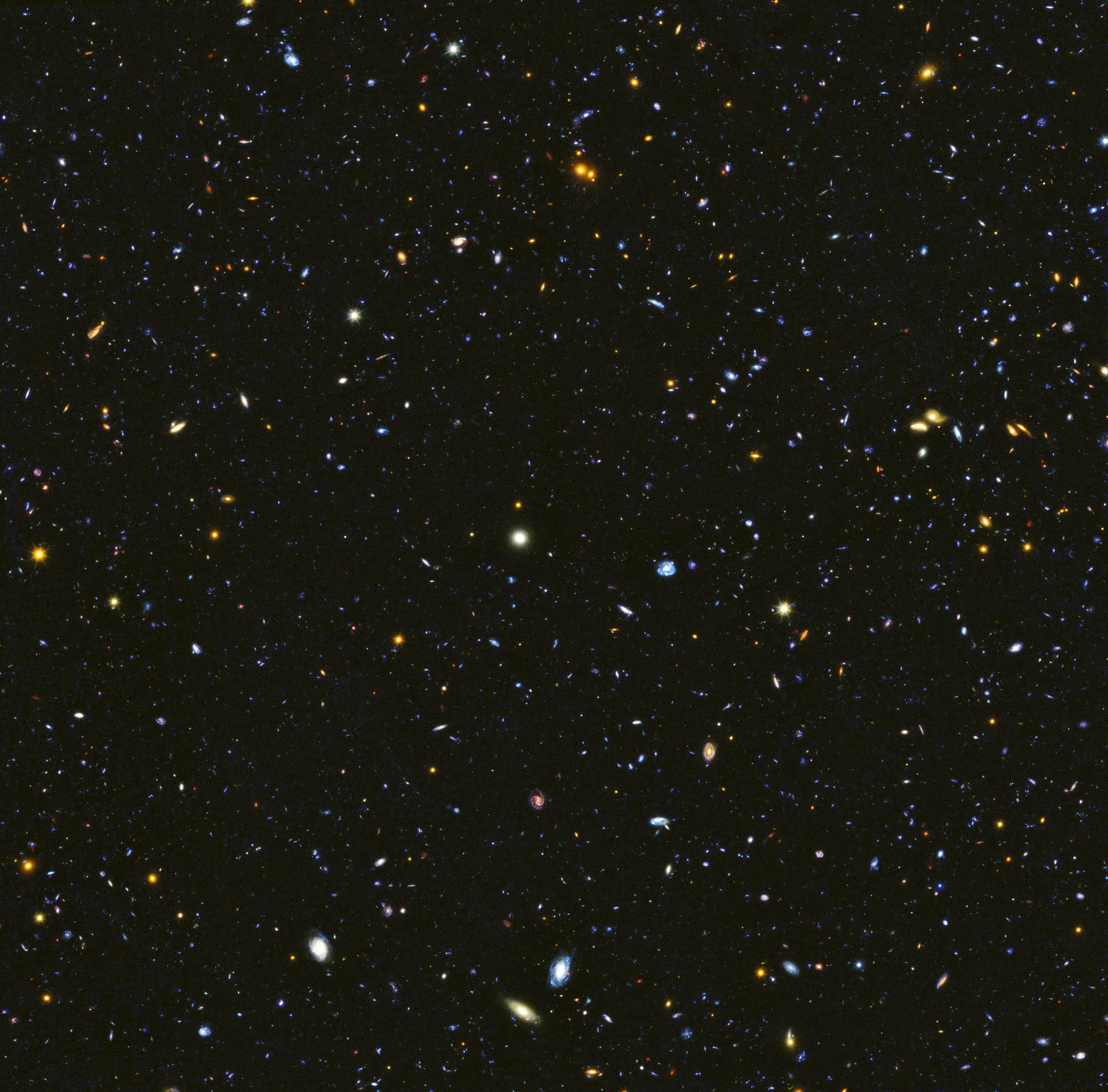
    This sea of approximately 15,000 galaxies — about 12,000 of which are forming stars — is one of the most comprehensive portraits yet of the universe’s evolutionary history. The ultraviolet vision from NASA’s Hubble Space Telescope, combined with infrared and visible-light data from Hubble and other space and ground-based telescopes, opens a new window on the evolving universe. It tracks the birth of stars over the last 11 billion years back to the cosmos’ busiest star-forming period, which happened about 3 billion years after the big bang. This image is a portion of the GOODS-South field, which is located in the southern constellation Fornax. Credit: NASA, ESA, P. Oesch (University of Geneva), and M. Montes (University of New South Wales)

    Because Earth’s atmosphere filters most ultraviolet light, Hubble can provide some of the most sensitive space-based ultraviolet observations possible.

    The program, called the Hubble Deep UV (HDUV) Legacy Survey, extends and builds on the previous Hubble multi-wavelength data in the CANDELS-Deep (Cosmic Assembly Near-infrared Deep Extragalactic Legacy Survey) fields within the central part of the GOODS (Great Observatories Origins Deep Survey) fields. This mosaic is 14 times the area of the Hubble Ultra Violet Ultra Deep Field released in 2014.

    This image is a portion of the GOODS-North field, which is located in the northern constellation Ursa Major.

    Reference: “HDUV: The Hubble Deep UV Legacy Survey” by P. A. Oesch, M. Montes, N. Reddy, R. J. Bouwens, G. D. Illingworth, D. Magee, H. Atek, C. M. Carollo, A. Cibinel, M. Franx, B. Holden, I. Labbé, E. J. Nelson, C. C. Steidel, P. G. van Dokkum, L. Morselli, R. P. Naidu and S. Wilkins, 13 July 2018, The Astrophysical Journal.
    DOI: 10.3847/1538-4365/aacb30

    The Hubble Space Telescope is a project of international cooperation between NASA and ESA (European Space Agency). NASA’s Goddard Space Flight Center in Greenbelt, Maryland, manages the telescope. The Space Telescope Science Institute (STScI) in Baltimore, Maryland, conducts Hubble science operations. STScI is operated for NASA by the Association of Universities for Research in Astronomy in Washington, D.C.

    Never miss a breakthrough: Join the SciTechDaily newsletter.
    Follow us on Google and Google News.

    Astronomy Hubble Space Telescope Space Telescope Science Institute
    Share. Facebook Twitter Pinterest LinkedIn Email Reddit

    Related Articles

    Hubble Finds Mysterious Replenishment of Water Vapor on Jupiter’s Moon Europa

    ‘Double’ Galaxy Mystifies Hubble Astronomers – “We Were Really Stumped”

    Supernova Requiem: Rerun of Massive Blast From Exploding Star Expected To Appear in 2037

    Doomed Celestial Visitor May Have Been Piece of Prehistoric Comet

    Hubble Finds First Evidence of Water Vapor in the Atmosphere of Jupiter’s Moon Ganymede

    Stunning First Images From Rebooted Hubble: Bizarre “Oddball” Galaxies

    Cosmic Mystery Deepens: Oddball “See-Through” Galaxy’s Missing Dark Matter

    Hubble Views Magnificent Lopsided Galaxy NGC 2276

    Magnetic Monsters: Hubble Tracks Down Location of Mysterious Radio Signals From Intergalactic Space

    Leave A Reply Cancel Reply

    • Facebook
    • Twitter
    • Pinterest
    • YouTube

    Don't Miss a Discovery

    Subscribe for the Latest in Science & Tech!

    Trending News

    Massive Study Warns Marijuana Use in Teens Is Linked to Serious Mental Illness

    Scientists Discover a Completely Unexpected Way T Cells Kill Cancer

    Scientists Just Found the Solar System’s Original “Planet Factory”

    Study Warns Widely Used Food Preservatives Linked to High Blood Pressure and Heart Disease

    New Treatment Could Reverse Osteoarthritis Within Weeks

    Physicists Have Measured “Negative Time” in Bizarre Quantum Experiment

    The Deadly Tapeworm Spreading Across America Has Reached the Pacific Northwest

    Could Low Vitamin D Be Making Your Pain Worse?

    Follow SciTechDaily
    • Facebook
    • Twitter
    • YouTube
    • Pinterest
    • Newsletter
    • RSS
    SciTech News
    • Biology News
    • Chemistry News
    • Earth News
    • Health News
    • Physics News
    • Science News
    • Space News
    • Technology News
    Recent Posts
    • Stanford’s Revolutionary New Microscope Reveals Living Cells in Stunning Detail
    • Scientists Discover a Sea Slug Smaller Than a Sesame Seed in Taiwan
    • Wasp Colonies Explode Into Violence After Losing Their Queen
    • Antarctica Suddenly Became Far More Sensitive to Climate Change 1 Million Years Ago
    • A Hidden Arctic Ocean Crisis Is Unfolding Beneath the Melting Ice
    Copyright © 1998 - 2026 SciTechDaily. All Rights Reserved.
    • Science News
    • About
    • Contact
    • Editorial Board
    • Privacy Policy
    • Terms of Use

    Type above and press Enter to search. Press Esc to cancel.