
Close Menu
    Facebook X (Twitter) Instagram
    SciTechDaily
    • Biology
    • Chemistry
    • Earth
    • Health
    • Physics
    • Science
    • Space
    • Technology
    Facebook X (Twitter) Pinterest YouTube RSS
    SciTechDaily
    Home»Space»Hubble Gazes Sidelong at a Galaxy Where a Supernova Was Discovered by Amateur Astronomers
    Space

    Hubble Gazes Sidelong at a Galaxy Where a Supernova Was Discovered by Amateur Astronomers

    By ESA/HubbleDecember 12, 20212 Comments2 Mins Read
    Facebook Twitter Pinterest Telegram LinkedIn WhatsApp Email Reddit
    Share
    Facebook Twitter LinkedIn Pinterest Telegram Email Reddit
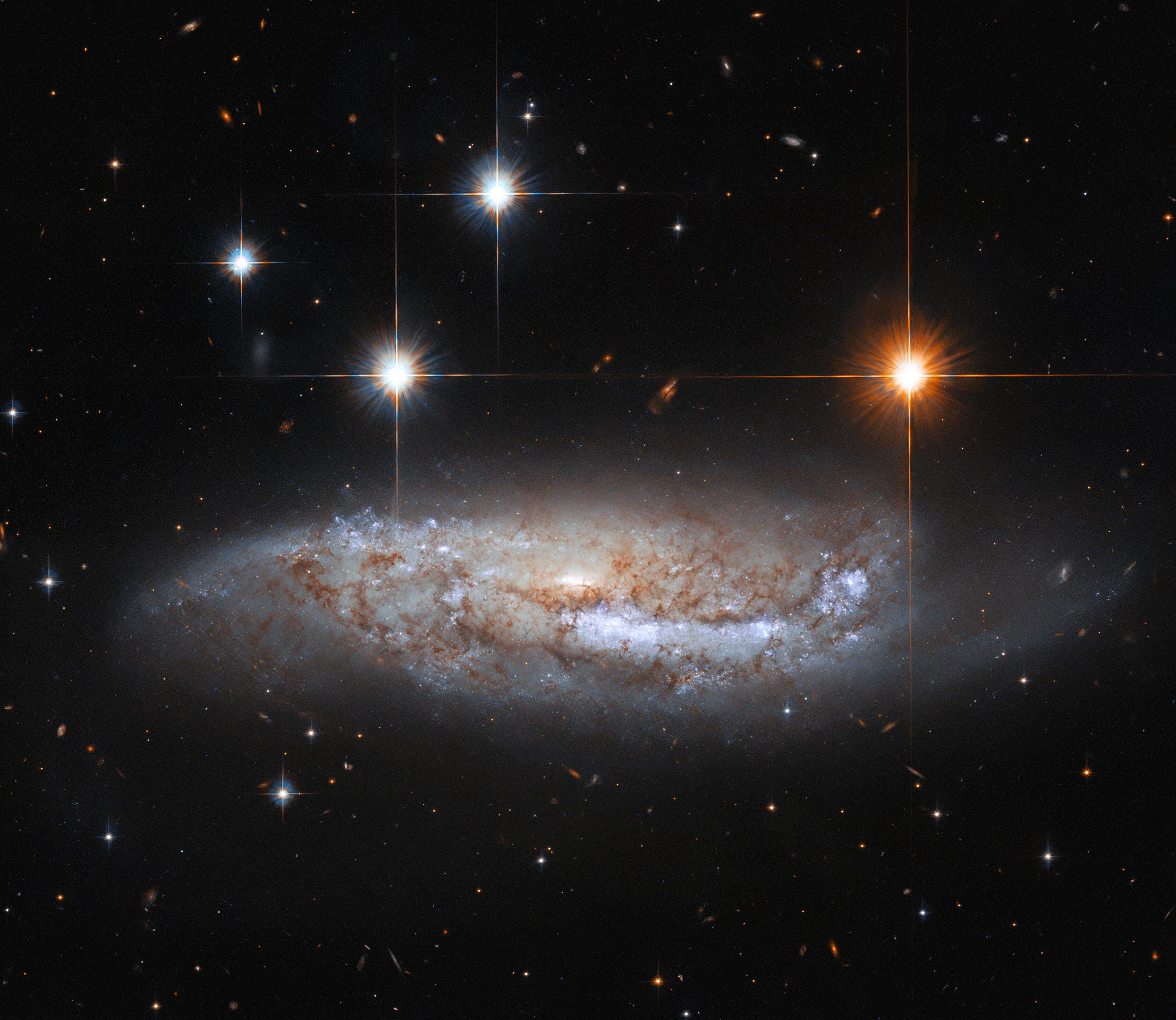
    Galaxy NGC 3568
    Side-on view of NGC 3568, a barred spiral galaxy roughly 57 million light-years from the Milky Way in the constellation Centaurus, captured by the Hubble Space Telescope. Credit: ESA/Hubble & NASA, M. Sun

    The Hubble Space Telescope has captured a striking side-on image of NGC 3568, a barred spiral galaxy 57 million light-years away in Centaurus.

    In this image, the NASA/ESA Hubble Space Telescope captures a side-on view of NGC 3568, a barred spiral galaxy roughly 57 million light-years from the Milky Way in the constellation Centaurus. In 2014 the light from a supernova explosion in NGC 3568 reached Earth — a sudden flare of light caused by the titanic explosion accompanying the death of a massive star. Whilst most astronomical discoveries are the work of teams of professional astronomers, this supernova was discovered by amateur astronomers from the Backyard Observatory Supernova Search in New Zealand. Dedicated amateur astronomers often make intriguing discoveries — particularly of fleeting astronomical phenomena such as supernovae. 

    This Hubble observation comes from a hoard of data built up to pave the way for future science with the upcoming NASA/ESA/CSA James Webb Space Telescope. By combining ground-based observations with data from Hubble’s Advanced Camera for Surveys and Wide Field Camera 3, astronomers have built a treasure trove of data on the connections between young stars and the clouds of cold gas in which they form. One of Webb’s key science goals is to explore the life cycle of stars — particularly how and where stars are born. Since Webb observes at infrared wavelengths, it will be able to peer through the clouds of gas and dust in stellar nurseries and observe the fledgling stars within. Webb’s superb sensitivity will even allow astronomers to directly investigate faint protostellar cores — the earliest stages of star birth.

    Never miss a breakthrough: Join the SciTechDaily newsletter.
    Follow us on Google and Google News.

    Astronomy European Space Agency Hubble Space Telescope NASA Popular
    Share. Facebook Twitter Pinterest LinkedIn Email Reddit

    Related Articles

    Hubble’s Newest Discovery Isn’t a Star, It’s a Window Into the Dark Universe

    Hubble Celebrates 34th Anniversary With a Spectacular View of the Little Dumbbell Nebula

    Hubble Views Spiral Galaxy NGC 5793

    Hubble Captures Face-On Image of Messier 61

    Hubble Views an Ongoing Cosmic Collision

    Hubble Views Newborn Stars in Galaxy IC 5052

    New XDF Image, The Deepest-Ever View of the Universe

    Hubble Zooms in on the Center of M4

    Hubble Image of Peculiar Galaxy Pair Arp 116

    2 Comments

    1. KMacK on December 14, 2021 12:03 pm

      I really can’t understand NASA’s claim that Hubble is obsolete. Maybe it doesn’t have the “Shiniest New Stuff” but it is a dependable and, by now, expected participant in the observation of the Universe we’re living in. Yet NASA says it’s “Obsolete” and will be eventually “de-orbited” and burnt up as it re-enters the atmosphere. My observation is that since the United States no longer has the means to get a vessel up to Hubble, that rather than admit that we’ve messed up – again – by losing our near-space capability, it’s easier to simply say something is obsolete; rather than admitting that while we once could have made repairs to it, we can’t get to it anymore. It’s easier to let a piece of record-making equipment be destroyed than admit that NASA has again messed up.
      SHINY… National Amerian SHINY Adminsitration… that seems to fit.

      Reply
    2. Rachupalli.saaenaatha reddy on December 18, 2021 7:03 am

      Hindu mythology clearly speaks everything evoluted from sky to air to fire to water to matter then different& various shapes&verities so all from sky that was soonyam&unable touch sky&air but smelt

      Reply
    Leave A Reply Cancel Reply

    • Facebook
    • Twitter
    • Pinterest
    • YouTube

    Don't Miss a Discovery

    Subscribe for the Latest in Science & Tech!

    Trending News

    New Pill Lowers Stubborn Blood Pressure and Protects the Kidneys

    Humans May Have Hidden Regenerative Powers, New Study Suggests

    Scientists Just Solved the Mystery of Why Crabs Walk Sideways

    Doctors Are Surprised by What This Vaccine Is Doing to the Heart

    This Popular Supplement May Boost Your Brain, Not Just Your Muscles

    Scientists Say This Simple Supplement May Actually Reverse Heart Disease

    Warming Oceans Could Trigger a Dangerous Methane Surge

    This Simple Movement Could Be Secretly Cleaning Your Brain

    Follow SciTechDaily
    • Facebook
    • Twitter
    • YouTube
    • Pinterest
    • Newsletter
    • RSS
    SciTech News
    • Biology News
    • Chemistry News
    • Earth News
    • Health News
    • Physics News
    • Science News
    • Space News
    • Technology News
    Recent Posts
    • New MRI Breakthrough Captures Stunningly Clear Images of the Eye and Brain
    • Scientists Warn Sitting Too Much Can Harm Your Body in Surprising Ways
    • Your Blood Pressure Reading Could Be Wrong Because of One Simple Mistake
    • Scientists Discover Cheap Material That Kills Deadly Superbugs
    • This Magnetic Field Trick Creates Entirely New Forms of Matter
    Copyright © 1998 - 2026 SciTechDaily. All Rights Reserved.
    • Science News
    • About
    • Contact
    • Editorial Board
    • Privacy Policy
    • Terms of Use

    Type above and press Enter to search. Press Esc to cancel.