
Close Menu
    Facebook X (Twitter) Instagram
    SciTechDaily
    • Biology
    • Chemistry
    • Earth
    • Health
    • Physics
    • Science
    • Space
    • Technology
    Facebook X (Twitter) Pinterest YouTube RSS
    SciTechDaily
    Home»Space»Hubble Image of the Week – The Impressive Coma Cluster
    Space

    Hubble Image of the Week – The Impressive Coma Cluster

    By Mathias Jäger, ESA/HubbleSeptember 17, 2018No Comments2 Mins Read
    Facebook Twitter Pinterest Telegram LinkedIn WhatsApp Email Reddit
    Share
    Facebook Twitter LinkedIn Pinterest Telegram Email Reddit
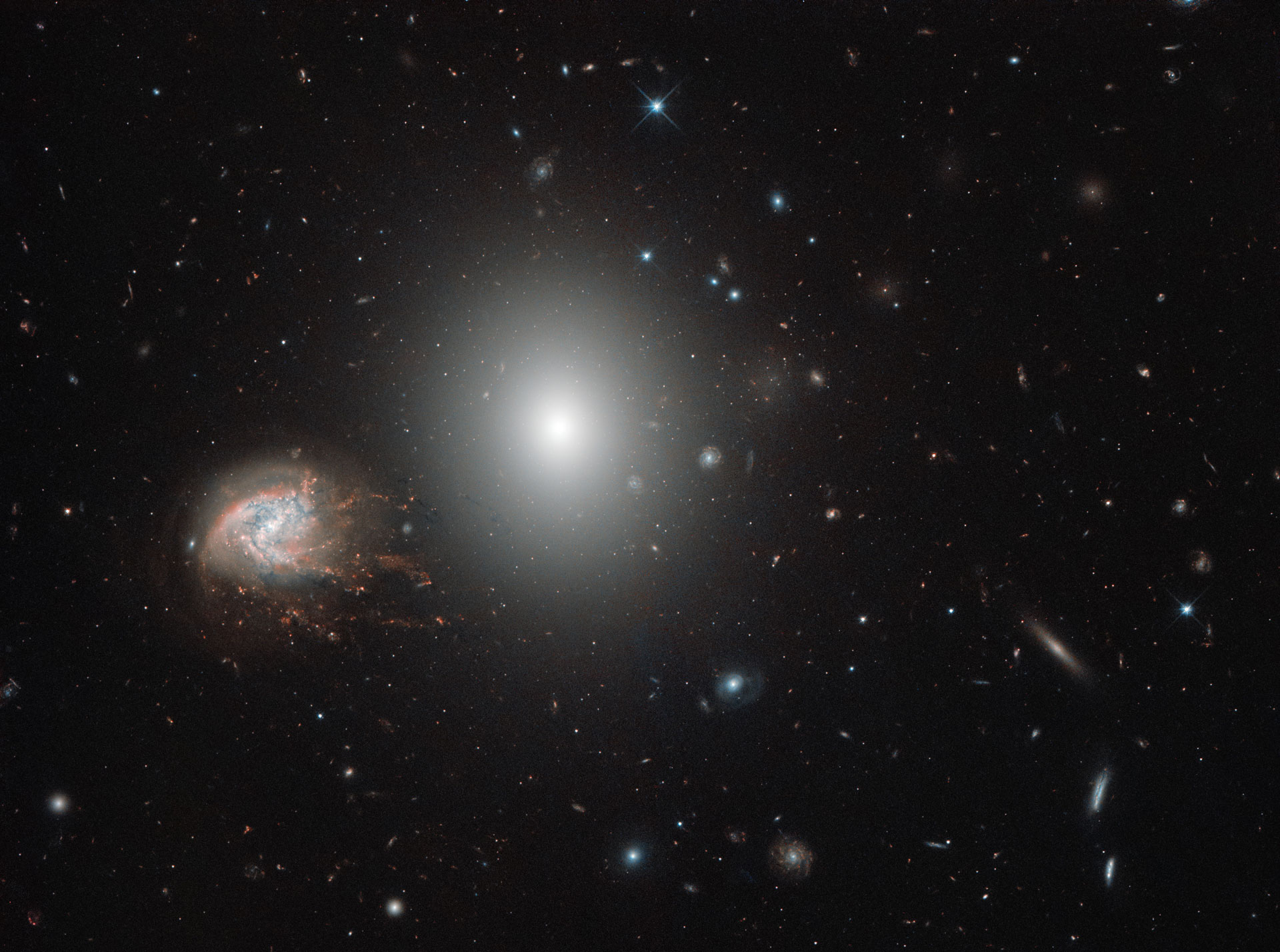
    Hubble Views the Coma Cluster
    Hubble Space Telescope image of galaxies NGC 4860 and NGC 4858. Credit: ESA/Hubble & NASA

    In the northern constellation of Coma Berenices (Berenice’s Hair) lies the impressive Coma Cluster — a structure of over a thousand galaxies bound together by gravity. Many of these galaxies are elliptical types, as is the brighter of the two galaxies dominating this image: NGC 4860 (center). However, the outskirts of the cluster also host younger spiral galaxies that proudly display their swirling arms. Again, this image shows a wonderful example of such a galaxy in the shape of the beautiful NGC 4858, which can be seen to the left of its bright neighbor and stands out on account of its unusual, tangled, fiery appearance.

    NGC 4858 is special. Rather than being a simple spiral, it is something called a “galaxy aggregate,” which is, just as the name suggests, a central galaxy surrounded by a handful of luminous knots of material that seem to stem from it, extending and tearing away and adding to or altering its overall structure. It is also experiencing an extremely high rate of star formation, possibly triggered by an earlier interaction with another galaxy. As we see it, NGC 4858 is forming stars so frantically that it will use up all of its gas long before it reaches the end of its life. The color of its bright knots indicates that they are formed of hydrogen, which glows in various shades of bright red as it is energized by the many young, hot stars lurking within.

    This scene was captured by the NASA/ESA Hubble Space Telescope’s Wide Field Camera 3 (WFC3), a powerful camera designed to explore the evolution of stars and galaxies in the early Universe.

    Never miss a breakthrough: Join the SciTechDaily newsletter.
    Follow us on Google and Google News.

    Astronomy Hubble Space Telescope
    Share. Facebook Twitter Pinterest LinkedIn Email Reddit

    Related Articles

    A Morphing Spiral Galaxy Amongst Friends

    Hubble Views Magnificent Lopsided Galaxy NGC 2276

    Hubble Captures Fantastic Detail of Eponymous Spiral Galaxy NGC 691

    Spectacular Image Captured by Hubble Shows a Strangely Contorted Spiral Galaxy

    A Distant Spiral in Virgo: Extraordinary Detail Seen in a Galaxy 150 Million Light-Years Away From Earth

    Magnetic Monsters: Hubble Tracks Down Location of Mysterious Radio Signals From Intergalactic Space

    A Menagerie of Galaxies: Hubble Captures a Cluster With Galaxies of All Shapes and Sizes

    How Habitable Are Planets That Orbit Red Dwarfs – The Most Common Type of Stars in the Galaxy?

    Cosmic Silver Lining: Hubble Spots V565 Surrounded by Four Prominent Diffraction Spikes

    Leave A Reply Cancel Reply

    • Facebook
    • Twitter
    • Pinterest
    • YouTube

    Don't Miss a Discovery

    Subscribe for the Latest in Science & Tech!

    Trending News

    The Secret to Healthy Aging May Be More Protein and More Exercise

    These 567-Million-Year-Old Fossils Are Rewriting the Story of Life on Earth

    The Spider-Like Creatures Helping Scientists Decode the Origins of Fatherhood

    Scientists Baffled by a Sudden Reversal Deep Inside Earth’s Core

    This Strange Sea Creature Can Survive Five Years Without Food – Scientists Finally Know Why

    New Quantum Sensor Opens a Window Into the Invisible Universe

    Stanford Scientists Reverse Age-Related Memory Loss by Targeting the Gut

    James Webb Uncovers the Atmosphere of a Hellish Lava World 41 Light-Years Away

    Follow SciTechDaily
    • Facebook
    • Twitter
    • YouTube
    • Pinterest
    • Newsletter
    • RSS
    SciTech News
    • Biology News
    • Chemistry News
    • Earth News
    • Health News
    • Physics News
    • Science News
    • Space News
    • Technology News
    Recent Posts
    • One of Arizona’s Largest Reservoirs Is Less Than 1% Full After Snowpack Collapse
    • Scientists Detect Hundreds of Iceberg Earthquakes at Antarctica’s Crumbling Doomsday Glacier
    • This 400-Year-Old Shark May Hold the Secret to Preserving Human Vision
    • Hip Replacements Are Lasting Far Longer Than Doctors Once Thought
    • Why Swallowing a Fish Bone Can Become a Life-Threatening Medical Emergency
    Copyright © 1998 - 2026 SciTechDaily. All Rights Reserved.
    • Science News
    • About
    • Contact
    • Editorial Board
    • Privacy Policy
    • Terms of Use

    Type above and press Enter to search. Press Esc to cancel.