
Close Menu
    Facebook X (Twitter) Instagram
    SciTechDaily
    • Biology
    • Chemistry
    • Earth
    • Health
    • Physics
    • Science
    • Space
    • Technology
    Facebook X (Twitter) Pinterest YouTube RSS
    SciTechDaily
    Home»Space»Hubble Reveals Galaxy Blazing With New Stars Born From Close Encounter
    Space

    Hubble Reveals Galaxy Blazing With New Stars Born From Close Encounter

    By Rob Garner, Space Telescope Science InstituteMay 18, 20191 Comment2 Mins Read
    Facebook Twitter Pinterest Telegram LinkedIn WhatsApp Email Reddit
    Share
    Facebook Twitter LinkedIn Pinterest Telegram Email Reddit
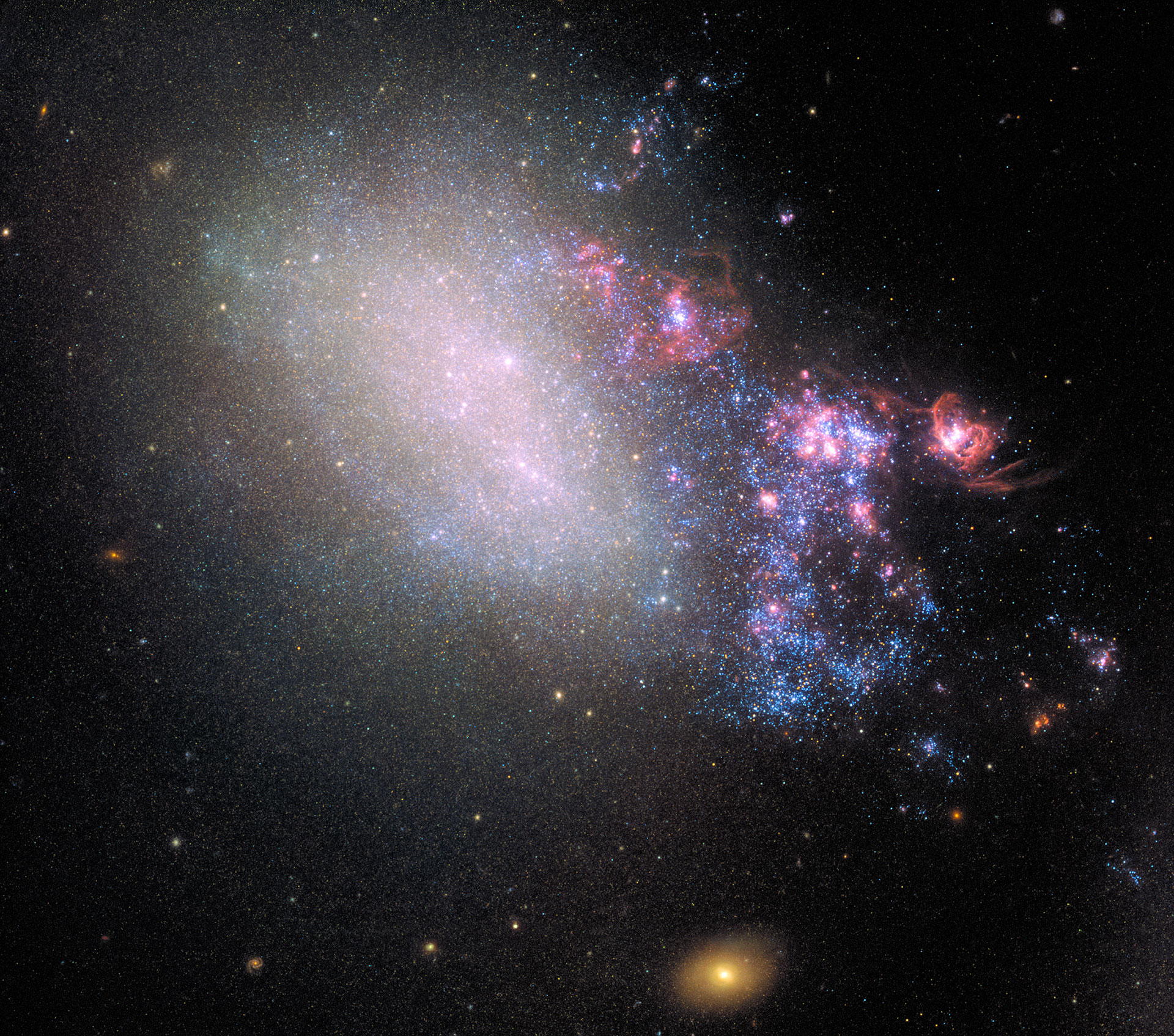
    Galaxy Blazes With New Stars
    The irregular galaxy NGC 4485 shows all the signs of having been involved in a hit-and-run accident with a bypassing galaxy. The larger culprit galaxy, NGC 4490, is off the bottom of the frame. The two galaxies sideswiped each other millions of years ago and are now 24,000 light-years apart.  Credit: T. Roberts (Durham University, UK), D. Calzetti (University of Massachusetts) and the LEGUS Team, R. Tully (University of Hawaii) and R. Chandar (University of Toledo)

    The irregular galaxy NGC 4485 shows all the signs of having been involved in a hit-and-run accident with a bypassing galaxy. Rather than destroying the galaxy, the chance encounter is spawning a new generation of stars, and presumably planets.

    The right side of the galaxy is ablaze with star formation, shown in the plethora of young blue stars and star-incubating pinkish nebulas. The left side, however, looks intact. It contains hints of the galaxy’s previous spiral structure, which, at one time, was undergoing normal galactic evolution.

    The larger culprit galaxy, NGC 4490, is off the bottom of the frame. The two galaxies sideswiped each other millions of years ago and are now 24,000 light-years apart. The gravitational tug-of-war between them created rippling patches of higher-density gas and dust within both galaxies. This activity triggered a flurry of star formation.

    This galaxy is a nearby example of the kind of cosmic bumper-car activity that was more common billions of years ago when the universe was smaller and galaxies were closer together.

    NGC 4485 lies 25 million light-years away in the northern constellation Canes Venatici (the Hunting Dogs).

    This new image, captured by Hubble’s Wide Field Camera 3 (WFC3), provides further insight into the complexities of galaxy evolution.

    The Hubble Space Telescope is a project of international cooperation between NASA and ESA (European Space Agency). NASA’s Goddard Space Flight Center in Greenbelt, Maryland, manages the telescope. The Space Telescope Science Institute (STScI) in Baltimore, Maryland, conducts Hubble science operations. STScI is operated for NASA by the Association of Universities for Research in Astronomy in Washington, D.C.

    Never miss a breakthrough: Join the SciTechDaily newsletter.
    Follow us on Google and Google News.

    Astronomy Hubble Space Telescope Space Telescope Science Institute
    Share. Facebook Twitter Pinterest LinkedIn Email Reddit

    Related Articles

    Hubble Finds Mysterious Replenishment of Water Vapor on Jupiter’s Moon Europa

    ‘Double’ Galaxy Mystifies Hubble Astronomers – “We Were Really Stumped”

    Supernova Requiem: Rerun of Massive Blast From Exploding Star Expected To Appear in 2037

    Doomed Celestial Visitor May Have Been Piece of Prehistoric Comet

    Hubble Finds First Evidence of Water Vapor in the Atmosphere of Jupiter’s Moon Ganymede

    Stunning First Images From Rebooted Hubble: Bizarre “Oddball” Galaxies

    Cosmic Mystery Deepens: Oddball “See-Through” Galaxy’s Missing Dark Matter

    Hubble Views Magnificent Lopsided Galaxy NGC 2276

    Magnetic Monsters: Hubble Tracks Down Location of Mysterious Radio Signals From Intergalactic Space

    1 Comment

    1. SEKJAR ALI on May 18, 2019 7:05 pm

      Please read this few lines of book of our god…sura an najm,,526 page…Al Qur’an
      Thank you for your expensive time..

      Reply
    Leave A Reply Cancel Reply

    • Facebook
    • Twitter
    • Pinterest
    • YouTube

    Don't Miss a Discovery

    Subscribe for the Latest in Science & Tech!

    Trending News

    First-of-Its-Kind Discovery: Homer’s Iliad Found Embedded in a 1,600-Year-Old Egyptian Mummy

    Beyond Inflammation: Scientists Uncover New Cause of Persistent Rheumatoid Arthritis

    A Simple Molecule Could Unlock Safer, Easier Weight Loss

    Scientists Just Built a Quantum Battery That Charges Almost Instantly

    Researchers Unveil Groundbreaking Sustainable Solution to Vitamin B12 Deficiency

    Millions of People Have Osteopenia Without Realizing It – Here’s What You Need To Know

    Researchers Discover Boosting a Single Protein Helps the Brain Fight Alzheimer’s

    World-First Study Reveals Human Hearts Can Regenerate After a Heart Attack

    Follow SciTechDaily
    • Facebook
    • Twitter
    • YouTube
    • Pinterest
    • Newsletter
    • RSS
    SciTech News
    • Biology News
    • Chemistry News
    • Earth News
    • Health News
    • Physics News
    • Science News
    • Space News
    • Technology News
    Recent Posts
    • This Simple Exercise Trick Builds Muscle With Less Effort, Study Finds
    • Middle Age Is Becoming a Breaking Point in America, Study Reveals
    • Scientists Discover How Coffee Impacts Memory, Mood, and Gut Health
    • How Cells Copy DNA Might Matter More Than We Ever Realized
    • Scientists Just Solved the Mystery of the Twelve Apostles
    Copyright © 1998 - 2026 SciTechDaily. All Rights Reserved.
    • Science News
    • About
    • Contact
    • Editorial Board
    • Privacy Policy
    • Terms of Use

    Type above and press Enter to search. Press Esc to cancel.