
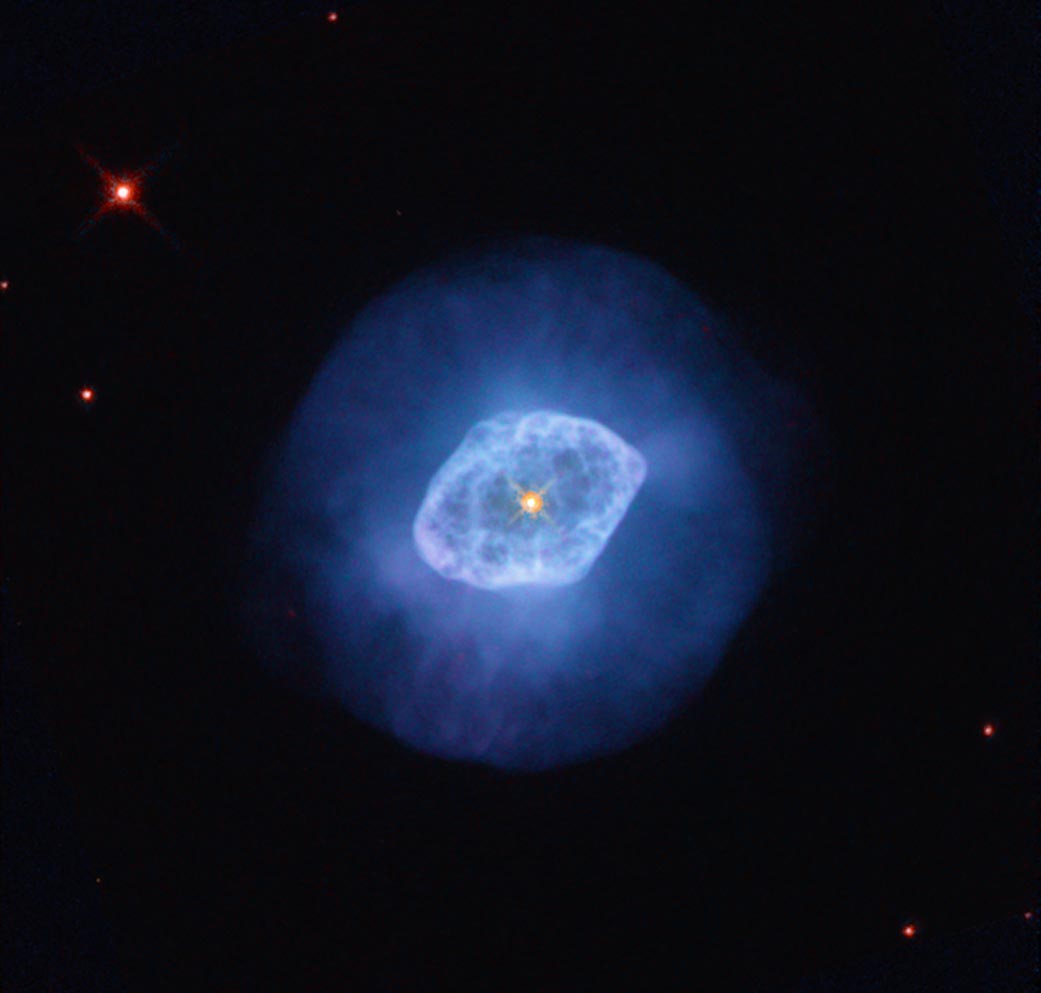
Hubble captured NGC 6891’s layered shells and glowing gas, evidence of repeated stellar eruptions thousands of years apart. Its light arises from hydrogen atoms ionized by the central white dwarf.
NGC 6891 is a bright, asymmetrical planetary nebula in the constellation Delphinus, the Dolphin. This Hubble image reveals a wealth of structure, including a spherical outer halo that is expanding faster than the inner nebula, and at least two ellipsoidal shells that are orientated differently. The image also reveals filaments and knots in the nebula’s interior, surrounding the central white dwarf star. From their motions, astronomers estimate that one of the shells is 4,800 years old while the outer halo is some 28,000 years old, indicating a series of outbursts from the dying star at different times.
Hubble studied NGC 6891 as part of efforts to gauge the distances to nebulae, and to learn more about how their structures formed and evolved. NGC 6891 is made up of gas that’s been ionized by the central white dwarf star, which stripped electrons from the nebula’s hydrogen atoms. As the energized electrons revert from their higher-energy state to a lower-energy state by recombining with the hydrogen nuclei, they emit energy in the form of light, causing the nebula’s gas to glow.
Never miss a breakthrough: Join the SciTechDaily newsletter.
Follow us on Google and Google News.
2 Comments
Bosons could be an initial source material for continuous accretion of matter, thus intensifying the gravitational field surrounding black holes.
Its pretty 🔍🔎