
Close Menu
    Facebook X (Twitter) Instagram
    SciTechDaily
    • Biology
    • Chemistry
    • Earth
    • Health
    • Physics
    • Science
    • Space
    • Technology
    Facebook X (Twitter) Pinterest YouTube RSS
    SciTechDaily
    Home»Space»Hubble Telescope Views Massive Galaxy Cluster RX J1347.5–1145
    Space

    Hubble Telescope Views Massive Galaxy Cluster RX J1347.5–1145

    By SciTechDailyFebruary 20, 20173 Comments2 Mins Read
    Facebook Twitter Pinterest Telegram LinkedIn WhatsApp Email Reddit
    Share
    Facebook Twitter LinkedIn Pinterest Telegram Email Reddit
    Hubble Views Massive Galaxy Cluster RX J1347.5–1145
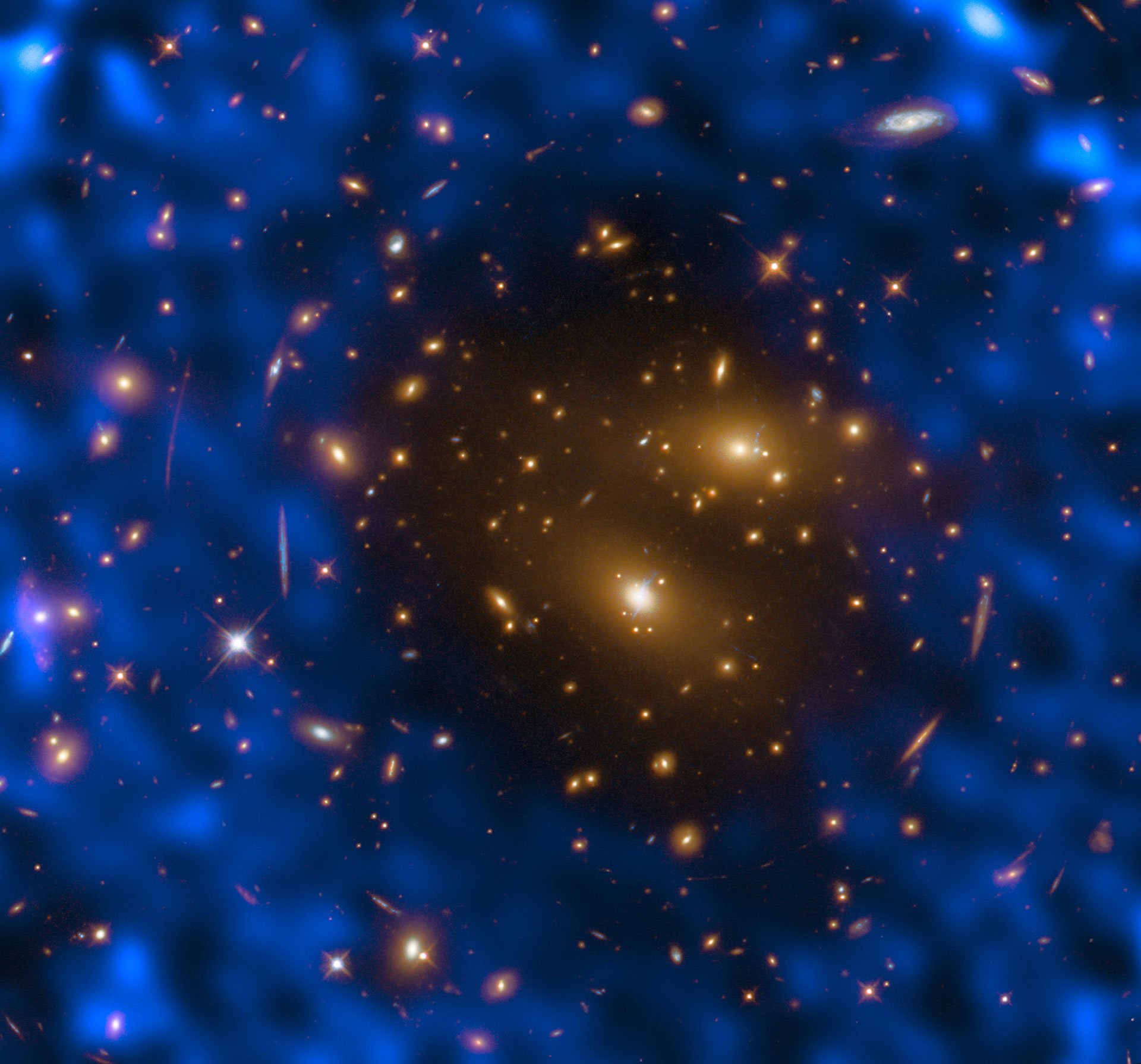
    RX J1347.5–1145, 5 billion light-years from Earth, is one of the most massive known galaxy clusters. Credit: ESA/Hubble & NASA, T. Kitayama (Toho University, Japan)/ESA/Hubble & NASA

    This newly released Hubble image shows one of most massive known galaxy clusters, RX J1347.5–1145.

    The events surrounding the Big Bang were so cataclysmic that they left an indelible imprint on the fabric of the cosmos. We can detect these scars today by observing the oldest light in the Universe. As it was created nearly 14 billion years ago, this light — which exists now as weak microwave radiation and is thus named the cosmic microwave background (CMB) — has now expanded to permeate the entire cosmos, filling it with detectable photons.

    The CMB can be used to probe the cosmos via something known as the Sunyaev-Zel’dovich (SZ) effect, which was first observed over 30 years ago. We detect the CMB here on Earth when its constituent microwave photons travel to us through space. On their journey to us, they can pass through galaxy clusters that contain high-energy electrons. These electrons give the photons a tiny boost of energy. Detecting these boosted photons through our telescopes is challenging but important — they can help astronomers to understand some of the fundamental properties of the Universe, such as the location and distribution of dense galaxy clusters.

    The NASA/ESA Hubble Space Telescope observed one of most massive known galaxy clusters, RX J1347.5–1145, seen in this Picture of the Week, as part of the Cluster Lensing And Supernova survey with Hubble (CLASH). This observation of the cluster, 5 billion light-years from Earth, helped the Atacama Large Millimeter/submillimeter Array (ALMA) in Chile to study the cosmic microwave background using the thermal Sunyaev-Zel’dovich effect. The observations made with ALMA are visible as the blue-purple hues.

    Never miss a breakthrough: Join the SciTechDaily newsletter.
    Follow us on Google and Google News.

    Astronomy Cosmology Hubble Space Telescope
    Share. Facebook Twitter Pinterest LinkedIn Email Reddit

    Related Articles

    Hubble Image of the Week: Starburst Galaxy Messier 94

    ESO and Hubble Reveal Fast-Moving, Wave-Like Features in the Debris Disk Around AU Microscopii

    New Phoenix Cluster Observations Provide A Fresh Perspective

    Hubble Image of Arp 194 – Cosmic Optical Illusions in Ursa Major

    Hubble Image of the Week – Evolution in Slow Motion

    Hubble Explores the Wings of the Twin Jet Nebula

    Astronomers Discover Supernovae in ‘Wrong Place at Wrong Time’

    Hubble Reveals Diffusion of Stars Through the Core of the Globular Cluster 47 Tucanae

    Study Suggest Spiral Galaxies Are Larger Than Previously Thought

    3 Comments

    1. Penelope McCalla on February 21, 2017 3:53 am

      This information is beyond my comprehension. Very challengeing and deeply increases my awe for the CREATOR.Thank you for sharing publicly that the average person (me)is blessed with the opportunity to gain a greater understanding of the universe’s complexities.

      Reply
      • Rich Cravitz on February 21, 2017 8:11 pm

        Which CREATOR though? The Hindu version? The Islamic version? The Christian version? The Aboriginal Australian version? Or perhaps one of the many other ones? Please be specific. Cheers.

        Reply
    2. Valeriy on February 21, 2017 7:14 pm

      There are some very complicated issues of galaxy formation. Unfortunately, here is the same problem as with the stars. The origin of galaxies remains unclear, in spite of huge activity in the field. What the “formation” means? It means that we have the material that is assembling into galaxies.

      Reply
    Leave A Reply Cancel Reply

    • Facebook
    • Twitter
    • Pinterest
    • YouTube

    Don't Miss a Discovery

    Subscribe for the Latest in Science & Tech!

    Trending News

    One of the Universe’s Largest Stars May Be Getting Ready To Explode

    Scientists Discover Enzyme That Could Supercharge Ozempic-Like Weight Loss Drugs

    Popular Sweetener Linked to DNA Damage – “It’s Something You Should Not Be Eating”

    Ancient “Rock” Microbes May Reveal How Complex Life Began

    Researchers Capture Quantum Interference in One of Nature’s Rarest Atoms

    “A Plague Is Upon Us”: The Mass Death That Changed an Ancient City Forever

    Scientists Discover Game-Changing New Way To Treat High Cholesterol

    This Small Change to Your Exercise Routine Could Be the Secret to Living Longer

    Follow SciTechDaily
    • Facebook
    • Twitter
    • YouTube
    • Pinterest
    • Newsletter
    • RSS
    SciTech News
    • Biology News
    • Chemistry News
    • Earth News
    • Health News
    • Physics News
    • Science News
    • Space News
    • Technology News
    Recent Posts
    • Scientists Raise Concerns Over Newly Recognized Pollutant Found Everywhere in the Air
    • New Study Challenges 40-Year Puzzle About Childhood Body Fat
    • 20-Year Study Finds Daily Multivitamins Don’t Extend Lifespan
    • Landmark Study Links Never Marrying to Significantly Higher Cancer Risk
    • Revolutionary Imaging Technique Unlocks Secrets of Matter at Extreme Speeds
    Copyright © 1998 - 2026 SciTechDaily. All Rights Reserved.
    • Science News
    • About
    • Contact
    • Editorial Board
    • Privacy Policy
    • Terms of Use

    Type above and press Enter to search. Press Esc to cancel.