
Close Menu
    Facebook X (Twitter) Instagram
    SciTechDaily
    • Biology
    • Chemistry
    • Earth
    • Health
    • Physics
    • Science
    • Space
    • Technology
    Facebook X (Twitter) Pinterest YouTube RSS
    SciTechDaily
    Home»Space»Hubble Views a Starburst Galaxy Hard at Work
    Space

    Hubble Views a Starburst Galaxy Hard at Work

    By NASAOctober 29, 2012No Comments2 Mins Read
    Facebook Twitter Pinterest Telegram LinkedIn WhatsApp Email Reddit
    Share
    Facebook Twitter LinkedIn Pinterest Telegram Email Reddit
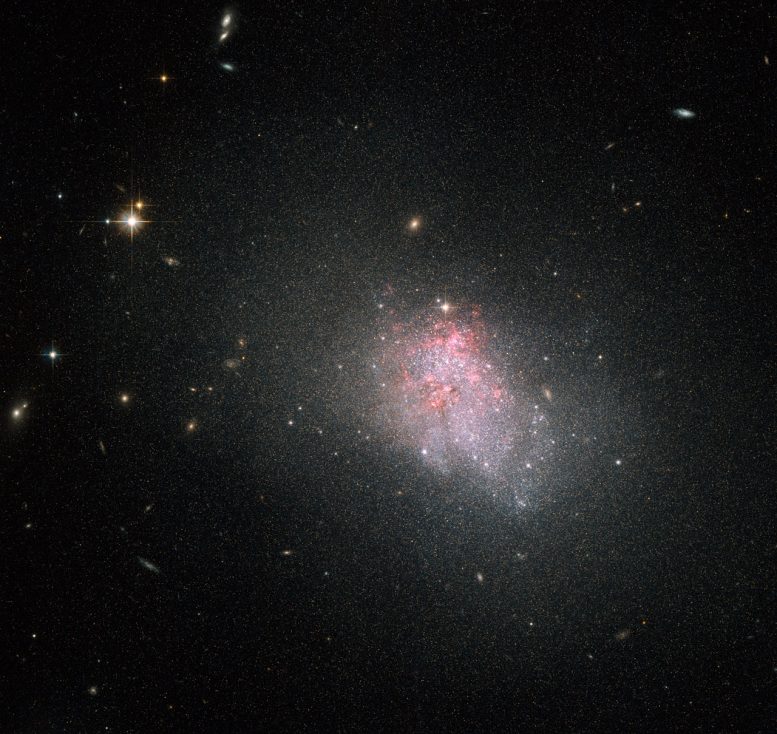
    NGC 3738, a starburst galaxy
    NGC 3738, a starburst galaxy. Credit: ESA/Hubble & NASA

    Located about 12 million light-years from the sun and part of the Messier 81 group of galaxies, starburst galaxy NGC 3738 is currently converting hydrogen gas located in the galaxy’s center into stars.

    The NASA/ESA Hubble Space Telescope has imaged the faint irregular galaxy NGC 3738, a starburst galaxy. The galaxy is in the midst of a violent episode of star formation, during which it is converting reservoirs of hydrogen gas located in the galaxy’s center into stars. Hubble spots this gas glowing red around NGC 3738, one of the most distinctive signs of ongoing star formation.

    Lying in the constellation of Ursa Major (The Great Bear), NGC 3738 is located about 12 million light-years from the sun, and belongs to the Messier 81 group of galaxies. This galaxy — first observed by astronomer William Herschel back in 1789 — is a nearby example of a blue compact dwarf, the faintest type of starburst galaxy. Blue compact dwarfs are small compared to large spiral galaxies — NGC 3738 is around 10,000 light-years across, just one tenth of the size of the Milky Way.

    This type of galaxy is blue in appearance by virtue of containing large clusters of hot, massive stars, which ionize the surrounding interstellar gas with their intense ultraviolet radiation. They are relatively faint and appear to be irregular in shape. Unlike spirals or elliptical galaxies, irregular galaxies do not have any distinctive features, such as a nuclear bulge or spiral arms. Rather, they are extremely chaotic in appearance. These galaxies are thought to resemble some of the earliest that formed in the Universe and may provide clues as to how stars appeared shortly after the Big Bang.

    This image was created by combining visual and infrared images taken with the Wide Field Channel of the Advanced Camera for Surveys aboard the Hubble Space Telescope. The field of view of the Wide Field Channel is approximately 3.4 by 3.4 arcminutes wide.

    Never miss a breakthrough: Join the SciTechDaily newsletter.
    Follow us on Google and Google News.

    Galaxy Hubble Space Telescope NASA Popular
    Share. Facebook Twitter Pinterest LinkedIn Email Reddit

    Related Articles

    Hubble Snaps Spiral Galaxy’s Profile – From Hydra Constellation, 80 Million Light-Years Away

    Hubble Image of the Week – A Distinctly Disorganized Dwarf Galaxy

    Hubble Spots Lenticular Galaxy NGC 5010

    Hubble Views Spiral Galaxy NGC 3344

    Hubble Image of Peculiar Galaxy Pair Arp 116

    Hubble Captures a New Image of Messier 107

    Hubble Views the Needle Galaxy, NGC 4565

    Dark Matter Core of Abell 520 Differs from Bullet Cluster

    Researchers Discover First Intermediate-Mass Black Hole

    Leave A Reply Cancel Reply

    • Facebook
    • Twitter
    • Pinterest
    • YouTube

    Don't Miss a Discovery

    Subscribe for the Latest in Science & Tech!

    Trending News

    5 Simple Ways To Remember More and Forget Less

    The Atomic Gap That Could Cost the Semiconductor Industry Billions

    Researchers Finally Solve 50-Year-Old Blood Group Mystery

    Scientists Discover “Molecular Switch” That Fuels Alzheimer’s Brain Inflammation

    Trees Emit Tiny Lightning Flashes During Storms and Scientists Finally Prove It

    Pomegranate Compound Could Help Protect Against Heart Disease

    Your Blood Test Might Already Show Alzheimer’s Risk

    Scientists Were Wrong About This Strange “Rule-Breaking” Particle

    Follow SciTechDaily
    • Facebook
    • Twitter
    • YouTube
    • Pinterest
    • Newsletter
    • RSS
    SciTech News
    • Biology News
    • Chemistry News
    • Earth News
    • Health News
    • Physics News
    • Science News
    • Space News
    • Technology News
    Recent Posts
    • Scientists Complete Largest 3D Map of the Universe to Probe Dark Energy
    • Hidden Parasite Found in Popular Portuguese Lake Raises Health Concerns
    • This Simple Trick Can Boost Your Workout Endurance by 20%
    • This Popular Supplement May Interfere With Cancer Treatment, Scientists Warn
    • Scientists Propose Radical New Way To Detect Alien Life – Without Traditional Biosignatures
    Copyright © 1998 - 2026 SciTechDaily. All Rights Reserved.
    • Science News
    • About
    • Contact
    • Editorial Board
    • Privacy Policy
    • Terms of Use

    Type above and press Enter to search. Press Esc to cancel.