
Close Menu
    Facebook X (Twitter) Instagram
    SciTechDaily
    • Biology
    • Chemistry
    • Earth
    • Health
    • Physics
    • Science
    • Space
    • Technology
    Facebook X (Twitter) Pinterest YouTube RSS
    SciTechDaily
    Home»Space»Hubble Captures a New Image of Messier 107
    Space

    Hubble Captures a New Image of Messier 107

    By NASAJuly 23, 2012No Comments2 Mins Read
    Facebook Twitter Pinterest Telegram LinkedIn WhatsApp Email Reddit
    Share
    Facebook Twitter LinkedIn Pinterest Telegram Email Reddit
    Hubble Messier 107
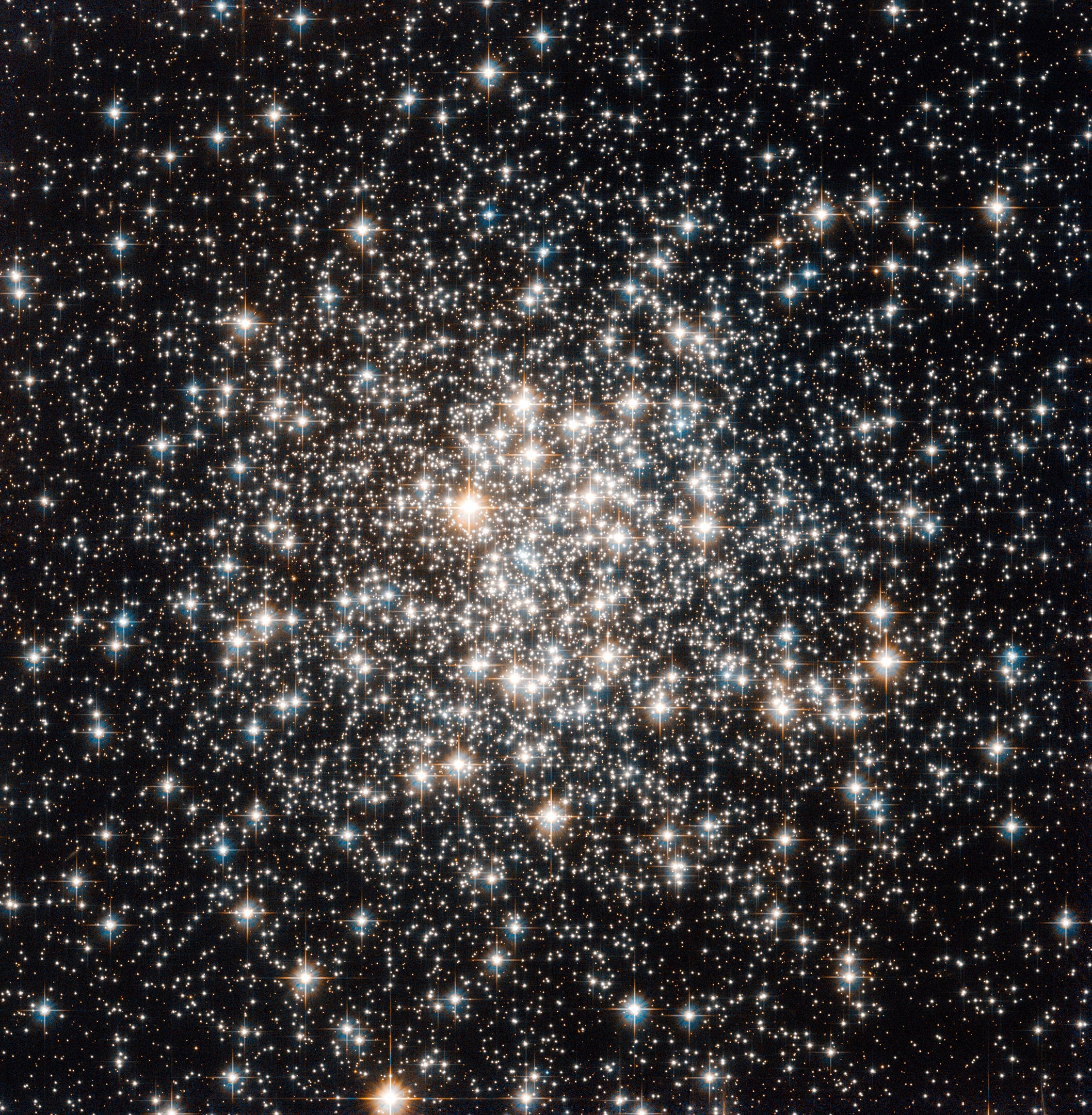
    Discovered in 1782 by Pierre Méchain, a French astronomer and colleague of Charles Messier, M107 was the last Messier object to be found. M104 through M109 were all discovered by Méchain and were considered “Méchain objects” until 1947, when they were added to the Messier catalog. M107 is located 20,000 light-years from Earth in the constellation Ophiuchus. It has an apparent magnitude of 8.9 and can be spotted through a small telescope most easily during July. Credit: ESA/Hubble & NASA

    NASA’s Hubble Space Telescope has captured a new image of globular star cluster Messier 107, which is located in the constellation of Ophiuchus.

    The NASA/ESA Hubble Space Telescope has captured a crowd of stars that looks rather like a stadium darkened before a show, lit only by the flashbulbs of the audience’s cameras. Yet the many stars of this object, known as Messier 107, are not a fleeting phenomenon, at least by human reckoning of time — these ancient stars have gleamed for many billions of years.

    Messier 107 is one of more than 150 globular star clusters found around the disc of the Milky Way galaxy. These spherical collections each contain hundreds of thousands of extremely old stars and are among the oldest objects in the Milky Way. The origin of globular clusters and their impact on galactic evolution remains somewhat unclear, so astronomers continue to study them through pictures such as this one obtained by Hubble.

    As globular clusters go, Messier 107 is not particularly dense. Visually comparing its appearance to other globular clusters, such as Messier 53 or Messier 54, this image reveals that the stars within Messier 107 are not packed as tightly, thereby making its members more distinct like individual fans in a stadium’s stands.

    Messier 107 can be found in the constellation of Ophiuchus (The Serpent Bearer) and is located about 20,000 light-years from the Solar System.

    French astronomer Pierre Méchain first noted the object in 1782, and British astronomer William Herschel documented it independently a year later. A Canadian astronomer, Helen Sawyer Hogg, added Messier 107 to Charles Messier’s famous astronomical catalog in 1947.

    This picture was obtained with the Wide Field Camera of Hubble’s Advanced Camera for Surveys. The field of view is approximately 3.4 by 3.4 arcminutes.

    Never miss a breakthrough: Join the SciTechDaily newsletter.
    Follow us on Google and Google News.

    Astronomy Galaxy Globular Cluster Hubble Space Telescope NASA Popular
    Share. Facebook Twitter Pinterest LinkedIn Email Reddit

    Related Articles

    A Real ‘Galactic Portal’ – This Is an Actual Hubble Picture, Not CGI

    Hubble Snaps Spiral Galaxy’s Profile – From Hydra Constellation, 80 Million Light-Years Away

    Hubble Image of the Week – A Distinctly Disorganized Dwarf Galaxy

    Hubble Views Spiral Galaxy NGC 3344

    Hubble Zooms in on the Center of M4

    Hubble Image of Peculiar Galaxy Pair Arp 116

    Hubble Views Globular Cluster Messier 56

    Hubble Views the Needle Galaxy, NGC 4565

    Hubble Captures New Image of Messier 9

    Leave A Reply Cancel Reply

    • Facebook
    • Twitter
    • Pinterest
    • YouTube

    Don't Miss a Discovery

    Subscribe for the Latest in Science & Tech!

    Trending News

    One of the Universe’s Largest Stars May Be Getting Ready To Explode

    Scientists Discover Enzyme That Could Supercharge Ozempic-Like Weight Loss Drugs

    Popular Sweetener Linked to DNA Damage – “It’s Something You Should Not Be Eating”

    Ancient “Rock” Microbes May Reveal How Complex Life Began

    Researchers Capture Quantum Interference in One of Nature’s Rarest Atoms

    “A Plague Is Upon Us”: The Mass Death That Changed an Ancient City Forever

    Scientists Discover Game-Changing New Way To Treat High Cholesterol

    This Small Change to Your Exercise Routine Could Be the Secret to Living Longer

    Follow SciTechDaily
    • Facebook
    • Twitter
    • YouTube
    • Pinterest
    • Newsletter
    • RSS
    SciTech News
    • Biology News
    • Chemistry News
    • Earth News
    • Health News
    • Physics News
    • Science News
    • Space News
    • Technology News
    Recent Posts
    • After 60 Years, Scientists Uncover Unexpected Brain Effects of Popular Diabetes Drug Metformin
    • New Research Uncovers Hidden Side Effects of Popular Weight-Loss Drugs
    • Scientists Rethink Extreme Warming After Surprising Ocean Discovery
    • The Surprising Role of Asteroids in the Origin of Life
    • Scientists Raise Concerns Over Newly Recognized Pollutant Found Everywhere in the Air
    Copyright © 1998 - 2026 SciTechDaily. All Rights Reserved.
    • Science News
    • About
    • Contact
    • Editorial Board
    • Privacy Policy
    • Terms of Use

    Type above and press Enter to search. Press Esc to cancel.