
Close Menu
    Facebook X (Twitter) Instagram
    SciTechDaily
    • Biology
    • Chemistry
    • Earth
    • Health
    • Physics
    • Science
    • Space
    • Technology
    Facebook X (Twitter) Pinterest YouTube RSS
    SciTechDaily
    Home»Space»Hubble Views Globular Cluster Palomar 2
    Space

    Hubble Views Globular Cluster Palomar 2

    By European Space AgencyApril 22, 2013No Comments2 Mins Read
    Facebook Twitter Pinterest Telegram LinkedIn WhatsApp Email Reddit
    Share
    Facebook Twitter LinkedIn Pinterest Telegram Email Reddit
    Hubble Views Globular Cluster Palomar 2
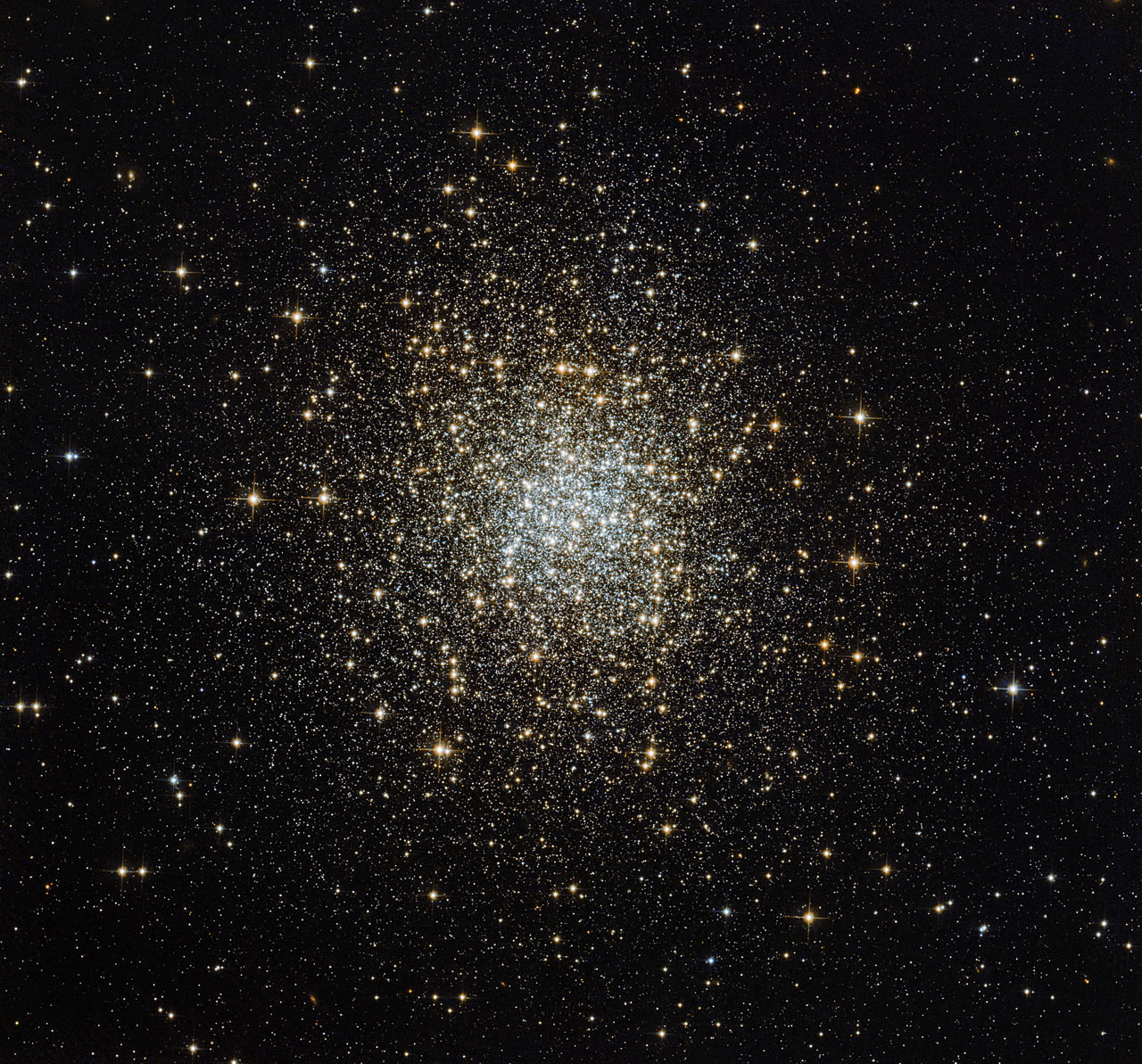
    Hubble Space Telescope image of globular cluster Paloma. Credit: ESA/NASA, Hubble

    In this image, the Hubble Space Telescope shows globular cluster Palomar 2, which is part of a group of 15 globulars known as the Palomar clusters.

    Palomar 2 is part of a group of 15 globulars known as the Palomar clusters. These clusters, as the name suggests, were discovered in survey plates from the first Palomar Observatory Sky Survey in the 1950s, a project that involved some of the most well-known astronomers of the day, including Edwin Hubble. They were discovered quite late because they are so faint — each is either extremely remote, very heavily hidden behind blankets of dust, or has a very small number of remaining stars.

    This particular cluster is unique in more than one way. For one, it is the only globular cluster that we see in this part of the sky, the northern constellation of Auriga (The Charioteer). Globular clusters orbit the center of a galaxy like the Milky Way in the same way that satellites circle around the Earth. This means that they normally lie closer in to the galactic center than we do, and so we almost always see them in the same region of the sky. Palomar 2 is an exception to this, as it is around five times further away from the center of the Milky Way than other clusters. It also lies in the opposite direction — further out than Earth — and so it is classed as an “outer halo” globular.

    It is also unusual due to its apparent dimness. The cluster is veiled by a mask of dust, dampening the apparent brightness of the stars within it and making it appear as a very faint burst of stars. The stunning NASA/ESA Hubble Space Telescope image shows Palomar 2 in a way that could not be captured from smaller or ground-based telescopes — some amateur astronomers with large telescopes attempt to observe all of the obscure and well-hidden Palomar 15 as a challenge, to see how many they can pick out from the starry sky.

    Never miss a breakthrough: Join the SciTechDaily newsletter.
    Follow us on Google and Google News.

    Astronomy European Space Agency Globular Cluster Hubble Space Telescope NASA
    Share. Facebook Twitter Pinterest LinkedIn Email Reddit

    Related Articles

    Newly Released Hubble Image of Globular Cluster NGC 1783

    New Hubble Image of One of the Oldest Known Globular Clusters

    Hubble Zooms in on the Center of M4

    Hubble Helps Solve the Mystery of Why Ultra-Faint Dwarf Galaxies Contain Few Stars

    Herbig-Haro 110, A Geyser of Hot Gas Flowing from a Newborn Star

    Hubble Space Telescope Views the Globular Cluster Messier 10

    Hubble Captures Image of Compact Blue Dwarf Galaxy UGC 5497

    A Spiral Within a Spiral, Galaxy ESO 498-G5

    Hubble Captures New Image of Messier 9

    Leave A Reply Cancel Reply

    • Facebook
    • Twitter
    • Pinterest
    • YouTube

    Don't Miss a Discovery

    Subscribe for the Latest in Science & Tech!

    Trending News

    Popular Sugar-Free Sweetener Linked to Liver Disease, Study Warns

    What Is Hantavirus? The Deadly Disease Raising Alarm Worldwide

    Scientists Just Discovered How the Universe Builds Monster Black Holes

    Scientists Unveil New Treatment Strategy That Could Outsmart Cancer

    A Simple Vitamin May Hold the Key to Treating Rare Genetic Diseases

    Scientists Think the Real Fountain of Youth May Be Hiding in Your Gut

    Ravens Don’t Follow Wolves, They Predict Them

    This Common Knee Surgery May Be Doing More Harm Than Good

    Follow SciTechDaily
    • Facebook
    • Twitter
    • YouTube
    • Pinterest
    • Newsletter
    • RSS
    SciTech News
    • Biology News
    • Chemistry News
    • Earth News
    • Health News
    • Physics News
    • Science News
    • Space News
    • Technology News
    Recent Posts
    • Why Are So Many New Fathers Dying? Scientists Say the U.S. Has a Dangerous Blind Spot
    • Scientists Identify Simple Supplement That Greatly Reduces Alzheimer’s Damage
    • You May Have a Dangerous Type of Cholesterol Even if Your Tests Look Normal
    • Study Reveals Dangerous Flaw in AI Symptom Checkers
    • New MRI Breakthrough Captures Stunningly Clear Images of the Eye and Brain
    Copyright © 1998 - 2026 SciTechDaily. All Rights Reserved.
    • Science News
    • About
    • Contact
    • Editorial Board
    • Privacy Policy
    • Terms of Use

    Type above and press Enter to search. Press Esc to cancel.