
Close Menu
    Facebook X (Twitter) Instagram
    SciTechDaily
    • Biology
    • Chemistry
    • Earth
    • Health
    • Physics
    • Science
    • Space
    • Technology
    Facebook X (Twitter) Pinterest YouTube RSS
    SciTechDaily
    Home»Space»Hubble Views Supermassive Black Hole Blowing Huge Gas Bubbles
    Space

    Hubble Views Supermassive Black Hole Blowing Huge Gas Bubbles

    By SciTechDailyJanuary 16, 2018No Comments2 Mins Read
    Facebook Twitter Pinterest Telegram LinkedIn WhatsApp Email Reddit
    Share
    Facebook Twitter LinkedIn Pinterest Telegram Email Reddit
    Hubble Views Supermassive Black Hole Blowing Huge Bubbles
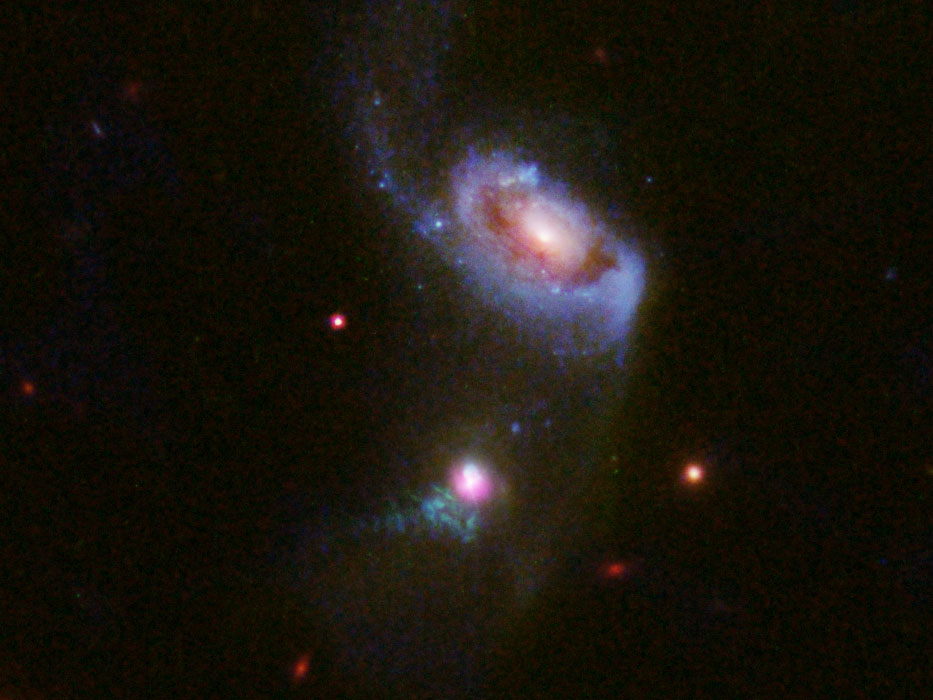
    The image shows a supermassive black hole blowing huge bubbles of hot, bright gas. It is located in the galaxy SDSS J1354+1327, which is 900 million light-years away. Credit: NASA, ESA, and J. Comerford (University of Colorado-Boulder)

    Researchers using a suite of telea supermassive black hole blowing huge bubbles of hot, bright gas — one bubble is currently expanding outwards from the black hole, while another older bubble slowly fades away. This cosmic behemoth sits within the galaxy at the bottom of this image, which lies 900 million light-years from Earth and is known as SDSS J1354+1327. The upper, larger, galaxy is known as SDSS J1354+1328.scopes including the NASA/ESA Hubble Space Telescope have spotted

    Supermassive which can have a mass equivalent to billions of suns, are found in the center of most galaxies (including the Milky Way). These black holes are able to “feed” on their surroundings, causing them to shine brilliantly as Active Galactic Nuclei (AGN). However, this feeding process is not continuous as it depends on how much matter is available for the black hole to consume; if the surrounding material is clumpy and irregular, an AGN can be seen turning “off” and “on,” and flickering over long cosmic timescales.

    This clumpy accretion is what scientists believe has happened with the black hole in SDSS J1354+1327. Scientists believe these two outflows of material are the result of the black hole burping out material after two different feeding events. The first outburst created the fading southern relic: a cone of gas measuring 33,000 light-years across. Around 100,000 years later, a second burst spawned the more compact and radiant outflow emanating from the top of the galaxy: a cone of shocked gas some 3,300 light-years across.

    Never miss a breakthrough: Join the SciTechDaily newsletter.
    Follow us on Google and Google News.

    Astronomy Black Hole Cosmology Hubble Space Telescope
    Share. Facebook Twitter Pinterest LinkedIn Email Reddit

    Related Articles

    Astronomers Discover A Black Hole Disk That Shouldn’t Exist

    Astronomers Directly Image a Black Hole Ripping Apart a Star

    Hubble Reveals a Supermassive Black Hole Kicked Out of Galactic Core

    Astronomers Solve the Mystery of a Rare Change in the Behavior of a Supermassive Black Hole

    Astronomers Discover Clues For How Giant Black Holes Formed So Quickly

    Astronomers Discover a 17 Billion Solar-Mass Black Hole in an Unlikely Place

    New Phoenix Cluster Observations Provide A Fresh Perspective

    Astronomers Discover Supernovae in ‘Wrong Place at Wrong Time’

    Hubble Views Abell 2261, An Elliptical Galaxy With an Unusually Large Core

    Leave A Reply Cancel Reply

    • Facebook
    • Twitter
    • Pinterest
    • YouTube

    Don't Miss a Discovery

    Subscribe for the Latest in Science & Tech!

    Trending News

    Tea or Coffee? Your Daily Choice Could Affect Osteoporosis Risk

    Vitamin C May Fight Cancer in a Surprising Way

    Hidden Earthquake Threat: Oregon’s Fault May Be Closer to the Surface Than Scientists Thought

    Scientists Discover Hidden Sleep Switch That Boosts Brainpower, Builds Muscle, and Burns Fat

    Ancient Mega-Floods Once Ripped Across Mars and Left This Giant Scar

    Scientists Discover Cheap, Natural Remedy for High Blood Pressure

    Earth’s Upper Atmosphere Is Cooling Fast and Scientists Finally Know Why

    32,000 Olympic Pools of Magma Nearly Erupted Beneath Atlantic Island

    Follow SciTechDaily
    • Facebook
    • Twitter
    • YouTube
    • Pinterest
    • Newsletter
    • RSS
    SciTech News
    • Biology News
    • Chemistry News
    • Earth News
    • Health News
    • Physics News
    • Science News
    • Space News
    • Technology News
    Recent Posts
    • Ancient Roman Gold Mines Discovered in Spain’s Pyrenees
    • Ancient DNA Reveals How Farming Spread and Nearly Broke a Civilization
    • 146,000-Year-Old Discovery Rewrites the Story of Human Creativity
    • The Type of Alcohol You Drink Could Affect How Long You Live
    • 19-Year Study Reveals the Surprising Truth About Sitting and Dementia
    Copyright © 1998 - 2026 SciTechDaily. All Rights Reserved.
    • Science News
    • About
    • Contact
    • Editorial Board
    • Privacy Policy
    • Terms of Use

    Type above and press Enter to search. Press Esc to cancel.