
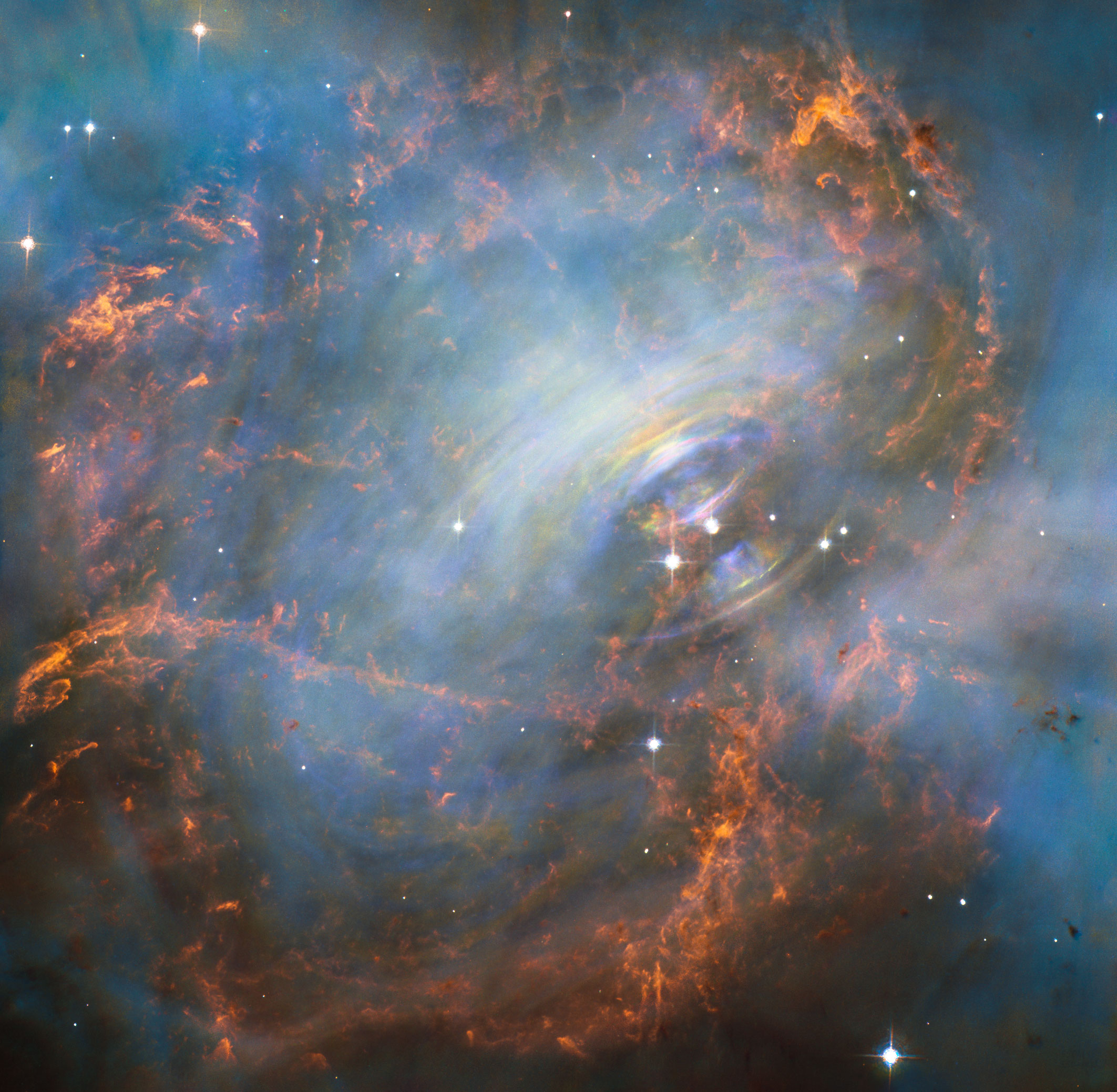
This newly released Hubble image reveals the heart of one of the most visually appealing, and most studied, supernova remnants known — the Crab Nebula. At the center of this nebula, the spinning core of a deceased star breathes life into the gas that surrounds it.
The Crab Nebula, which lies 6,500 light-years away in the constellation of Taurus (The Bull), is the result of a supernova — a colossal explosion that was the dying act of a massive star. During this explosion most of the material that made up the star was blown into space at immense speeds, forming an expanding cloud of gas known as a supernova remnant.
This extraordinary view of the nebula is one that has never been seen before. Unlike many popular images of this well-known object, which highlight the spectacular filaments in the outer regions, this image shows just the inner part of the nebula and combines three separate high-resolution images — each represented in a different color — taken around ten years apart.
At the very center of the Crab Nebula lies what remains of the innermost core of the original star, now a strange and exotic object known as a neutron star. Made entirely of subatomic particles called neutrons, a neutron star has about the same mass as the Sun, but compressed into a sphere only a few tens of kilometers across. A typical neutron star spins incredibly fast and the one at the center of the Crab Nebula is no exception, rotating approximately 30 times per second.
This video zooms into part of the sky in the constellation of Taurus (The Bull) ending on the inner parts of the famous Crab Nebula, a supernova remnant.
The region around a neutron star is a showcase for extreme physical processes and considerable violence. The rapid motion of the material nearest to the star is revealed by the subtle rainbow of colors in this time-lapse image, the rainbow effect being due to the movement of material over the time between one image and another.
Hubble’s sharp eye also captures the intricate details of the ionized gas, shown in red in this image, that forms a swirling medley of cavities and filaments. Inside this shell of ionized gas, a ghostly blue glow surrounds the spinning neutron star. This glow is radiation given off by electrons spiraling in the powerful magnetic field around the star at nearly the speed of light.
The supernova explosion from which the Crab Nebula was born was one of the first to be recorded in human history. This has made the Crab Nebula an invaluable object for the study of supernova remnants and has enabled astronomers to probe the lives and deaths of stars as never before.
This fulldome clip of the Crab Nebula allows for a close inspection of one of the most intricate and fascinating objects in our galaxy. This complicated web of gas and dust is what remains of a star which exploded and lit up the skies of Earth in 1054, as documented by Chinese astronomers at the time.
Never miss a breakthrough: Join the SciTechDaily newsletter.
Follow us on Google and Google News.
1 Comment
Crab Nebula was once a shining star for us some centuries ago which thereafter became very dull and not brilliant star because of the super nova explosion which happened there at that time. It is nice to recapture the grandeur of the crab nebula now with the help of Hubble telescope.Thank You.