
Russian researchers have discovered that most high-energy neutrinos originate from quasars, redefining their assumed sources and challenging existing models.
Scientists of the P. N. Lebedev Physical Institute of the Russian Academy of Sciences (LPI RAS), the Moscow Institute of Physics and Technology (MIPT), and the Institute for Nuclear Research of RAS (INR RAS) studied the arrival directions of astrophysical neutrinos with energies more than a trillion electronvolts (TeV) and came to an unexpected conclusion: all of them are born near black holes in the centers of distant active galaxies powerful radio sources. Previously, only neutrinos with the highest energies were assumed to be obtained in sources of this class.
It is believed that there are massive black holes in the centers of active galaxies in our universe. They are the heart of these objects with a luminosity of hundreds of millions of suns. Active galaxies, which are also “simply” quasars, are clearly visible from the Earth with both optical and radio telescopes.
Earlier, Russian scientists Alexander Plavin, Sergey Troitsky and the Kovalevs (father and son, both Yuri) have found a connection between the origin of neutrinos of the highest energies (above 200 trillion electronvolts, that is, TeV) and radio quasars. This was quite surprising, because theoretical papers of the 1990s indicated that astrophysical neutrinos would only be born at energies above 1000 TeV.
Detecting the Undetectable: IceCube and Baikal GVD
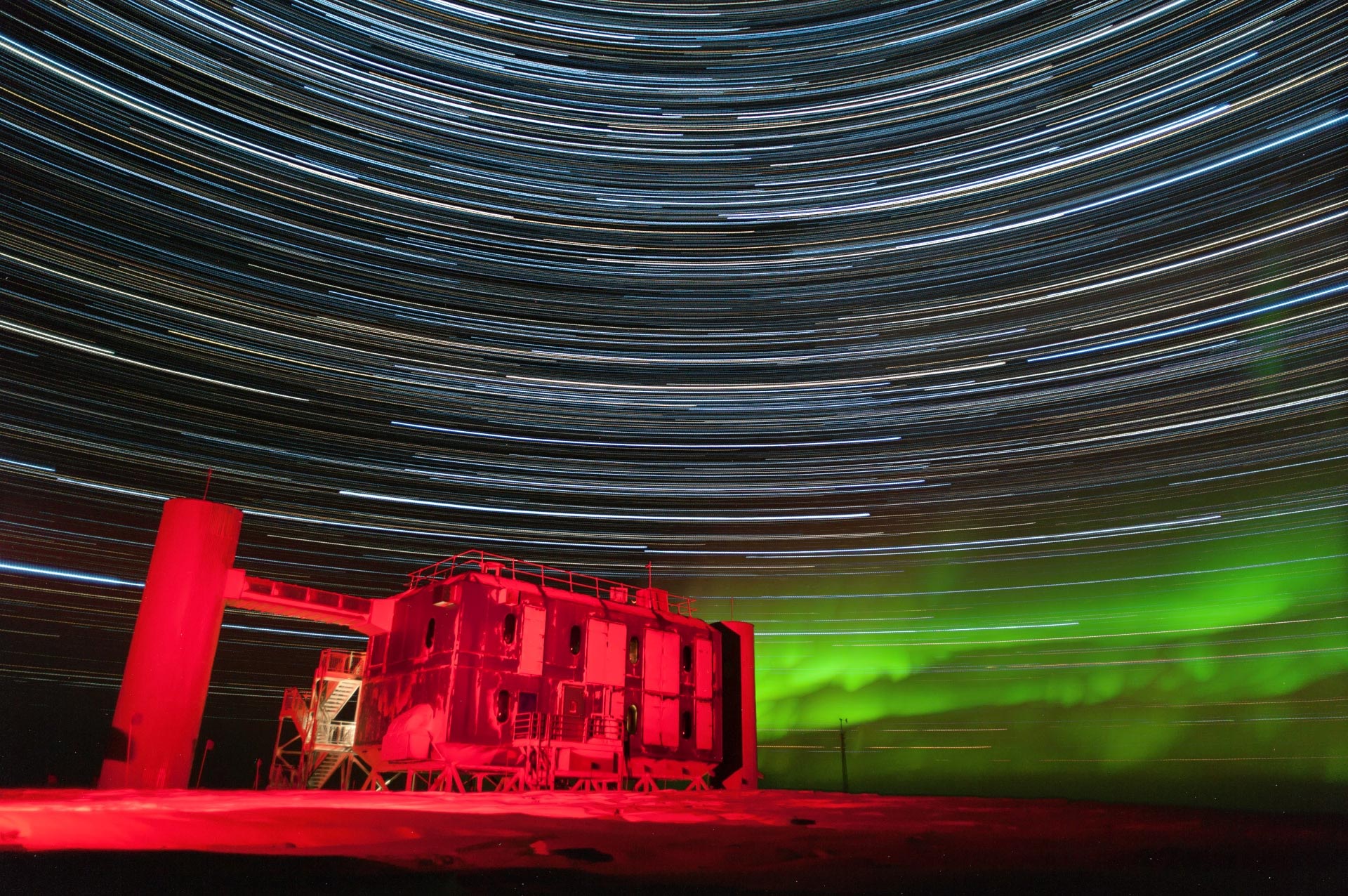
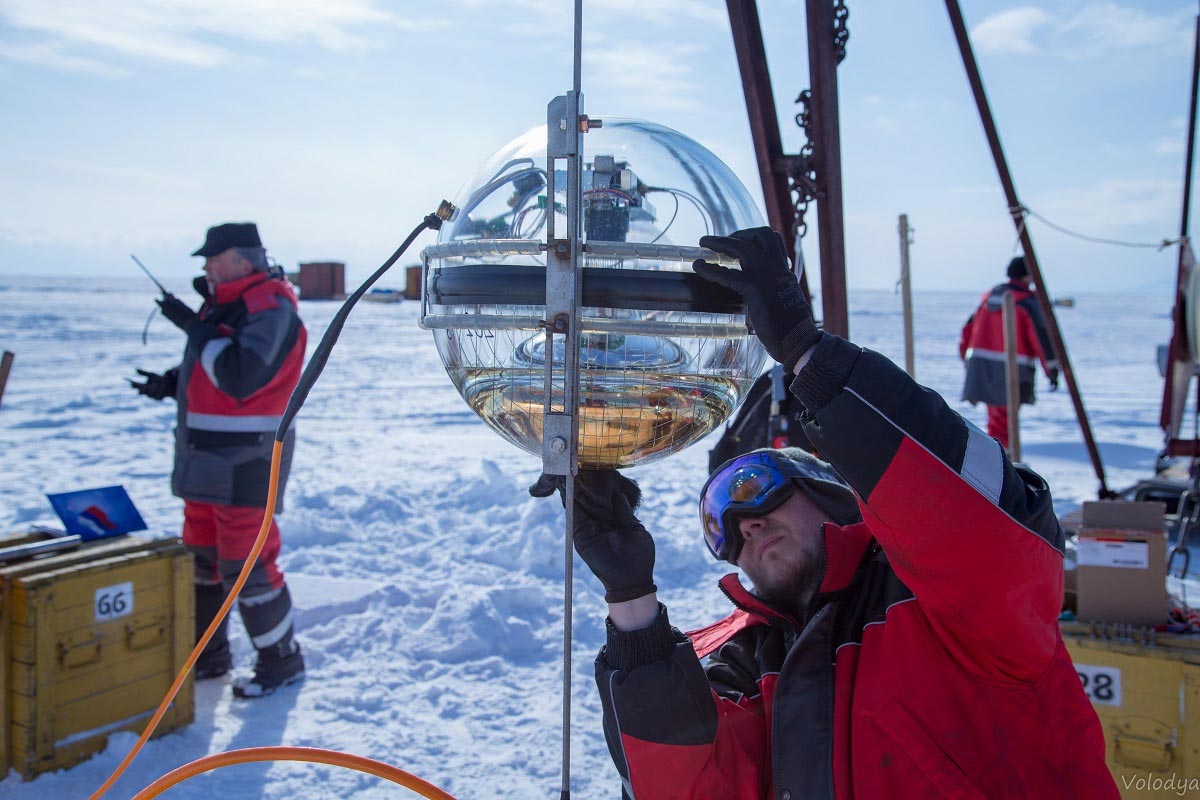
Neutrinos are tiny elementary particles with a mass barely above zero, but they can cross the universe without interacting with matter and without any delays on their way. Millions of neutrinos per second pass through every person on Earth, completely unnoticed. To register neutrinos, an international collaboration of scientists has built a special ice telescope in Antarctica: the Cherenkov IceCube detector with a volume of 1 cubic kilometer. In Russia, INR RAS and JINR are now completing the construction of the Baikal GVD water telescope in Lake Baikal, the volume of which has already reached 0.4 cubic kilometers. Now data acquisition is underway on the running part of the facility, which had already been put into operation. These installations study the sky in different hemispheres: North and South.
After analyzing data collected over 7 years on the IceCube telescope, the scientists initially chose to analyze a range above 200 TeV to study which direction these neutrinos came from. It turned out that a significant part of them was born in quasars, identified by radio telescopes by their high brightness. More precisely, neutrinos were born somewhere in the centers of quasars. There are massive black holes feeding their accretion disks, as well as ultra-fast ejections of very hot gas. Moreover, there is a connection between the powerful bursts of radio emission in these quasars and the registration of neutrinos by the Ice Cube telescope. Since neutrinos travel through the universe at the speed of light, flares come to us at the same time as neutrinos.

Now in their new article published in The Astrophysical Journal, Russian scientists argue that neutrinos of energies in the tens of TeV are also emitted by quasars. As a result, it turns out that all — well, almost all — high-energy astrophysical neutrinos are born in quasars. Note, in addition to them, there are neutrinos that are born in the earth’s atmosphere, and even in the Ice Cube detector itself during the interaction of cosmic rays with matter.
A Fresh Theory for Low-Energy Neutrino Creation
“It is amazing, since for the production of neutrinos with energies that differ by a factor of 100-1000 different physical conditions are required. The mechanisms of neutrino production in active galactic nuclei discussed earlier worked only at high energies. We have proposed a new mechanism for neutrino production in quasars, which explains the results obtained. While this is an approximate model, it is necessary to work on it, to carry out computer simulation,” says the chief researcher of INR RAS, corresponding member of the Russian Academy of Sciences Sergey Troitsky. The co-author of the discovery from LPI and MIPT, corresponding member of the Russian Academy of Sciences, Yuri Kovalev, explained the results in the program Hamburg Account on OTR.

In September 2020, a consortium led by the Institute for Nuclear Research of the Russian Academy of Sciences won a three-year grant from the Ministry of Education and Science with funding of 100 million rubles per year on the topic “Neutrino and Astrophysics of Particles.” Seven organizations united together: INR RAS, JINR, LPI, MIPT, SAO RAS, SAI MSU, Irkutsk State University. About 100 scientists will work on solving the problem of the origin of neutrinos, as well as studying their properties. The project also includes other studies aimed at understanding the nature of high-energy astrophysical neutrinos, including the search for photons of the same energy range at the Carpet-3 installation of the Baksan Neutrino Observatory, INR RAS (North Caucasus).
The connection between neutrinos and radio quasars has aroused great interest in the world. The joint work of Russian scientists with the ANTARES neutrino experiment in the Mediterranean Sea begins. A recent article by European and American scientists independently confirmed the discovery of the Russian team using radio telescope data in the United States and Finland. New events of the arrival of astrophysical neutrinos are now tracked by the world’s largest radio telescopes and antenna arrays.
In 2021, Russian scientists will collect the first data from the Baikal GVD telescope and analyze it together with the data from RATAN-600 and the world’s radio telescope networks, which will allow them to examine the centers of quasars in detail. A lot of interesting things await us.
Credit: “Directional Association of TeV to PeV Astrophysical Neutrinos with Radio Blazars” by A. V. Plavin, Y. Y. Kovalev, Yu. A. Kovalev and S. V. Troitsky, 19 February 2021, The Astrophysical Journal.
DOI: 10.3847/1538-4357/abceb8
Never miss a breakthrough: Join the SciTechDaily newsletter.
Follow us on Google and Google News.