
Scientists have used a technique called astrometry to directly image one of the lowest-mass planets, AF Lep b, orbiting a young Sun-like star. This method could revolutionize the way we discover extrasolar planets, especially those that are challenging to detect due to their distance, mass, or orientation relative to Earth.
Astronomers using W. M. Keck Observatory on Maunakea, Hawaiʻi Island have discovered one of the lowest-mass planets whose images have been directly captured. Not only were they able to measure its mass, but they were also able to determine that its orbit is similar to the giant planets in our own solar system.
The planet, called AF Lep b, is among the first ever discovered using a technique called astrometry; this method measures the subtle movements of a host star over many years to help astronomers determine whether hard-to-see orbiting companions, including planets, are gravitationally tugging at it.
The study, led by astronomy graduate student Kyle Franson at the University of Texas at Austin (UT Austin), is published in the Astrophysical Journal Letters.
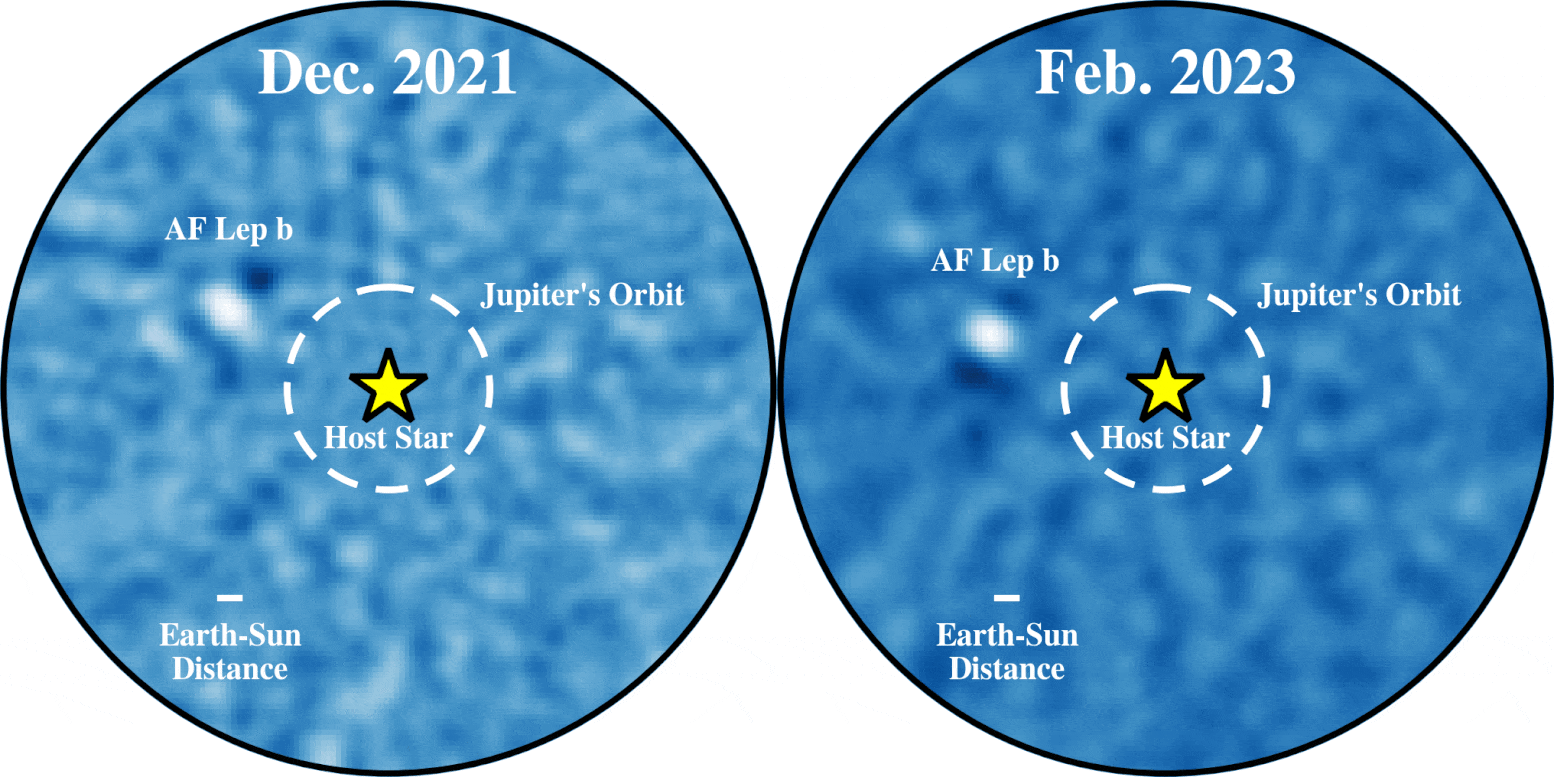
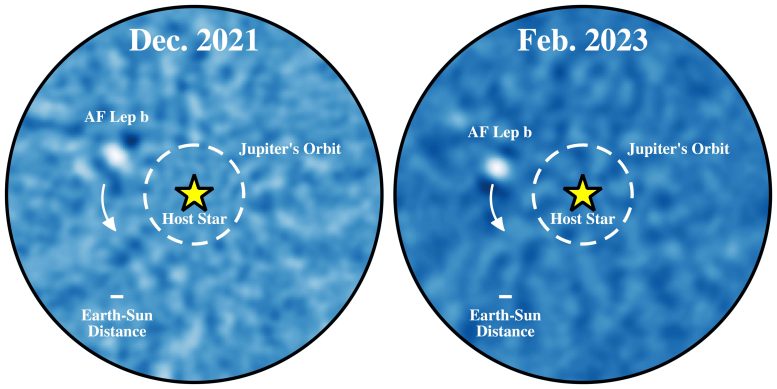
“When we processed the observations using the Keck II telescope in real time to carefully remove the glare of the star, the planet immediately popped out and became increasingly apparent the longer we observed,” said Franson.
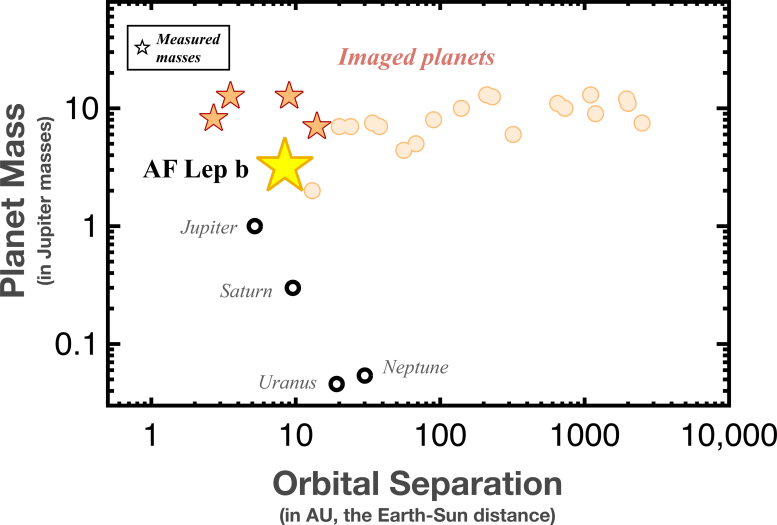
The direct images Franson’s team captured revealed that AF Lep b is about three times the mass of Jupiter and orbits AF Leporis, a young Sun-like star about 87.5 light-years away. They took a series of deep images of the planet starting in December 2021; two other teams also captured images of the same planet since then.
Revolutionizing Exoplanet Discovery with New Methods
“This is the first time this method has been used to find a giant planet orbiting a young analog of the Sun,” said Brendan Bowler, an assistant professor of astronomy at UT Austin and senior author on the study. “This opens the door to using this approach as a new tool for exoplanet discovery.”
Despite having a much smaller mass than its host star, an orbiting planet causes a star’s position to wobble slightly around the center of mass of the planetary system. Astrometry uses this shift in a star’s position on the sky relative to other stars to infer the existence of orbiting planets. Franson and Bowler identified the star AF Leporis as one that might harbor a planet, given the way it had moved during 25 years of observations from the Hipparcos and Gaia satellites.
To directly image the planet, the UT Austin team used Keck Observatory’s adaptive optics system, which corrects for fluctuations caused by turbulence in Earth’s atmosphere, paired with the Keck II Telescope’s Near-Infrared Camera 2 (NIRC2) Vector Vortex Coronagraph, which suppresses light from the host star so the planet could be seen more clearly. AF Lep b is about 10,000 times fainter than its host star and is located about 8 times the Earth-Sun distance.
A Breakthrough in Planet Hunting Efficiency
“Imaging planets is challenging,” Franson said. “We only have about 15 examples, and we think this new ‘dynamically informed’ approach made possible by the Keck II telescope and NIRC2 adaptive optics imaging will be much more efficient compared to blind surveys which have been carried out for the past two decades.”
The two most common ways of finding extrasolar planets involve observing slight, periodic dimming of the starlight if a planet happens to regularly pass in front of the star— like a moth spiraling around a porch light — and measuring minute changes in the frequencies of starlight that result from the planet tugging the star back and forth along the direction to Earth. Both methods tend to work best with large planets orbiting close to their host stars, and both methods are indirect: we don’t see the planet, we only see how it influences the star.
The method of combining direct imaging with astrometry could help astronomers find extrasolar planets that were hard to find before with other methods because they were too far from their host star, were too low mass, or didn’t have orbits that were edge-on as seen from Earth. Another benefit of this technique is that it allows astronomers to directly measure a planet’s mass, which is difficult with other methods at wide orbital distances.
Bowler said the team plans to continue studying AF Lep b.
“This will be an excellent target to further characterize with the James Webb Space Telescope and the next generation of large ground-based telescopes like the Giant Magellan Telescope and the Thirty Meter Telescope,” Bowler said. “We’re already planning more sensitive follow-up efforts at longer wavelengths to study the physical properties and atmospheric chemistry of this planet.”
Reference: “Astrometric Accelerations as Dynamical Beacons: A Giant Planet Imaged inside the Debris Disk of the Young Star AF Lep” by Kyle Franson, Brendan P. Bowler, Yifan Zhou, Tim D. Pearce, Daniella C. Bardalez Gagliuffi, Lauren I. Biddle, Timothy D. Brandt, Justin R. Crepp, Trent J. Dupuy, Jacqueline Faherty, Rebecca Jensen-Clem, Marvin Morgan, Aniket Sanghi, Christopher A. Theissen, Quang H. Tran and Trevor N. Wolf, 22 June 2023, Astrophysical Journal Letters.
DOI: 10.3847/2041-8213/acd6f6
NASA Keck time is administered by the NASA Exoplanet Science Institute. Data presented herein were obtained at the W. M. Keck Observatory from telescope time allocated to the National Aeronautics and Space Administration through the agency’s scientific partnership with the California Institute of Technology and the University of California.
Never miss a breakthrough: Join the SciTechDaily newsletter.
Follow us on Google and Google News.