
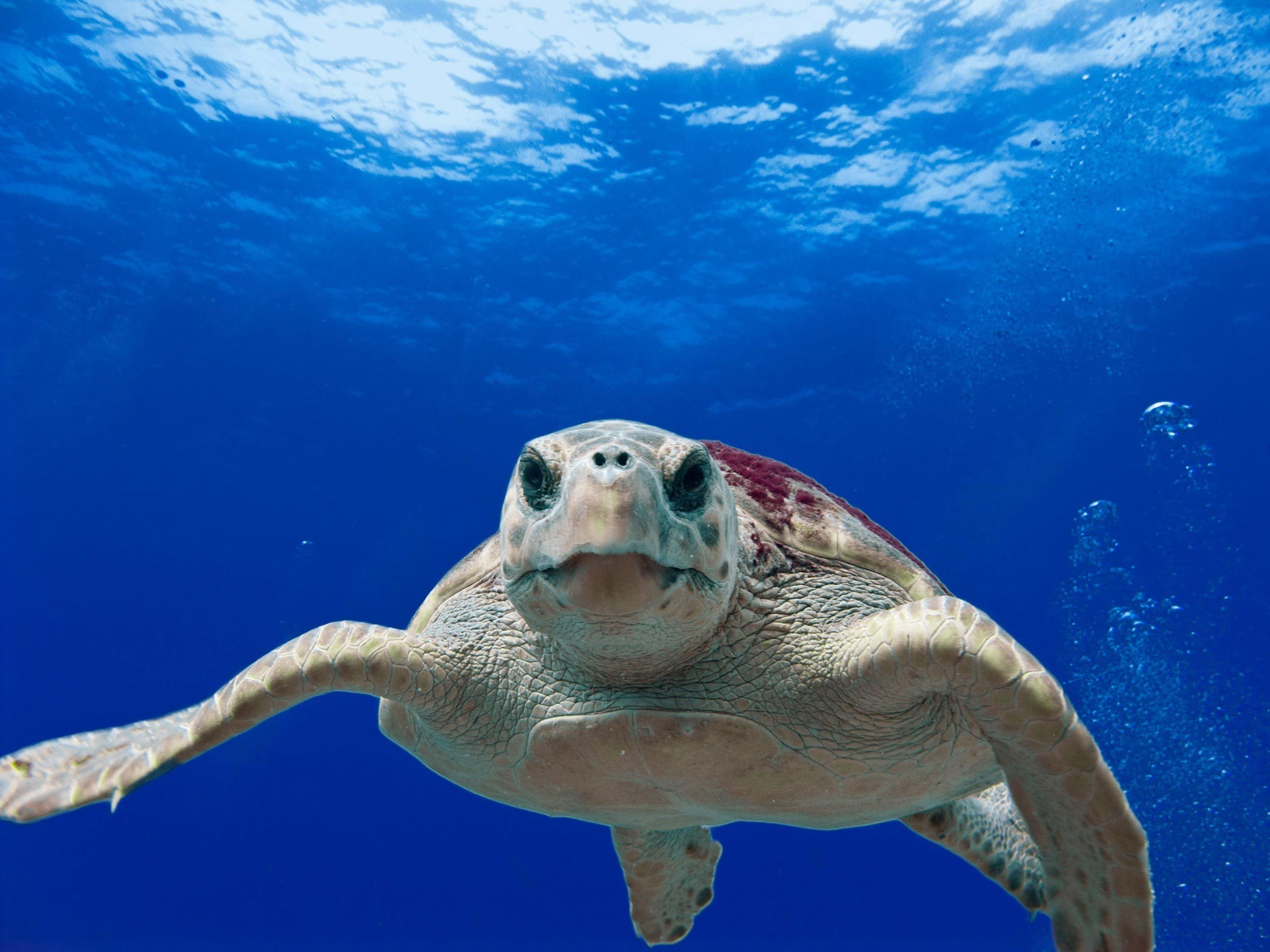
North Pacific loggerhead turtles’ years-long oceanic journeys remain poorly understood. Using data from satellite tracking and other techniques, scientists reveal a unique phenomenon that may explain the endangered migrants’ pathway.
“Not all those who wander are lost … ”
J.R.R. Tolkien
Known as “the lost years,” it is a little-understood journey that unfolds over thousands of miles and as much as two decades or more. Now, a Stanford-led study illuminates the secrets of the North Pacific loggerhead turtles’ epic migration between their birthplace on the beaches of Japan and reemergence years later in foraging grounds off the coast of Baja California. The study, published April 8 in Frontiers in Marine Science, provides evidence for intermittent passages of warm water that allow sea turtles to cross otherwise inhospitably cold ocean barriers. The findings could help inform the design of conservation measures to protect sea turtles and other migratory sea creatures amid climatic changes that are altering their movements.
“For decades, our ability to connect the migratory dots for this endangered species has remained elusive,” said study lead author Dana Briscoe, who was a research associate at the Stanford Woods Institute for the Environment during the research and now works at the Cawthron Institute, New Zealand’s largest independent marine science organization. “This work builds on the backbone of exceptional research about these ‘lost years,’ and for the first time ever we are excited to provide evidence of a ‘thermal corridor’ to explain a longstanding mystery of one of the ocean’s greatest migrants.”
Endangered Migrants
Wildlife seekers thrill by the sight of sea turtles, but ship traffic, fishing nets, and other perils have been less kind. The International Union for Conservation of Nature lists six of the seven sea turtle species as critically endangered, endangered, or vulnerable.
Despite scientific advancements in core habitat use, we still know precious little about the movement of turtles and other long-lived sea creatures between disparate locations. This knowledge gap makes it impossible to effectively assess and protect these species.
The researchers wanted to know how and why some loggerheads travel to the western coastline of North America while others remain in the central Pacific Ocean. How is it that some sea turtles – creatures highly sensitive to temperature – can cross a frigid zone called the Eastern Pacific Barrier between the two ocean regions that normally stops most creatures in their tracks?
To unlock that mystery, the researchers created the largest dataset on satellite-tagged loggerhead sea turtles ever compiled, employed sophisticated remote sensing oceanographic techniques, and collected one of the first detailed records of sea turtle aging and stable isotope testing – a bone analysis that can be used to provide information about an animal’s life. The work relied upon decades of research by the international team of scientists.
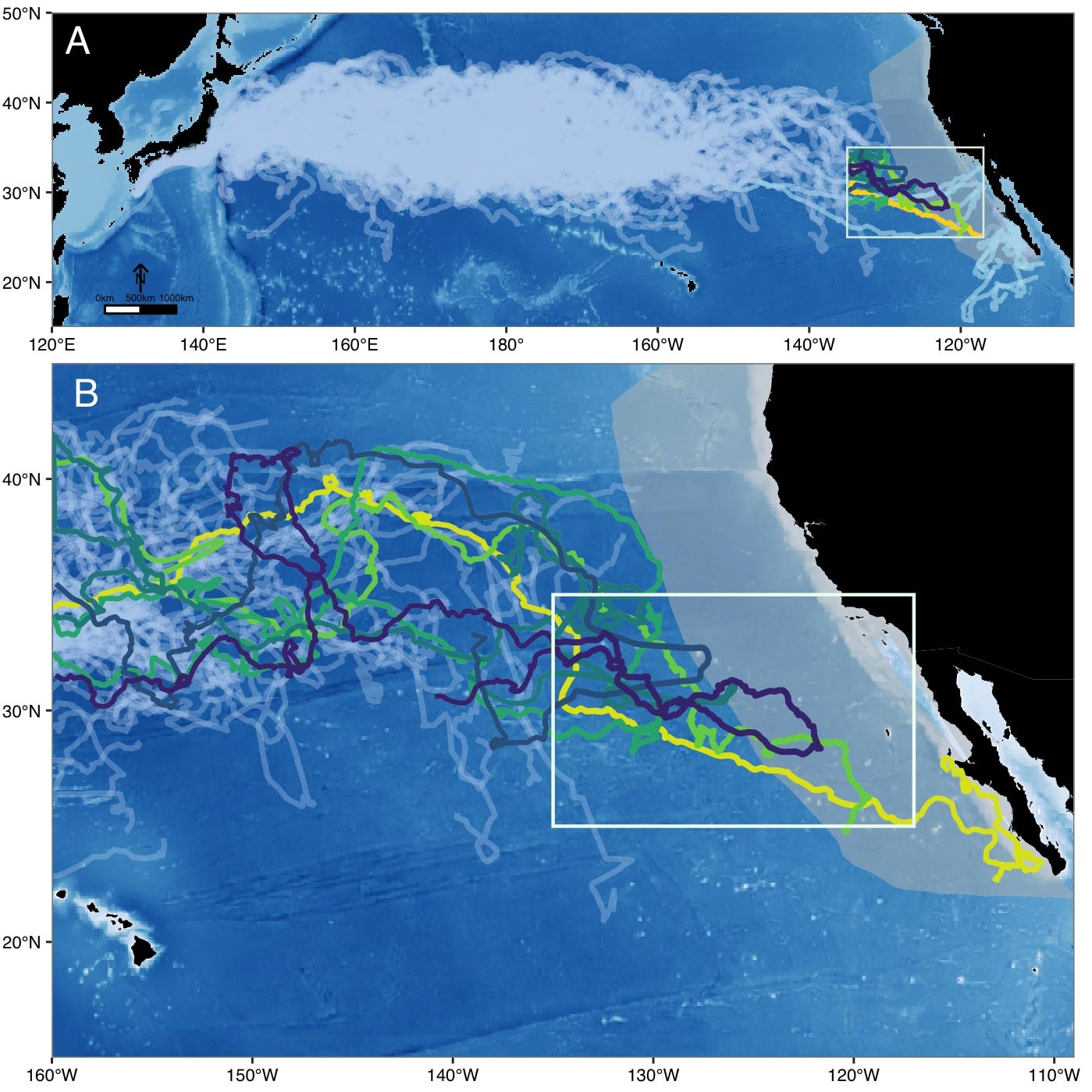
They started by looking at a 15-year study tracking the movements of more than 200 turtles tagged with satellite tracking devices. Six of the turtles caught the researchers’ attention because – unlike their peers – they made distinct movements toward the North American coast. Adding to the intrigue, the “sentinels,” as the researchers called them, made their journey during the early spring months. A look at remotely sensed ocean conditions for the time period showed that the farthest-roaming of the sentinels swam through water significantly warmer than their peers had confronted on their travels.
A bigger picture analysis involved identifying the years loggerheads arrived in Baja California by measuring stable isotope “fingerprints” in the bones of sea turtles stranded on beaches there. Because like us, turtles are what they eat, these stable isotope signatures can reveal when the turtles transitioned from the open sea to the coast. The analysis showed significantly greater annual numbers of eastward-bound sea turtles during warm ocean conditions.
The likely cause, according to the researchers: the development of a “thermal corridor” from unusually warm sea surface temperatures due to El Niño and other intermittent warming conditions that allowed the turtles to cross the Eastern Pacific Barrier to coastal foraging grounds.
The corridor was present during the late spring and summer, and was also preceded by early warming of temperatures in the months before it opened. Such anomalous conditions, especially if sustained for several months, may provide key environmental cues to sea turtles and other animals concentrated in the eastern edge of the central Pacific that the thermal corridor is opening. Studies combining data from loggerhead aerial surveys, at-sea-sightings, stranding records, and tissue samples supported the hypothesis.
A Dangerous Trend
The phenomenon may be part of a trend. As the planet undergoes unprecedented climate changes, locations once considered impassable obstacles to species movements, like the Eastern Pacific Barrier, are being redefined. This, in turn, is shifting the distributions and migratory pathways of creatures ranging from sea birds to white sharks and presenting new conservation challenges.
For the North Pacific loggerhead, the trend could mean higher exposure to bycatch – unintentional fisheries harvest – off the Baja California coast and other potentially important North American foraging grounds, including the Southern California Bight. The study provides important insights, such as an understanding of how animal movements relate to climate variation, that could help predict when sea turtles and other protected species could be vulnerable to such threats.
The researchers caution that their multi-year dataset represents only a snapshot of an important developmental period for sea turtles. The small number of turtles that moved into the eastern North Pacific limits the ability to fully test the study’s hypothesis under varying conditions. To do that, the researchers call for more satellite tagging and stable isotope studies of turtle bones in this region.
“Understanding how and why species like the North Pacific loggerhead move among habitats is crucial to helping them navigate threats,” said study senior author Larry Crowder, the Edward Ricketts Provostial Professor at Stanford’s Hopkins Marine Station. “Emerging technologies and analyses can help illuminate these journeys.”
Reference: “Dynamic Thermal Corridor May Connect Endangered Loggerhead Sea Turtles Across the Pacific Ocean” by Dana K. Briscoe, Calandra N. Turner Tomaszewicz, Jeffrey A. Seminoff, Denise M. Parker, George H. Balazs, Jeffrey J. Polovina, Masanori Kurita, Hitoshi Okamoto, Tomomi Saito, Marc R. Rice and Larry B. Crowder, 8 April 2021, Frontiers in Marine Science.
DOI: 10.3389/fmars.2021.630590
Crowder is also a professor of biology in the School of Humanities and Sciences and a senior fellow at the Stanford Woods Institute for the Environment. Co-authors of the study include Calandra Turner Tomaszewicz and Jeffrey A. Seminoff of the NOAA National Marine Fisheries Service; Denise Parker and George Balazs of Golden Honu Services of Oceania; Jeffrey Polovina of the University of Hawai‘i at Mānoa; Masanori Kurita and Hitoshi Okamoto of the Port of Nagoya Public Aquarium (Japan); Tomomi Saito of Kōchi University (Japan); and Marc Rice of Hawai‘i Preparatory Academy.
Funding for this study provided by the Crowder Lab at Stanford’s Hopkins Marine Station, the National Marine Fisheries Service, the National Academy of Sciences, Stanford’s Department of Biology and the Stanford Woods Institute for the Environment.
Never miss a breakthrough: Join the SciTechDaily newsletter.
Follow us on Google and Google News.