
Close Menu
    Facebook X (Twitter) Instagram
    SciTechDaily
    • Biology
    • Chemistry
    • Earth
    • Health
    • Physics
    • Science
    • Space
    • Technology
    Facebook X (Twitter) Pinterest YouTube RSS
    SciTechDaily
    Home»Space»India’s Vikram Lander Crash Site Found on Moon [Images]
    Space

    India’s Vikram Lander Crash Site Found on Moon [Images]

    By NASA's Goddard Space Flight CenterDecember 2, 2019No Comments3 Mins Read
    Facebook Twitter Pinterest Telegram LinkedIn WhatsApp Email Reddit
    Share
    Facebook Twitter LinkedIn Pinterest Telegram Email Reddit
    Vikram Lander Impact Point and Debris Field
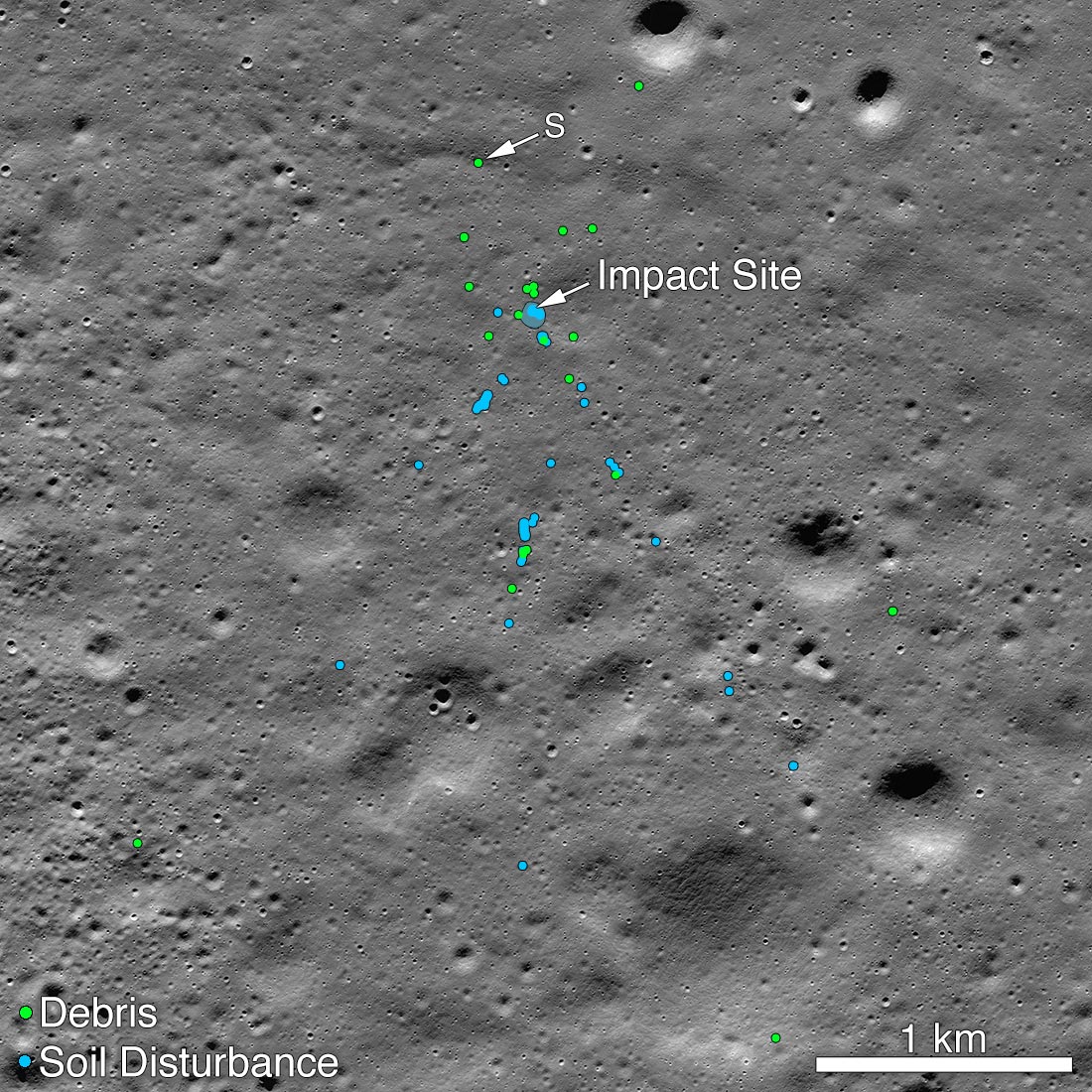
    This image shows the Vikram Lander impact point and associated debris field. Green dots indicate spacecraft debris (confirmed or likely). Blue dots locate disturbed soil, likely where small bits of the spacecraft churned up the regolith. “S” indicates debris identified by Shanmuga Subramanian. This portion of the Narrow Angle Camera mosaic was made from images M1328074531L/R and M1328081572L/R acquired November 11, 2019.
    Credit: NASA/Goddard/Arizona State University.

    The Chandrayaan 2 Vikram lander was targeted for a highland smooth plain about 600 kilometers (3,700 miles) from the south pole; unfortunately, the Indian Space Research Organisation (ISRO) lost contact with their lander shortly before the scheduled touchdown (September 7 in India, September 6 in the United States). Despite the loss, getting that close to the surface was an amazing achievement.

    The Lunar Reconnaissance Orbiter Camera team released the first mosaic (acquired September 17) of the site on September 26 and many people have downloaded the mosaic to search for signs of Vikram. Shanmuga Subramanian contacted the LRO project with a positive identification of debris. After receiving this tip, the LROC team confirmed the identification by comparing before and after images.
    Vikram Impact After Before Ratio
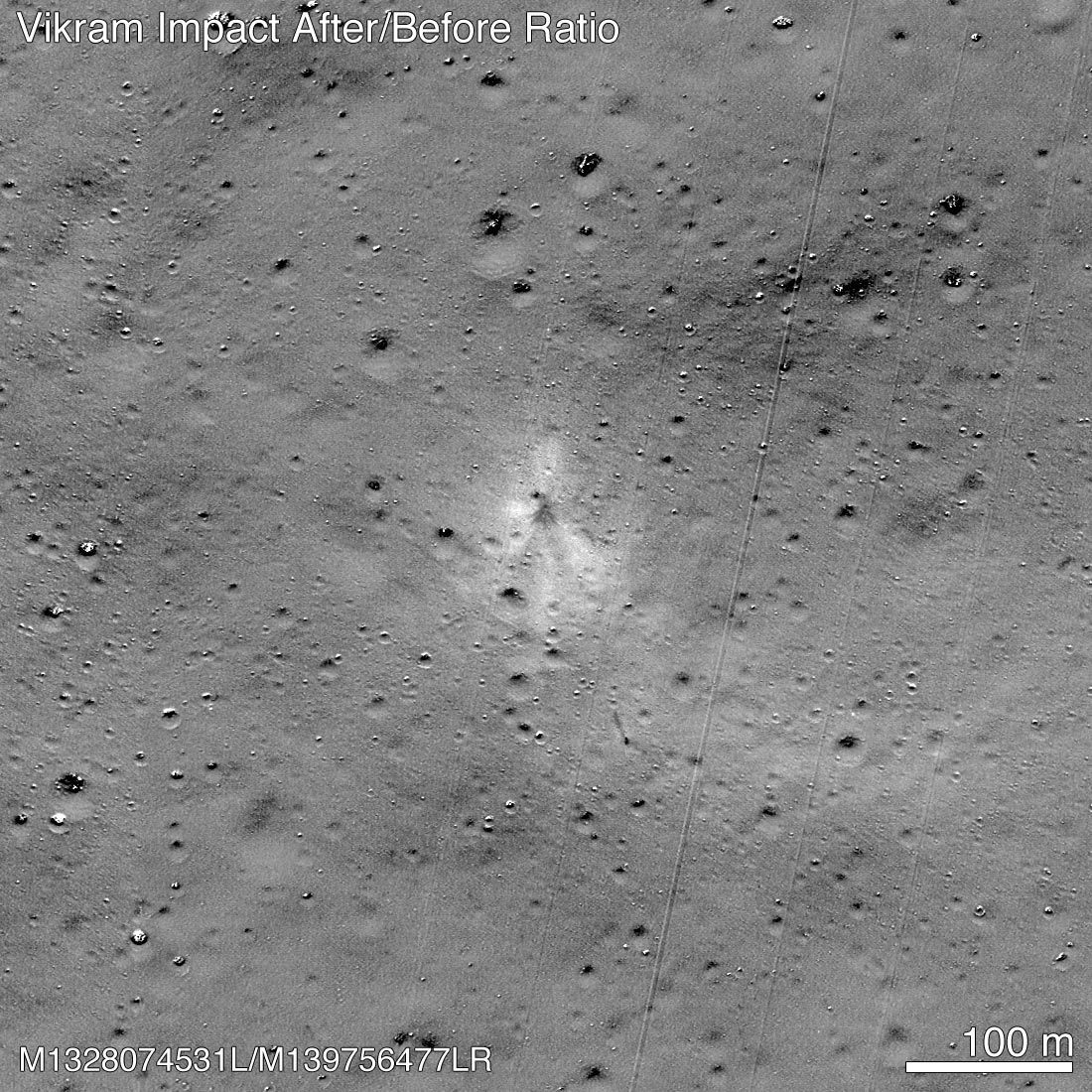
    This before and after image ratio highlights changes to the surface; the impact point is near center of the image and stands out due the dark rays and bright outer halo. Note the dark streak and debris about 100 meters to the SSE of the impact point. Diagonal straight lines are uncorrected background artifacts. Credit: NASA/Goddard/Arizona State University

    When the images for the first mosaic were acquired the impact point was poorly illuminated and thus not easily identifiable. Two subsequent image sequences were acquired on October 14 and 15, and November 11. The LROC team scoured the surrounding area in these new mosaics and found the impact site (70.8810°S, 22.7840°E, 834 m elevation) and associated debris field. The November mosaic had the best pixel scale (0.7 meters) and lighting conditions (72° incidence angle).

    The debris first located by Shanmuga is about 750 meters northwest of the main crash site and was a single bright pixel identification in that first mosaic (1.3-meter pixels, 84° incidence angle). The November mosaic shows best the impact crater, ray, and extensive debris field. The three largest pieces of debris are each about 2×2 pixels and cast a one-pixel shadow.
    Vikram Moon Lander Impact Site
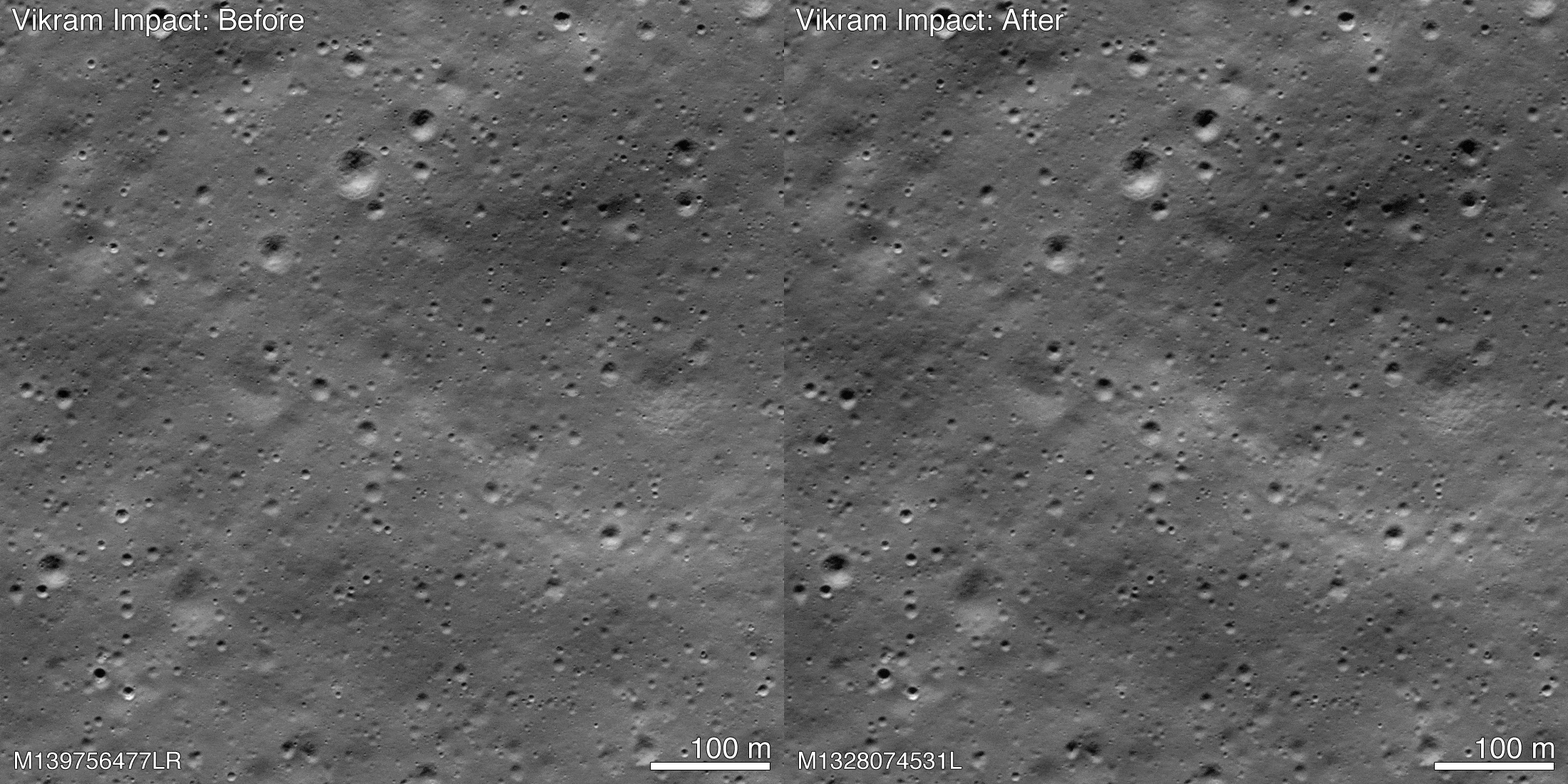
    Before and after images show the Vikram impact point. Changes to the surface are subtle and are more easily seen in the ratio image presented above. Credit: NASA/Goddard/Arizona State University

    Never miss a breakthrough: Join the SciTechDaily newsletter.
    Follow us on Google and Google News.

    India Moon NASA NASA Goddard Space Flight Center Popular
    Share. Facebook Twitter Pinterest LinkedIn Email Reddit

    Related Articles

    NASA’s Artemis Moon Telescope Could Explore the Cosmos in Unprecedented Detail

    NASA’s Lunar Reconnaissance Orbiter Spots Japan’s SLIM Lander on the Moon

    NASA’s Lunar Reconnaissance Orbiter Spots Chandrayaan-3 Landing Site on Moon

    Impact Crater From Russia’s Luna 25 Crash Spied by NASA’s Lunar Orbiter

    NASA’s Lunar Orbiter Captures Impact Site of Failed HAKUTO-R Moon Lander

    Don’t Miss Eclipses: NASA Releases New Map of Upcoming Solar Eclipses

    NASA’s Lunar IceCube – Moon-Observing CubeSat Ready for Artemis Launch

    NASA Spacecraft Finds Pits on the Moon That Always Hover Around a Comfortable Temperature

    NASA Scientists Begin Studying 50-Year-Old Frozen Apollo 17 Moon Samples

    Leave A Reply Cancel Reply

    • Facebook
    • Twitter
    • Pinterest
    • YouTube

    Don't Miss a Discovery

    Subscribe for the Latest in Science & Tech!

    Trending News

    Scientists Uncover Potential Brain Risks of Popular Fish Oil Supplements

    Scientists Discover a Surprising Way To Make Bread Healthier and More Nutritious

    After 60 Years, Scientists Uncover Unexpected Brain Effects of Popular Diabetes Drug Metformin

    New Research Uncovers Hidden Side Effects of Popular Weight-Loss Drugs

    Scientists Rethink Extreme Warming After Surprising Ocean Discovery

    Landmark Study Links Never Marrying to Significantly Higher Cancer Risk

    Researchers Discover Unknown Beetle Species Just Steps From Their Lab

    Largest-Ever Study Finds Medicinal Cannabis Ineffective for Anxiety, Depression, PTSD

    Follow SciTechDaily
    • Facebook
    • Twitter
    • YouTube
    • Pinterest
    • Newsletter
    • RSS
    SciTech News
    • Biology News
    • Chemistry News
    • Earth News
    • Health News
    • Physics News
    • Science News
    • Space News
    • Technology News
    Recent Posts
    • Strange 65-Foot Dinosaur Discovered in Argentina
    • Researchers Uncover Source of Strange Deformation in Earth’s Largest Continental Rift
    • Scientists Solve Mystery of Where the Colorado River Vanished Millions of Years Ago
    • Not Just Alzheimer’s: Scientists Uncover Clues to a Second, Overlooked Disorder
    • Scientists Uncover Dangerous Connection Between Serotonin and Heart Valve Disease
    Copyright © 1998 - 2026 SciTechDaily. All Rights Reserved.
    • Science News
    • About
    • Contact
    • Editorial Board
    • Privacy Policy
    • Terms of Use

    Type above and press Enter to search. Press Esc to cancel.