
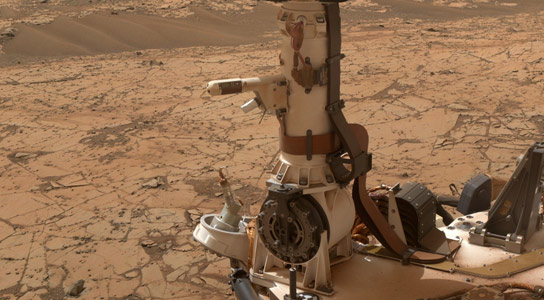
New calculations indicate favorable conditions for small quantities of brine to form during some nights throughout the year on Mars. The possibility of liquid brines on Mars has wider implications for habitability and geological water-related processes.
Martian weather and soil conditions that NASA’s Curiosity rover has measured, together with a type of salt found in Martian soil, could put liquid brine in the soil at night.
Perchlorate identified in Martian soil by the Curiosity mission, and previously by NASA’s Phoenix Mars Lander mission, has properties of absorbing water vapor from the atmosphere and lowering the freezing temperature of water. This has been proposed for years as a mechanism for possible existence of transient liquid brines at higher latitudes on modern Mars, despite the Red Planet’s cold and dry conditions.
New calculations were based on more than a full Mars year of temperature and humidity measurements by Curiosity. They indicate that conditions at the rover’s near-equatorial location were favorable for small quantities of brine to form during some nights throughout the year, drying out again after sunrise. Conditions should be even more favorable at higher latitudes, where colder temperatures and more water vapor can result in higher relative humidity more often.
“Liquid water is a requirement for life as we know it, and a target for Mars exploration missions,” said the report’s lead author, Javier Martin-Torres of the Spanish Research Council, Spain, and Lulea University of Technology, Sweden, and a member of Curiosity’s science team. “Conditions near the surface of present-day Mars are hardly favorable for microbial life as we know it, but the possibility for liquid brines on Mars has wider implications for habitability and geological water-related processes.”
The weather data in the report published today in Nature Geosciences come from the Cuirosity’s Rover Environmental Monitoring Station (REMS), which was provided by Spain and includes a relative-humidity sensor and a ground-temperature sensor. NASA’s Mars Science Laboratory Project is using Curiosity to investigate both ancient and modern environmental conditions in Mars’ Gale Crater region. The report also draws on measurements of hydrogen in the ground by the rover’s Dynamic Albedo of Neutrons (DAN) instrument, from Russia.
“We have not detected brines, but calculating the possibility that they might exist in Gale Crater during some nights testifies to the value of the round-the-clock and year-round measurements REMS is providing,” said Curiosity Project Scientist Ashwin Vasavada of NASA’s Jet Propulsion Laboratory, Pasadena, California, one of the new report’s co-authors.
Curiosity is the first mission to measure relative humidity in the Martian atmosphere close to the surface and ground temperature through all times of day and all seasons of the Martian year. Relative humidity depends on the temperature of the air, as well as the amount of water vapor in it. Curiosity’s measurements of relative humidity range from about five percent on summer afternoons to 100 percent on autumn and winter nights.
Air filling pores in the soil interacts with air just above the ground. When its relative humidity gets above a threshold level, salts can absorb enough water molecules to become dissolved in liquid, a process called deliquescence. Perchlorate salts are especially good at this. Since perchlorate has been identified both at near-polar and near-equatorial sites, it may be present in soils all over the planet.
Researchers using the High Resolution Imaging Science Experiment (HiRISE) camera on NASA’s Mars Reconnaissance Orbiter have in recent years documented numerous sites on Mars where dark flows appear and extend on slopes during warm seasons. These features are called recurring slope lineae, or RSL. A leading hypothesis for how they occur involves brines formed by deliquesence.
“Gale Crater is one of the least likely places on Mars to have conditions for brines to form, compared to sites at higher latitudes or with more shading. So if brines can exist there, that strengthens the case they could form and persist even longer at many other locations, perhaps enough to explain RSL activity,” said HiRISE Principal Investigator Alfred McEwen of the University of Arizona, Tucson, also a co-author of the new report.
In the 12 months following its August 2012 landing, Curiosity found evidence of ancient streambeds and a lakebed environment more than 3 billion years ago that offered conditions favorable for microbial life. Now, the rover is examining a layered mountain inside Gale Crater for evidence about how ancient environmental conditions evolved. JPL, a division of the California Institute of Technology in Pasadena, manages the Mars Science Laboratory and Mars Reconnaissance Projects for NASA’s Science Mission Directorate, Washington.
Reference: “Transient liquid water and water activity at Gale crater on Mars” by F. Javier Martín-Torres, María-Paz Zorzano, Patricia Valentín-Serrano, Ari-Matti Harri, Maria Genzer, Osku Kemppinen, Edgard G. Rivera-Valentin, Insoo Jun, James Wray, Morten Bo Madsen, Walter Goetz, Alfred S. McEwen, Craig Hardgrove, Nilton Renno, Vincent F. Chevrier, Michael Mischna, Rafael Navarro-González, Jesús Martínez-Frías, Pamela Conrad, Tim McConnochie, Charles Cockell, Gilles Berger, Ashwin R. Vasavada, Dawn Sumner and David Vaniman, 13 April 2015, Nature Geoscience.
DOI: 10.1038/ngeo2412
Never miss a breakthrough: Join the SciTechDaily newsletter.
Follow us on Google and Google News.