
Close Menu
    Facebook X (Twitter) Instagram
    SciTechDaily
    • Biology
    • Chemistry
    • Earth
    • Health
    • Physics
    • Science
    • Space
    • Technology
    Facebook X (Twitter) Pinterest YouTube RSS
    SciTechDaily
    Home»Technology»Innovation Spins Spider Web Architecture Into 3D Biomedical Imaging Technology
    Technology

    Innovation Spins Spider Web Architecture Into 3D Biomedical Imaging Technology

    By Purdue UniversityOctober 25, 2020No Comments3 Mins Read
    Facebook Twitter Pinterest Telegram LinkedIn WhatsApp Email Reddit
    Share
    Facebook Twitter LinkedIn Pinterest Telegram Email Reddit
    Purdue Spider Web Architecture
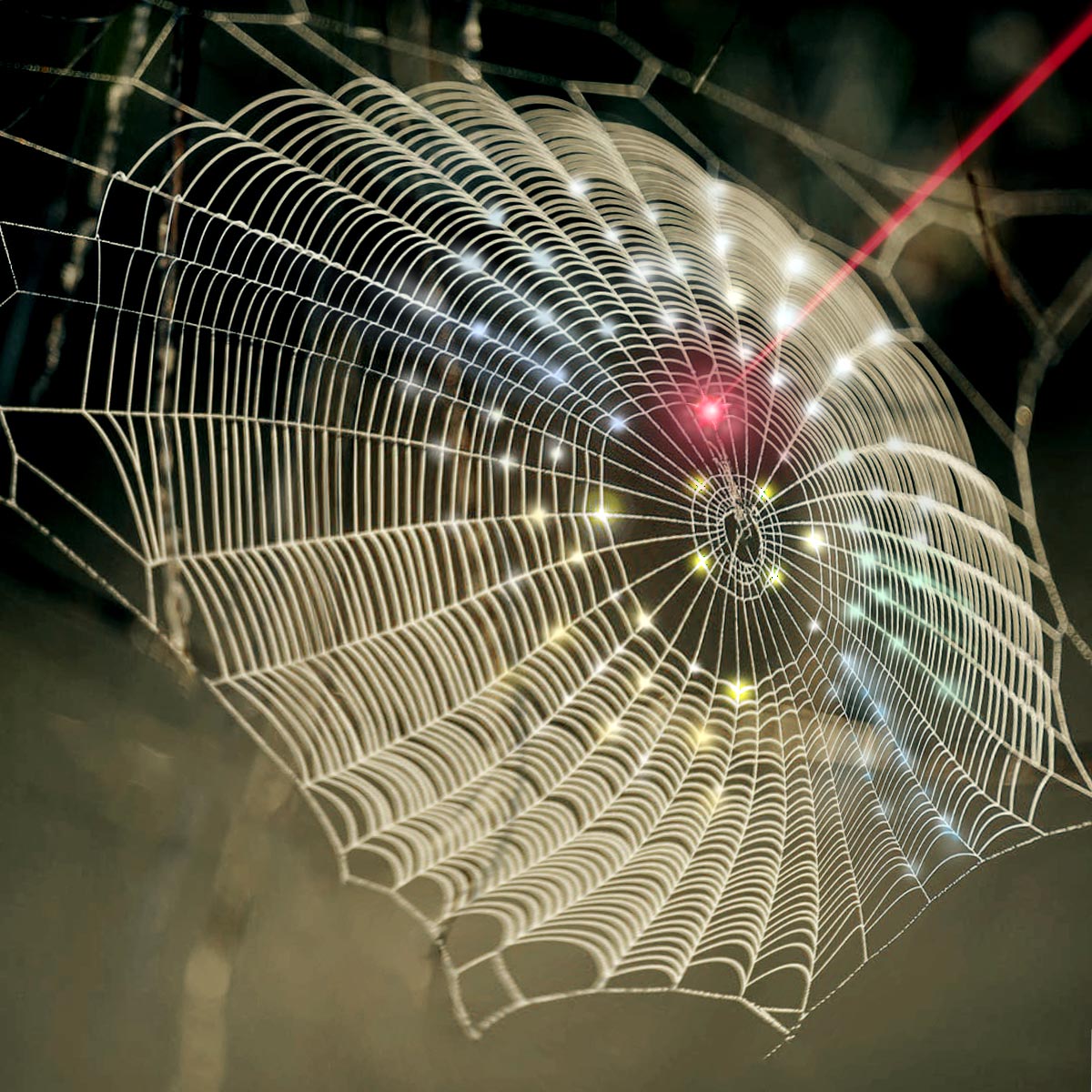
    A spiderweb-inspired fractal design is used for hemispherical 3D photodetection to replicate the vision system of arthropods. Credit: Sena Huh/Purdue University

    Purdue University innovators are taking cues from nature to develop 3D photodetectors for biomedical imaging.

    The Purdue researchers used some architectural features from spider webs to develop the technology. Spider webs typically provide excellent mechanical adaptability and damage-tolerance against various mechanical loads such as storms.

    “We employed the unique fractal design of a spider web for the development of deformable and reliable electronics that can seamlessly interface with any 3D curvilinear surface,” said Chi Hwan Lee, a Purdue assistant professor of biomedical engineering and mechanical engineering. “For example, we demonstrated a hemispherical, or dome-shaped, photodetector array that can detect both direction and intensity of incident light at the same time, like the vision system of arthropods such as insects and crustaceans.”

    The Purdue technology uses the structural architecture of a spider web that exhibits a repeating pattern. This work is supported by the National Science Foundation (NSF; CMMI-1928784) and the Air Force Research Laboratory (AFRL; S-114-054-002). It is published in Advanced Materials.

    Lee said this provides unique capabilities to distribute externally induced stress throughout the threads according to the effective ratio of spiral and radial dimensions and provides greater extensibility to better dissipate force under stretching. Lee said it also can tolerate minor cuts of the threads while maintaining overall strength and function of the entire web architecture.

    “The resulting 3D optoelectronic architectures are particularly attractive for photodetection systems that require a large field of view and wide-angle antireflection, which will be useful for many biomedical and military imaging purposes,” said Muhammad Ashraful Alam, the Jai N. Gupta Professor of Electrical and Computer Engineering.

    Alam said the work establishes a platform technology that can integrate a fractal web design with system-level hemispherical electronics and sensors, thereby offering several excellent mechanical adaptability and damage-tolerance against various mechanical loads.

    “The assembly technique presented in this work enables deploying 2D deformable electronics in 3D architectures, which may foreshadow new opportunities to better advance the field of 3D electronic and optoelectronic devices,” Lee said.

    Reference: “Fractal Web Design of a Hemispherical Photodetector Array with Organic‐Dye‐Sensitized Graphene Hybrid Composites” by Eun Kwang Lee, Ratul Kumar Baruah, Jung Woo Leem, Woohyun Park, Bong Hoon Kim, Augustine Urbas, Zahyun Ku, Young L. Kim, Muhammad Ashraful Alam and Chi Hwan Lee, 12 October 2020, Advanced Materials.
    DOI: 10.1002/adma.202004456

    The team is working with the Purdue Research Foundation Office of Technology Commercialization to secure a patent for the technology.

    Never miss a breakthrough: Join the SciTechDaily newsletter.
    Follow us on Google and Google News.

    Biochemistry Biotechnology Imaging Materials Science Medical Imaging Purdue University
    Share. Facebook Twitter Pinterest LinkedIn Email Reddit

    Related Articles

    Biomedical Imaging Breakthrough: Silver Nanoislands Amplify Signals 10,000,000x

    Pioneering Single-Pixel Technology Achieves 3D Imaging of Living Cells

    New Microscopy Imaging Technique: RESORT Unveils Living Systems Like Never Before

    New Infrared Imager Can Map Out a Person’s Blood Vessels Without Touching the Skin

    Scientists Use Bacteria As Micro-3D Printers to Create Highly Customized Structures

    New Material Can Generate Hydrogen From Fresh, Salt, or Polluted Water by Exposure to Sunlight

    Nanodiamonds Improve Effectiveness of Breast Cancer Treatment

    A Cost-Effective Fabrication Method for Micro-Scale Graphene-Based Supercapacitors

    New Hydrogel Offers Many Possibilities

    Leave A Reply Cancel Reply

    • Facebook
    • Twitter
    • Pinterest
    • YouTube

    Don't Miss a Discovery

    Subscribe for the Latest in Science & Tech!

    Trending News

    AI Could Detect Early Signs of Alzheimer’s in Under a Minute – Far Before Traditional Tests

    What if Dark Matter Has Two Forms? Bold New Hypothesis Could Explain a Cosmic Mystery

    This Metal Melts in Your Hand – and Scientists Just Discovered Something Strange

    Beef vs. Chicken: Surprising Results From New Prediabetes Study

    Alzheimer’s Breakthrough: Scientists Discover Key Protein May Prevent Toxic Protein Clumps in the Brain

    Quantum Reality Gets Stranger: Physicists Put a Lump of Metal in Two Places at Once

    Scientists May Have Found the Key to Jupiter and Saturn’s Moon Mystery

    Scientists Uncover Brain Changes That Link Pain to Depression

    Follow SciTechDaily
    • Facebook
    • Twitter
    • YouTube
    • Pinterest
    • Newsletter
    • RSS
    SciTech News
    • Biology News
    • Chemistry News
    • Earth News
    • Health News
    • Physics News
    • Science News
    • Space News
    • Technology News
    Recent Posts
    • Living With Roommates Might Be Changing Your Gut Microbiome Without You Knowing
    • Simple and Cheap Blood Test Could Detect Cancer and Other Diseases Before Symptoms Appear
    • Century-Old Cleaning Chemical Linked to 500% Increased Risk of Parkinson’s Disease
    • What if Your Memories Never Happened? Physicists Take a New Look at the Boltzmann Brain Paradox
    • Students Found an Ancient Star That Shouldn’t Be in the Milky Way
    Copyright © 1998 - 2026 SciTechDaily. All Rights Reserved.
    • Science News
    • About
    • Contact
    • Editorial Board
    • Privacy Policy
    • Terms of Use

    Type above and press Enter to search. Press Esc to cancel.