

Close Menu
    Facebook X (Twitter) Instagram
    SciTechDaily
    • Biology
    • Chemistry
    • Earth
    • Health
    • Physics
    • Science
    • Space
    • Technology
    Facebook X (Twitter) Pinterest YouTube RSS
    SciTechDaily
    Home»Space»Interstellar Peptides Point to Extraterrestrial Origin of Life’s Building Blocks
    Space

    Interstellar Peptides Point to Extraterrestrial Origin of Life’s Building Blocks

    By Friedrich Schiller University JenaApril 27, 2024No Comments3 Mins Read
    Facebook Twitter Pinterest Telegram LinkedIn WhatsApp Email Reddit
    Share
    Facebook Twitter LinkedIn Pinterest Telegram Email Reddit
    Interstellar Chemical Molecule Ice Art
    Research has demonstrated that peptides, crucial organic compounds, can form on cosmic dust particles even in the presence of water. This challenges previous beliefs and suggests that the formation of life’s building blocks in space is feasible, despite the conditions. Credit: SciTechDaily.com

    Peptides can form on cosmic dust despite water presence, challenging previous beliefs and suggesting a possible extraterrestrial origin for life’s building blocks.

    Peptides are organic compounds that play a crucial role in many biological processes, for example, as enzymes. A research team led by Dr. Serge Krasnokutski from the Astrophysics Laboratory at the Max Planck Institute for Astronomy at the University of Jena had already demonstrated that simple peptides can form on cosmic dust particles. However, it was previously assumed that this would not be possible if molecular ice, which covers the dust particle, contains water – which is usually the case.

    Now, the team, in collaboration with the University of Poitiers, France, has discovered that the presence of water molecules is not a major obstacle for the formation of peptides on such dust particles. The researchers report on their findings in the journal Science Advances.
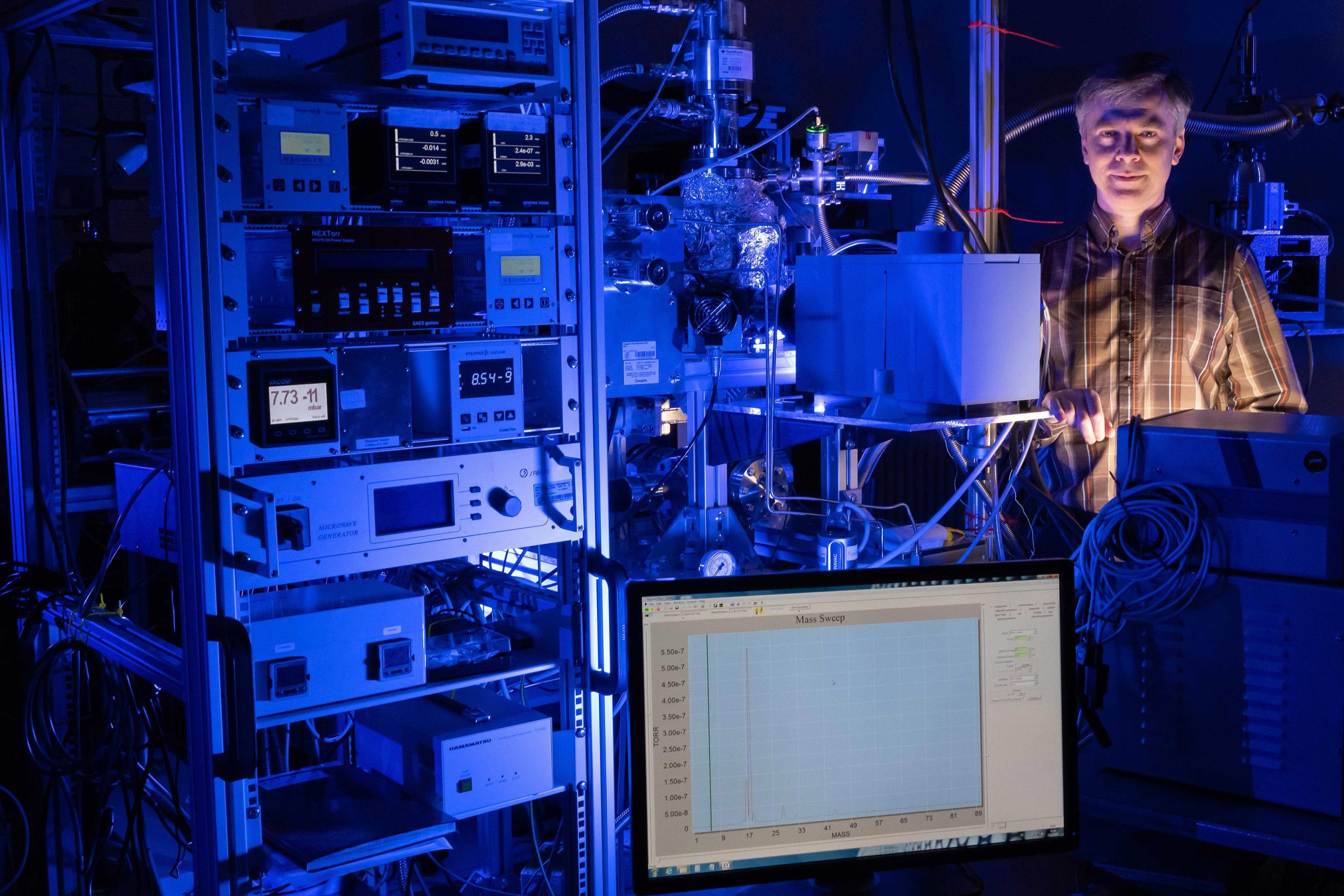
    Serge Krasnokutski
    Dr. Serge Krasnokutski from University of Jena, Germany uses a vacuum chamber to investigate the formation of biomolecules in space. Credit: Jens Meyer/University of Jena

    Chemistry in the Icy Vacuum

    “We have replicated conditions similar to those in outer space in a vacuum chamber, also adding substances that occur in so-called molecular clouds,” explains Krasnokutski. These substances include ammonia, atomic carbon, and carbon monoxide. “Thus, all the chemical elements needed for simple peptides are present,” adds the physicist.

    These raw materials, Krasnokutski describes, initially form chemical precursors to amino acids known as aminoketenes. These then combine to form chains, resulting in polypeptides.

    “It was previously suspected that the individual aminoketenes would bond to form peptides,” the scientist explains. “However, for this step, the absence of water might be crucial as it could hinder the reaction. At the same time, most interstellar dust particles are covered with water-containing molecular ice,” says Krasnokutski.

    Hence, the assumption until now has been that if peptides form in space, they do so only to a limited extent.

    Precise Analysis in France

    “The highly precise mass spectrometric analyses now possible at the University of Poitiers, however, showed that the presence of water in the molecular ice slows down the formation of peptides by fifty percent, but they still form,” he explains. “When you consider the time scales on which astronomical processes occur, this slowdown is practically negligible.”

    The question of whether the first biomolecules on our planet are of terrestrial or extraterrestrial origin – or both – will likely remain unresolved for the foreseeable future. However, outer space as a source of our life cannot be ruled out, as this discovery indicates.

    Reference: “Formation of extraterrestrial peptides and their derivatives” by Serge A. Krasnokutski, Cornelia Jäger, Thomas Henning, Claude Geffroy, Quentin B. Remaury and Pauline Poinot, 17 April 2024, Science Advances.
    DOI: 10.1126/sciadv.adj7179

    Never miss a breakthrough: Join the SciTechDaily newsletter.
    Follow us on Google and Google News.

    Astrobiology Astrophysics Friedrich Schiller University Jena Popular
    Share. Facebook Twitter Pinterest LinkedIn Email Reddit

    Related Articles

    How Life Came to Earth – Quantum Mechanical Tunneling Effect Might Play a Role

    Astronomers Could Spot Clues to Alien Life Orbiting Long-Dead Stars

    Earth 2.0? Astronomers Discover Large Exoplanet That Could Have the Right Conditions for Life

    Extreme Solar Events and the Search for Habitable Exoplanets

    “They’re out There” – Exoplanet Axis Study Boosts Hopes of Complex Life

    Astronomers Discover Complex Organic Molecules in Infant Star System

    Early Chemistry of a Star’s Protoplanetary Disc Shapes Life-Friendly Atmospheres

    Searching for Life on Earth-Like Planets May Be a Mistake, Need to Consider Superhabitable Planets

    Astronomers Obtain Precise Measurements of the Two Kepler-16 Stars

    Leave A Reply Cancel Reply

    • Facebook
    • Twitter
    • Pinterest
    • YouTube

    Don't Miss a Discovery

    Subscribe for the Latest in Science & Tech!

    Trending News

    Why Popular Diabetes Drugs Like Ozempic Don’t Work for Everyone: The “Genetic Glitch”

    Scientists Stunned After Finding Plant Thought Extinct for 60 Years

    Scientists Discover Tiny New Spider That Hunts Prey 6x Its Size

    Natural Component From Licorice Shows Promise for Treating Inflammatory Bowel Disease

    Scientists Warn: Popular Sweetener Linked to Dangerous Metabolic Effects

    Monster Storms on Jupiter Unleash Lightning Beyond Anything on Earth

    Scientists Create “Liquid Gears” That Spin Without Touching

    The Simple Habit That Could Help Prevent Cancer

    Follow SciTechDaily
    • Facebook
    • Twitter
    • YouTube
    • Pinterest
    • Newsletter
    • RSS
    SciTech News
    • Biology News
    • Chemistry News
    • Earth News
    • Health News
    • Physics News
    • Science News
    • Space News
    • Technology News
    Recent Posts
    • Pomegranate Compound Could Help Protect Against Heart Disease
    • Your Blood Test Might Already Show Alzheimer’s Risk
    • Common Pregnancy Medications Linked to Higher Autism Risk in Massive U.S. Study
    • Scientists Teach AI To Think Like a Professional Chemist
    • Scientists Were Wrong About This Strange “Rule-Breaking” Particle
    Copyright © 1998 - 2026 SciTechDaily. All Rights Reserved.
    • Science News
    • About
    • Contact
    • Editorial Board
    • Privacy Policy
    • Terms of Use

    Type above and press Enter to search. Press Esc to cancel.