
Close Menu
    Facebook X (Twitter) Instagram
    SciTechDaily
    • Biology
    • Chemistry
    • Earth
    • Health
    • Physics
    • Science
    • Space
    • Technology
    Facebook X (Twitter) Pinterest YouTube RSS
    SciTechDaily
    Home»Space»James Webb Space Telescope Explores Star Formation in Distant Galaxies
    Space

    James Webb Space Telescope Explores Star Formation in Distant Galaxies

    By Stockholm UniversityFebruary 10, 20231 Comment2 Mins Read
    Facebook Twitter Pinterest Telegram LinkedIn WhatsApp Email Reddit
    Share
    Facebook Twitter LinkedIn Pinterest Telegram Email Reddit
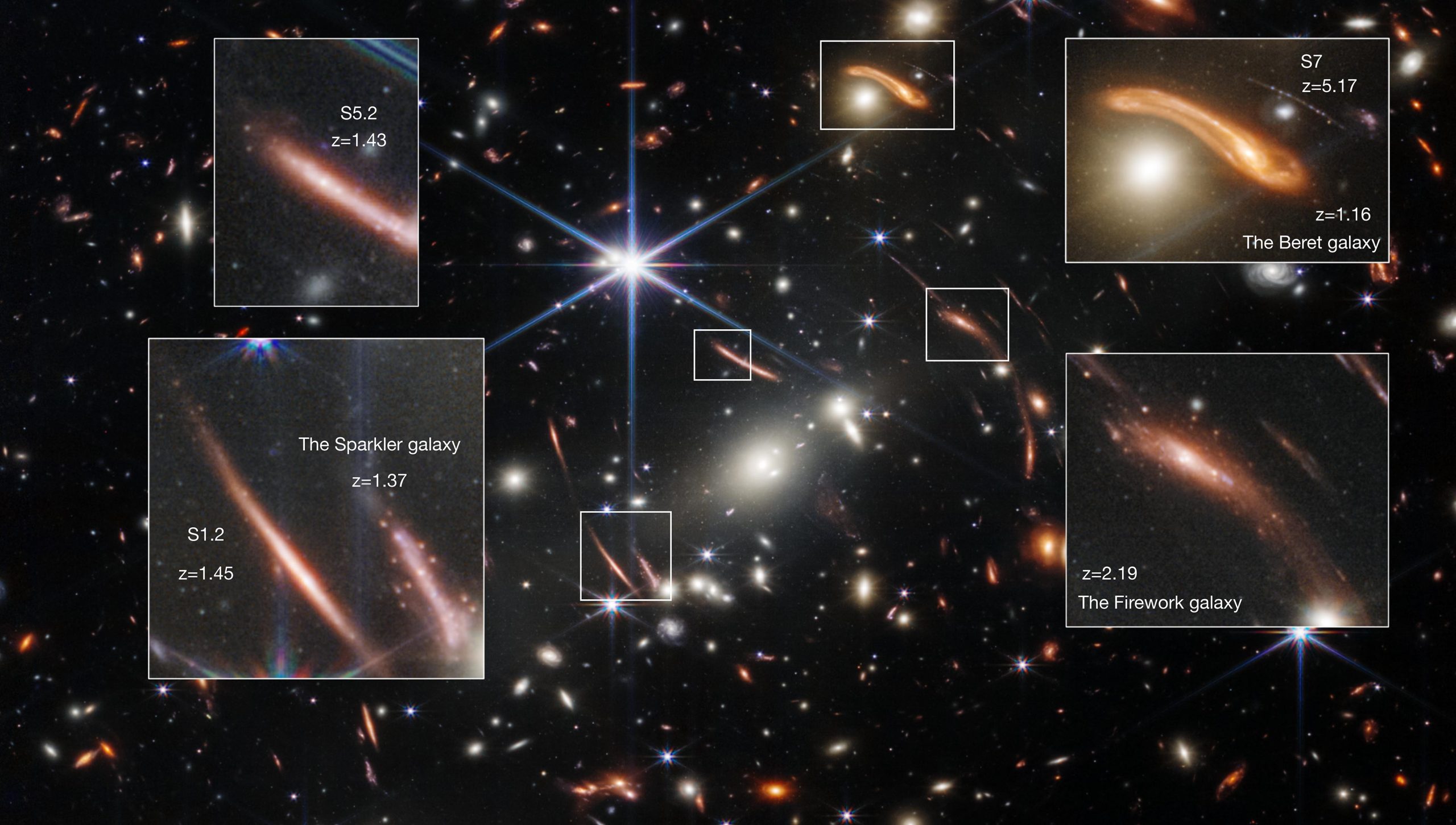
    James Webb Space Telescope Galaxy Cluster (SMACS0723)
    The James Webb Space Telescope captured this image of a galaxy cluster (SMACS0723). The five zoomed in galaxies are so far away that we observe them as they were when the Universe was between one and five billion years old. Today the Universe is 13.7 billion years old. Credit: Image adapted from image release by NASA, ESA, CSA, STScI

    Thanks to the James Webb Space Telescope’s first images of galaxy clusters, researchers have, for the very first time, been able to examine very compact structures of star clusters inside galaxies, so-called clumps. In a paper published in the Monthly Notices of the Royal Astronomical Society, researchers from Stockholm University have studied the first phase of star formation in distant galaxies.

    “The galaxy clusters we examined are so massive that they bend light rays passing through their center, as predicted by Einstein in 1915. And this in turn produces a kind of magnifying glass effect: the images of background galaxies are magnified,” explains Adélaïde Claeyssens, Department of Astronomy, Stockholm University, one of the lead authors of the study.

    The magnifying glass effect together with the resolution of the James Webb Space Telescope made it possible for the researchers to detect stellar clumps, very compact galaxy structures. These observations allowed the researchers to study the link between clump formation and evolution and galaxy growth a few million years after the Big Bang. And that in a way that has not been possible before.

    “The images from the James Webb Space Telescope show that we can now detect very small structures inside very distant galaxies and that we can see these clumps in many of these galaxies. The telescope is a game-changer for the entire field of research and helps us understand how galaxies form and evolve,” says Angela Adamo, Oscar Klein Center, Stockholm University, one of the lead authors of the study.

    The oldest galaxy studied in the paper is so far away that we see what it looked like 13 billion years ago, when the Universe was only 680 million years old.

    Reference: “Star formation at the smallest scales; A JWST study of the clump populations in SMACS0723” by Adélaïde Claeyssens, Angela Adamo, Johan Richard, Guillaume Mahler, Matteo Messa and Miroslava Dessauges-Zavadsky, 5 January 2023, Monthly Notices of the Royal Astronomical Society.
    DOI: 10.1093/mnras/stac3791

    Never miss a breakthrough: Join the SciTechDaily newsletter.
    Follow us on Google and Google News.

    Astronomy Astrophysics James Webb Space Telescope Popular Stars Stockholm University
    Share. Facebook Twitter Pinterest LinkedIn Email Reddit

    Related Articles

    Webb Telescope Captures the Final Moments of a Doomed Star Cloaked in Dust

    Webb Space Telescope Discovers Strange Cosmic “Fingerprint”

    Magnetic Monster? NASA’s Hubble Sees Unexplained Brightness from Colossal Explosion

    Ultrabright Radio Flashes Detected Coming From Inside Our Own Galaxy

    Research Shows NASA’s James Webb Space Telescope Will Reveal Hidden Galaxies

    Extreme Magnetic Fields and Temperature Variation of Distant Magnetars

    Death by Spaghettification: Telescopes Record Last Moments of Star Devoured by a Black Hole

    Astronomers Turn Up the Heavy Metal to Shed Light on Star Formation – “It’s Absolutely Mind-Blowing Stuff”

    A White Dwarf’s Surprise Planetary Companion: First-of-Its-Kind Exoplanet Detected Around Dead Star

    1 Comment

    1. Torbjörn Larsson on February 12, 2023 2:56 am

      Unfortunately the data does not yet suffice to resolve several important degeneracies:

      “We derive ages, masses, extinctions, metallicities, and 𝑅eff for
      a population of 221 clumps in the redshift range 1 to 8.5. Even
      with available optical SEDs, we still notice unbreakable degeneracies
      such as SFH, age-extinction, and metallicities.”

      Reply
    Leave A Reply Cancel Reply

    • Facebook
    • Twitter
    • Pinterest
    • YouTube

    Don't Miss a Discovery

    Subscribe for the Latest in Science & Tech!

    Trending News

    Your Blood Pressure Reading Could Be Wrong Because of One Simple Mistake

    Astronomers Stunned by Ancient Galaxy With No Spin

    Physicists May Be on the Verge of Discovering “New Physics” at CERN

    Scientists Solve 320-Million-Year Mystery of Reptile Skin Armor

    Scientists Say This Daily Walking Habit May Be the Secret to Keeping Weight Off After Dieting

    New Therapy Rewires the Brain To Restore Joy in Depression Patients

    Giant Squid Detected off Western Australia in Stunning Deep-Sea Discovery

    Popular Sugar-Free Sweetener Linked to Liver Disease, Study Warns

    Follow SciTechDaily
    • Facebook
    • Twitter
    • YouTube
    • Pinterest
    • Newsletter
    • RSS
    SciTech News
    • Biology News
    • Chemistry News
    • Earth News
    • Health News
    • Physics News
    • Science News
    • Space News
    • Technology News
    Recent Posts
    • The Hidden Types of Dementia Most People Have Never Heard Of
    • Scientists Discover Why Alcohol Prevents the Liver From Healing, Even After You Quit
    • Scientists Solve a 60-Year-Old Fat Cell Mystery — and It Changes What We Know About Obesity
    • A Crucial Atlantic Current Is Weakening and Weather Could Change Worldwide
    • Scientists Stunned As Volcano Removes Methane From the Air
    Copyright © 1998 - 2026 SciTechDaily. All Rights Reserved.
    • Science News
    • About
    • Contact
    • Editorial Board
    • Privacy Policy
    • Terms of Use

    Type above and press Enter to search. Press Esc to cancel.