
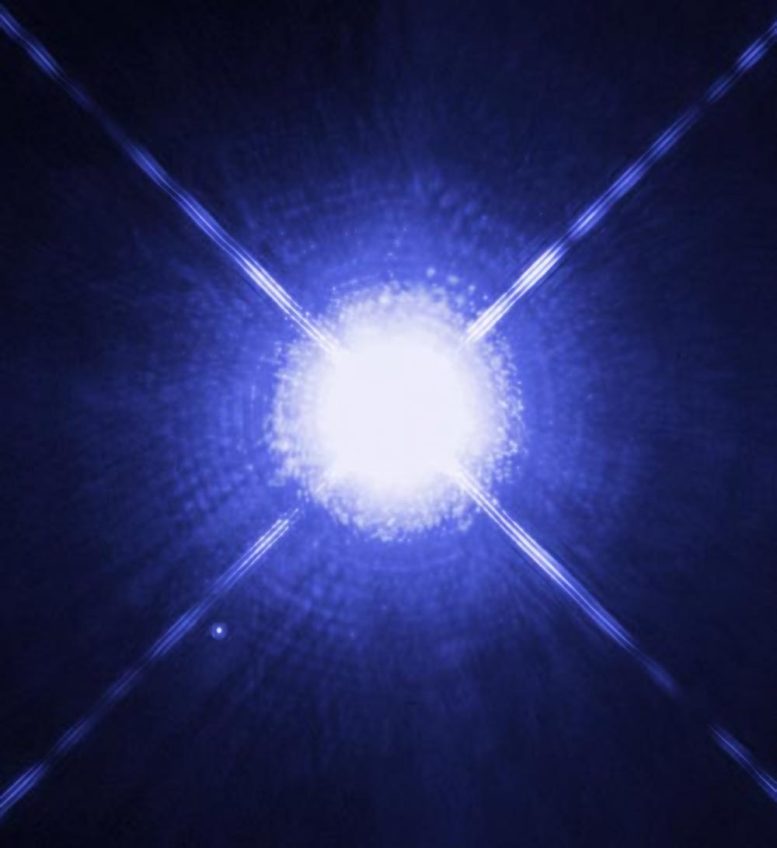
In a new study, researchers suggest that white dwarfs can still support habitable planets, demonstrating that the James Webb Space Telescope, set to be launched by NASA in 2018, will be capable of detecting oxygen and water in the atmosphere of an Earth-like planet orbiting a white dwarf.
Because it has no source of energy, a dead star — known as a white dwarf — will eventually cool down and fade away. But circumstantial evidence suggests that white dwarfs can still support habitable planets, says Prof. Dan Maoz of Tel Aviv University’s School of Physics and Astronomy.
Now Prof. Maoz and Prof. Avi Loeb, Director of Harvard University’s Institute for Theory and Computation and a Sackler Professor by Special Appointment at TAU, have shown that, using advanced technology to become available within the next decade, it should be possible to detect biomarkers surrounding these planets — including oxygen and methane — that indicate the presence of life.
Published in the Monthly Notices of the Royal Astronomical Society, the researchers’ “simulated spectrum” demonstrates that the James Webb Space Telescope (JWST), set to be launched by NASA in 2018, will be capable of detecting oxygen and water in the atmosphere of an Earth-like planet orbiting a white dwarf after only a few hours of observation time — much more easily than for an Earth-like planet orbiting a sun-like star.
Their collaboration is made possible by the Harvard TAU Astronomy Initiative, recently endowed by Dr. Raymond and Beverly Sackler.
Faint light, clear signals
“In the quest for extraterrestrial biological signatures, the first stars we study should be white dwarfs,” said Prof. Loeb. Prof. Maoz agrees, noting that if “all the conditions are right, we’ll be able to detect signs of life” on planets orbiting white dwarf stars using the much-anticipated JWST.
An abundance of heavy elements already observed on the surface of white dwarfs suggest rocky planets orbit a significant fraction of them. The researchers estimate that a survey of 500 of the closest white dwarfs could spot one or more habitable planets.
The unique characteristics of white dwarfs could make these planets easier to spot than planets orbiting normal stars, the researchers have shown. Their atmospheres can be detected and analyzed when a star dims as an orbiting planet crosses in front of it. As the background starlight shines through the planet’s atmosphere, elements in the atmosphere will absorb some of the starlight, leaving chemical clues of their presence — clues that can then be detected from the JWST.
When an Earth-like planet orbits a normal star, “the difficulty lies in the extreme faintness of the signal, which is hidden in the glare of the ‘parent’ star,” Prof. Maoz says. “The novelty of our idea is that, if the parent star is a white dwarf, whose size is comparable to that of an Earth-sized planet, that glare is greatly reduced, and we can now realistically contemplate seeing the oxygen biomarker.”
In order to estimate the kind of data that the JWST will be able to see, the researchers created a “synthetic spectrum,” which replicates that of an inhabited planet similar to Earth orbiting a white dwarf. They demonstrated that the telescope should be able to pick up signs of oxygen and water, if they exist on the planet.
A critical sign of life
The presence of oxygen biomarkers would be the most critical signal of the presence of life on extraterrestrial planets. Earth’s atmosphere, for example, is 21 percent oxygen, and this is entirely produced by our planet’s plant life as a result of photosynthesis. Without the existence of plants, an atmosphere would be entirely devoid of oxygen.
The JWST will be ideal for hunting out signs of life on extraterrestrial planets because it is designed to look into the infrared region of the light spectrum, where such biomarkers are prominent. In addition, as a space-based telescope, it will be able to analyze the atmospheres of Earth-like planets outside our solar system without weeding out the similar signatures of Earth’s own atmosphere.
Reference: “Detecting biomarkers in habitable-zone earths transiting white dwarfs” by Abraham Loeb and Dan Maoz, 14 March 2013, Monthly Notices of the Royal Astronomical Society.
DOI: 10.1093/mnrasl/slt026
Never miss a breakthrough: Join the SciTechDaily newsletter.
Follow us on Google and Google News.