
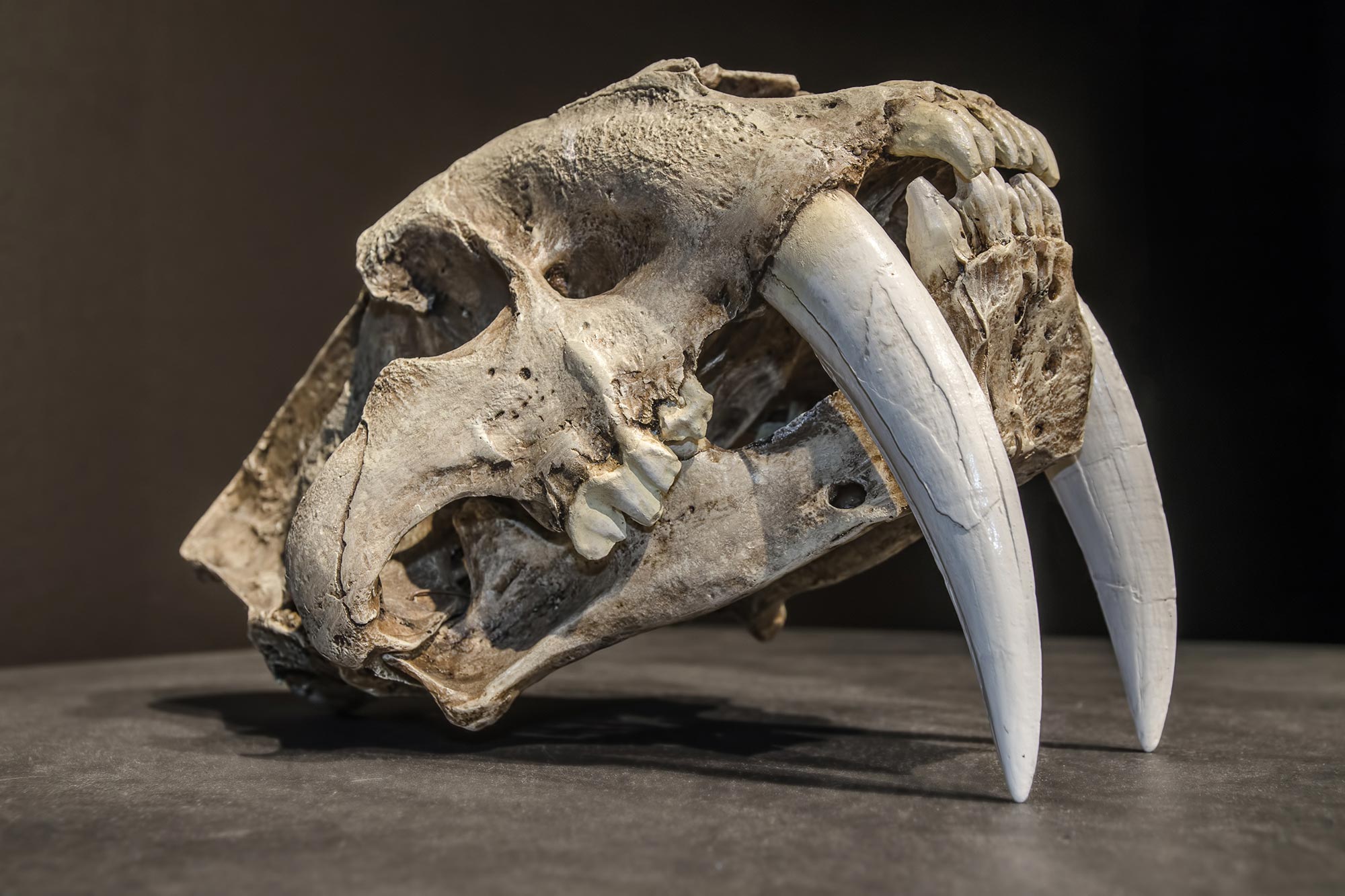
Researchers have uncovered why the formidable teeth of saber-toothed predators like Smilodon were evolutionarily advantageous, using innovative techniques like 3D-printed tooth replicas and computer simulations.
Their study not only highlights the diversity in tooth shapes and hunting strategies but also discusses the species’ susceptibility to extinction and its implications for evolutionary biology.
Evolutionary Advantage of Saber-Toothed Predators
Saber-toothed predators, famously represented by the iconic Smilodon, evolved independently across multiple mammal groups. A new study published today (January 9) in Current Biology sheds light on why: these distinctive teeth were “functionally optimal,” making them highly effective for puncturing prey.
The research, led by scientists from the University of Bristol in collaboration with Monash University, found that the long, sharp, blade-like teeth of saber-toothed predators provided a significant advantage as specialized tools for hunting and capturing prey.
The findings not only explain why saber-toothed adaptations emerged at least five separate times in mammals but also offer insights into their eventual extinction. The teeth, while highly specialized, may have acted as an “evolutionary ratchet,” enhancing hunting success but leaving these predators more vulnerable to extinction when ecosystems shifted, and prey became scarce.
The Balance of Saber-Tooth Traits
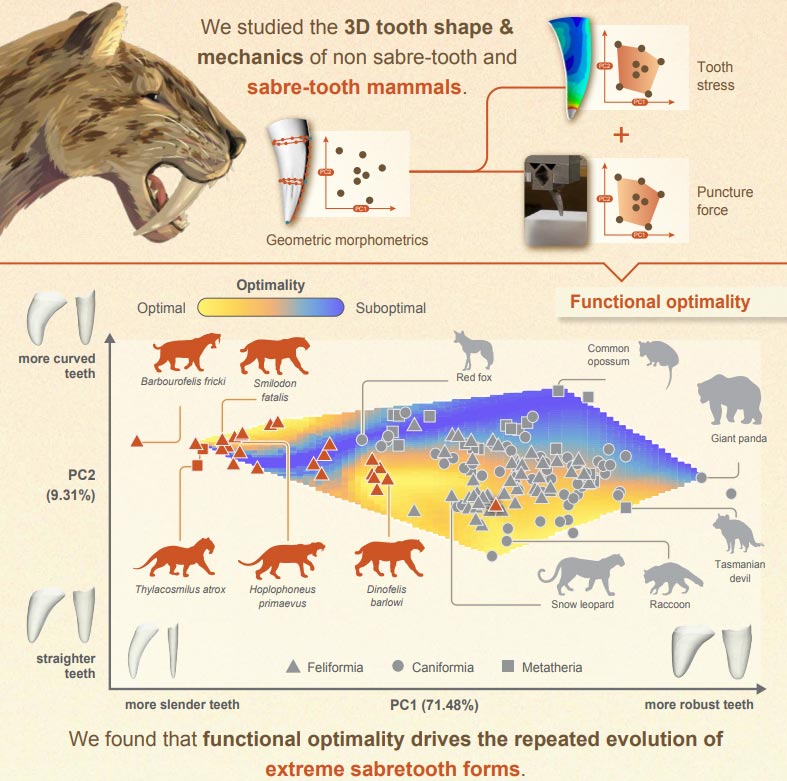
The team set out to test whether the saber-tooth shape was an optimal balance between the two competing needs: sharp and slender enough to effectively puncture prey and blunt and robust enough to resist breaking. Using 3D-printed steel tooth replicas in a series of biting experiments and advanced computer simulations, they analyzed the shape and performance of 95 different carnivorous mammal teeth, including 25 saber-toothed species.
Lead author Dr. Tahlia Pollock, part of the Palaeobiology Research Group in Bristol’s School of Earth Sciences, explained: “Our study helps us better understand how extreme adaptations evolve – not just in saber-toothed predators but across nature.
“By combining biomechanics and evolutionary theory, we can uncover how natural selection shapes animals to perform specific tasks.”
Another key finding challenges the traditional idea that saber-toothed predators fall into just two categories: ‘dirk-toothed’ and ‘scimitar-toothed’. Instead, the research uncovered a spectrum of saber-tooth shapes, from the long, curved teeth of Barbourofelis fricki to the straighter, more robust teeth of Dinofelis barlowi. This supports a growing body of research suggesting a greater diversity of hunting strategies among these predators than previously thought.
Future Research and Implications
Looking ahead, the team plans to expand their analysis to include all tooth types, aiming to uncover the biomechanical trade-offs that shaped the evolution of diverse dental structures across the animal kingdom.
“The findings not only deepen our understanding of saber-toothed predators but also have broader implications for evolutionary biology and biomechanics,” added Professor Alistair Evans, from the School of Biological Sciences at Monash University. “Insights from this research could even help inform bioinspired designs in engineering.”
Reference: “Functional optimality underpins the repeated evolution of the extreme “saber-tooth” morphology” by Tahlia I. Pollock, William J. Deakin, Narimane Chatar, Pablo S. Milla Carmona, Douglass S. Rovinsky, Olga Panagiotopoulou, William M.G. Parker, Justin W. Adams, David P. Hocking, Philip C.J. Donoghue, Emily J. Rayfield and Alistair R. Evans, 9 January 2025, Current Biology.
DOI: 10.1016/j.cub.2024.11.059
Never miss a breakthrough: Join the SciTechDaily newsletter.
Follow us on Google and Google News.
2 Comments
Clouded leopard is not extinct
I liked the article yet I was left with unanswered questions.Did sabre toothed cat just puncture prey with its mouth closed or open? Also a big cat now goes for the neck to acquire a kill.This would not work with a sabre tooth,I suspect that the sabre tooth had a unique hunting strategy when it came to big game like the mammoth,the cat would encourage the mammoth to try and kill it by head smashing and in the process the lion would be on its back,it would reach up and disembowel the mammoth soft underbelly while keeping it’s mouth closed