
New research indicates that complex life began forming almost a billion years earlier than previously thought.
Using an expanded molecular clock approach, scientists mapped out a clearer timeline of how early gene families evolved. They discovered that key eukaryotic features emerged long before mitochondria or atmospheric oxygen became abundant. The result is a new evolutionary model that rewrites the story of early life.
Early Emergence of Complex Life
New research has uncovered that complex life began forming much earlier, and across a longer timeframe, than scientists had previously assumed. The findings offer fresh insight into the environmental conditions that shaped early evolution and call into question several longstanding scientific ideas in this field.
Led by the University of Bristol and published today in Nature (December 3), the study reports that complex organisms arose well before oxygen became abundant in Earth’s atmosphere. Oxygen had long been thought to be essential for the development of advanced life, but the results indicate that this requirement may not hold for the earliest stages of evolution.
“The Earth is approximately 4.5 billion years old, with the first microbial life forms appearing over 4 billion years ago. These organisms consisted of two groups – bacteria and the distinct but related archaea, collectively known as prokaryotes,” said co-author Anja Spang, from the Department of Microbiology & Biogeochemistry at the Royal Netherlands Institute for Sea Research.
Prokaryotes dominated the planet for hundreds of millions of years before more complex eukaryotic cells emerged. This latter group includes algae, fungi, plants, and animals.
Revisiting the Origins of Eukaryotes
Davide Pisani, Professor of Phylogenomics in the School of Biological Sciences at the University of Bristol and co-author, explained: “Previous ideas on how and when early prokaryotes transformed into complex eukaryotes have largely been in the realm of speculation. Estimates have spanned a billion years, as no intermediate forms exist and definitive fossil evidence has been lacking.”
To address these uncertainties, the international team expanded upon the existing ‘molecular clocks’ technique, which estimates when species last shared a common ancestor.
“The approach was two-fold: by collecting sequence data from hundreds of species and combining this with known fossil evidence, we were able to create a time-resolved tree of life. We could then apply this framework to better resolve the timing of historical events within individual gene families,” added co-lead author Professor Tom Williams in the Department of Life Sciences at the University of Bath.
By comparing more than 100 gene families across multiple biological systems and focusing on traits that differentiate eukaryotes from prokaryotes, the researchers began reconstructing the sequence of events that shaped the rise of complex life.
A Much Earlier Start to Cellular Complexity
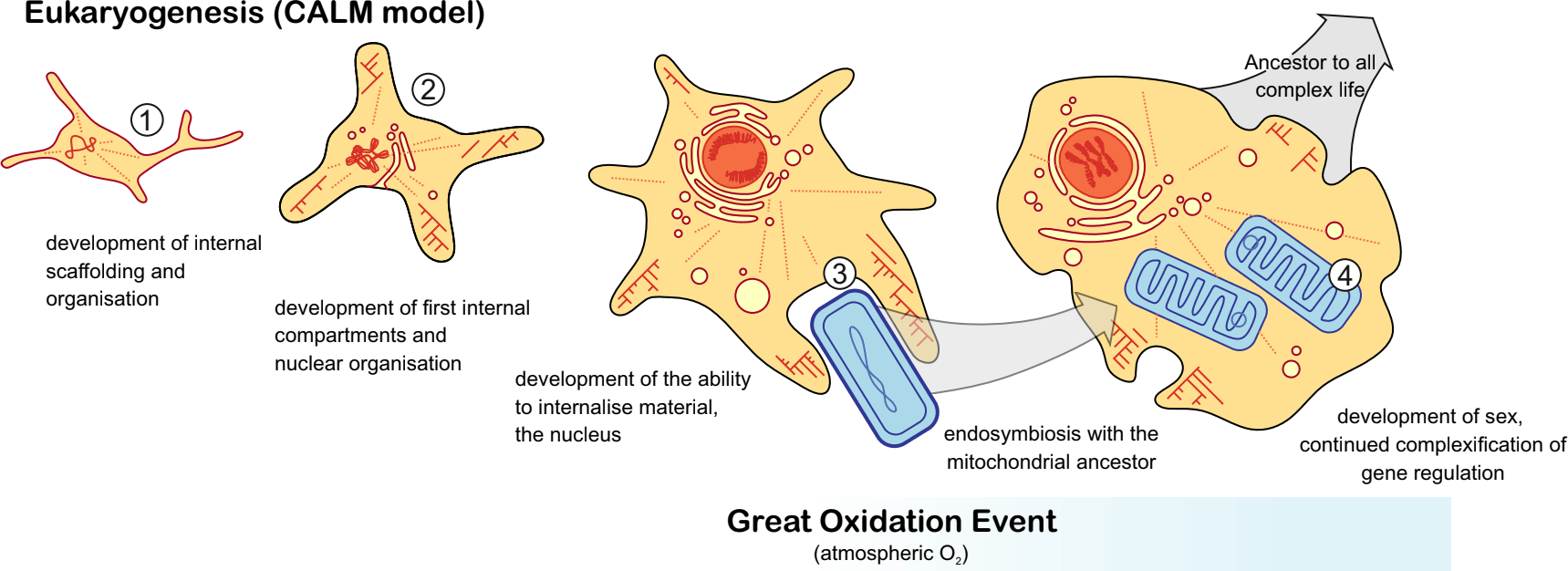
The team found that the transition toward complexity began nearly 2.9 billion years ago, almost a billion years earlier than some prior estimates. Their results also indicate that the nucleus and other internal cellular structures formed well before mitochondria.
“The process of cumulative complexification took place over a much longer time period than previously thought,” said author Gergely Szöllősi, head of the Model-Based Evolutionary Genomics Unit at the Okinawa Institute of Science and Technology (OIST).
These findings enabled the researchers to rule out several existing hypotheses for eukaryogenesis (the evolution of complex life). Because their results did not fully match any current model, they introduced a new scenario called ‘CALM’ – Complex Archaeon, Late Mitochondrion.
Introducing the CALM Model
Lead author Dr. Christopher Kay, Research Associate in the School of Biological Sciences at the University of Bristol, explained: “What sets this study apart is looking into detail about what these gene families actually do – and which proteins interact with which – all in absolute time. It has required the combination of a number of disciplines to do this: palaeontology to inform the timeline, phylogenetics to create faithful and useful trees, and molecular biology to give these gene families a context. It was a big job.”
“One of our most significant findings was that the mitochondria arose significantly later than expected. The timing coincides with the first substantial rise in atmospheric oxygen,” said author Philip Donoghue, Professor of Palaeobiology in the School of Earth Sciences at the University of Bristol.
“This insight ties evolutionary biology directly to Earth’s geochemical history. The archaeal ancestor of eukaryotes began evolving complex features roughly a billion years before oxygen became abundant, in oceans that were entirely anoxic.”
Reference: “Dated gene duplications elucidate the evolutionary assembly of eukaryotes” by Christopher J. Kay, Anja Spang, Gergely J. Szöllősi, Davide Pisani, Tom A. Williams and Philip C. J. Donoghue, 3 December 2025, Nature.
DOI: 10.1038/s41586-025-09808-z
Never miss a breakthrough: Join the SciTechDaily newsletter.
Follow us on Google and Google News.
8 Comments
I love this newsletter!! Thanks so much. I’m not a scientist but your articles are so well written—clear in language as simple as posible. Thanks very much—please continue. I believe it’s important for as many people as possible to have a grasp of the never ending marvelous discoveries being written about for the layman. This knowledge can help keep us grounded and aware of the wonderful world and cosmos we live in.
Best regards, Dr. Gloria Gannaway
For the existence of life, a heat engine, Earth should be hotter than the Cosmic Background Radiation. When CBR was hotter than Earth, absorption of radiations would be higher, and this would have resulted in photosynthesis reactions that caused release of oxygen. So by the time CBR became colder sufficient oxygen would be available for the emergence of life. The present evolution story misses the crucial role of temperature difference between Earth and the CBR.
The cosmic background radiation was about a factor 2 hotter than the 3 K it is today at the time Earth formed around 4.5 billion years ago or at a redshift age of around 1. Earth formed at a glowing hot temperature of about 1000 K. So that was never a problem.
A problem with your description is that it is life that do photosynthesis and oxygenated the atmosphere around 2.5 billion years ago. Cyanobacteria at the time, plants and animals evolved much later, but life evolved right after Earth formed (see the paper dating, say – they alsow show the photosynthesis lineages dates). Oxygen is not necessary for early life (and instead would have been poisonous), it is a factor that allowed evolution of *complex* eukaryote lineages.
A lot of things are happening different than we think… and different than they keep telling us.
Nobody “keep telling” you to read scientific advances and then turn around and imply that the telling is intentional different than what we see. Science is an error correcting, learning tool – which is why societies can rely on its advances to make industries and hospitals and earn money or save lives. It is not a political or religious dogmatic tool that is out to captivate (money supporting) devotees.
Oh, yeah? Tell that to the government, the school system and the media.
They’re the ones treating science like it’s a dogma.
These are top tier authors and the paper is a huge effort which I’m fairly optimistic will advance the field, however I have some concerns.
They claim to use the same methods as earlier cross bracing ribosomal species trees, yet they put their last archaeal and bacterial common ancestors (LACA and LBCA) much later and in the reverse order than usual. A fact they don’t comment on in the paper. Unless I am mistaken in first reading, their trees are using select marker protein concatenations instead of select ribosomal protein concatenations that are considered to reach deeper back in time.
Another concern is the likelihood of the result, something they do discuss but in (to me) vague terms. That the pre-mitochondrial LECA lineage had evolved considerable complexity is supported by the find of eukaryote signature proteins in our sister lineages of Asgard archaea that are still around. But a lot of the suggested complexity is not there, meaning we lack sampled pre-mitochondrial lineages. That could be a result of the great dying associated with the oxygenation of the atmosphere where an estimated 99 % of lineages went extinct. But at the same time we see a lot of surviving diversity in the rest of Archaea (as the paper’s own tree suggest). I don’t think this paper solves that problem which has long been associated with eukaryogenesis.
(I should add that say Spang and Williams are among the discoverers of the Asgard eukaryote signature proteins.)