
Close Menu
    Facebook X (Twitter) Instagram
    SciTechDaily
    • Biology
    • Chemistry
    • Earth
    • Health
    • Physics
    • Science
    • Space
    • Technology
    Facebook X (Twitter) Pinterest YouTube RSS
    SciTechDaily
    Home»Chemistry»“Killing Two Birds With One Stone” – Hydrophobic Molecular Sieve Developed for Humidity-Resistance Hydrogen Sulfide Sensor
    Chemistry

    “Killing Two Birds With One Stone” – Hydrophobic Molecular Sieve Developed for Humidity-Resistance Hydrogen Sulfide Sensor

    By Hefei Institutes of Physical Science, Chinese Academy of SciencesMarch 28, 2023No Comments3 Mins Read
    Facebook Twitter Pinterest Telegram LinkedIn WhatsApp Email Reddit
    Share
    Facebook Twitter LinkedIn Pinterest Telegram Email Reddit
    Hydrophobic Molecular Sieve
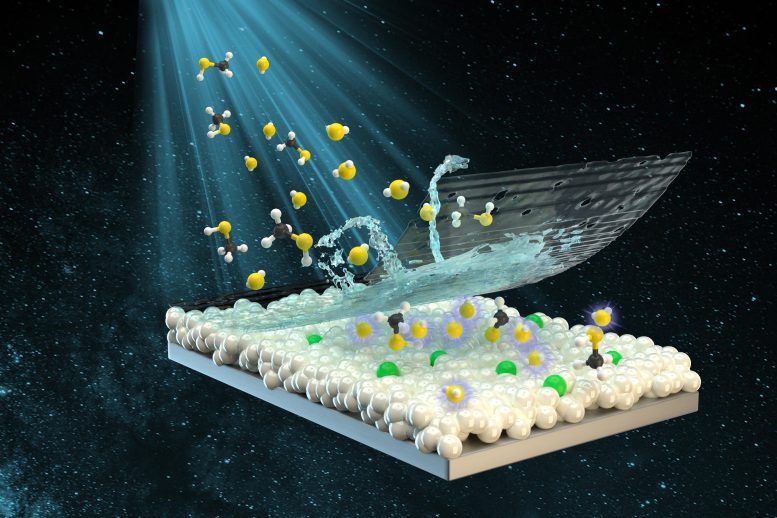
    Bifunctional role of PDMS membrane in designing H2S sensors —humidity resistant and selectivity improved. Credit: Zhang Ruofan

    Scientists created a humidity-resistant H2S sensor using a PDMS-coated CuCrO2 design.

    A team of researchers under the leadership of Prof. Meng Gang from the Hefei Institutes of Physical Science (HFIPS), Chinese Academy of Sciences (CAS), explored the use of polydimethylsiloxane (PDMS) in developing high-performance, humidity-resistant hydrogen sulfide (H2S) sensors, providing a path towards the practical application of H2S chemiresistors in humid air environments.

    The results were published in ACS Applied Materials & Interfaces and Chemical Communication, respectively.

    H2S is a colorless, flammable, explosive, highly corrosive, and highly toxic gas, which widely exists in semi-closed and high-humidity locations. Some oxides including delafossite, ZnO, and CuO have a high response to H2S in dry air, but the humidity tends to interfere with the response of sensors. In addition, H2S is a highly corrosive gas, and its corrosiveness increases with the increase of humidity. This leads to rapid corrosion and degradation of sensors in high-humidity environments, which becomes an important challenge for the practical application of sensors.

    In order to solve these problems, scientists evaporated a hydrophobic and semipermeable membrane of polydimethylsiloxane (PDMS) on the Pt single-atom anchored CuCrO2 by the thermal evaporation method.

    Zhang Ruofan, first author of the paper, described the biofunctional role of PDMS as “killing two birds with one stone.”

    PDMS had hydrophobic nature. It could effectively isolate the intrusion of water vapor in the environment, weakened the influence of environmental humidity on the sensor, and significantly improved the long-term stability of the sensor in a humid environment.

    On the other side, the micropores in the PDMS membrane could effectively block methyl mercaptan (CH3SH) molecules whose diameter was slightly larger than H2S. It acted as a “molecular sieve”, further improving the selectivity of the sensor for H2S.

    The humidity-resistant H2S sensor based on PDMS-coated CuCrO2 had a low operating temperature (100 ℃ or 212 ºF), high response (up to 151 for 5 ppm H2S at 50% relative humidity), high selectivity, and good long-term stability, which laid an important foundation for the practical application of H2S sensor in petrochemical, natural gas, and other fields.

    References:

    “Bifunctional role of PDMS membrane in designing humidity-tolerant H2S chemiresistors with high selectivity” by Ruofan Zhang, Zanhong Deng, Junqing Chang, Zhongyao Zhao, Shimao Wang and Gang Meng, 16 January 2023, Chemical Communications.
    DOI: 10.1039/D2CC05880D

    “Pt-Anchored CuCrO2 for Low-Temperature-Operating High-Performance H2S Chemiresistors” by Ruofan Zhang, Zanhong Deng, Lei Shi, Mahesh Kumar, Junqing Chang, Shimao Wang, Xiaodong Fang, Wei Tong and Gang Meng, 20 May 2022, ACS Applied Materials & Interfaces.
    DOI: 10.1021/acsami.2c00619

    Never miss a breakthrough: Join the SciTechDaily newsletter.
    Follow us on Google and Google News.

    Chinese Academy of Sciences Materials Science Sensor
    Share. Facebook Twitter Pinterest LinkedIn Email Reddit

    Related Articles

    Scientists Discover Hidden Pathway Inside Catalysts That Defies Decades of Assumptions

    New Catalyst Breakthrough Slashes Platinum Use in Green Hydrogen Tech

    The New King of Propylene? Cobalt Catalyst Outperforms Precious Metals

    This Tiny Discovery Could Change How We Store Energy and Filter Gases

    Stronger, Smarter, and More Selective: Armor-Like MOF Membrane Sets New Standard for Chemical Separations

    Chinese Breakthrough: Revolutionary Superconducting Material With Record-Breaking Properties

    iPODs Transforms Microfluidic Testing for a Faster, Portable Future

    Photonic Cellulose Nanocrystal Sensor Revolutionizes Biomedical Monitoring

    Catalytic Hydrogenation of CO2 to Methanol: Low Temperature and High Efficiency

    Leave A Reply Cancel Reply

    • Facebook
    • Twitter
    • Pinterest
    • YouTube

    Don't Miss a Discovery

    Subscribe for the Latest in Science & Tech!

    Trending News

    Popular Supplement Ingredient Linked to Shorter Lifespan in Men

    Scientists May Have Found a Way To Repair Nerve Damage in Multiple Sclerosis

    “Totally Unexpected” – Scientists Discover Pancreatic Cancer’s Fatal Addiction

    A Strange Quantum Effect May Explain One of Biology’s Greatest Mysteries

    James Webb Telescope Reveals the Universe’s Hidden Cosmic Web in Stunning Detail

    Scientists Identify Simple Supplement That Greatly Reduces Alzheimer’s Damage

    You May Have a Dangerous Type of Cholesterol Even if Your Tests Look Normal

    Your Blood Pressure Reading Could Be Wrong Because of One Simple Mistake

    Follow SciTechDaily
    • Facebook
    • Twitter
    • YouTube
    • Pinterest
    • Newsletter
    • RSS
    SciTech News
    • Biology News
    • Chemistry News
    • Earth News
    • Health News
    • Physics News
    • Science News
    • Space News
    • Technology News
    Recent Posts
    • Scientists Say a 40-Year-Old Childhood Obesity Warning May Be Completely Wrong
    • Marijuana Use May Raise Lung Cancer Risk, Researchers Warn
    • This Common Type of Food May Be Raising Your Risk of Heart Disease
    • Fur Seals’ Hearts Suddenly Spike Hours After Returning to Land
    • Scientists Say Cognitive Decline Isn’t Inevitable — Your Brain Can Improve at Any Age
    Copyright © 1998 - 2026 SciTechDaily. All Rights Reserved.
    • Science News
    • About
    • Contact
    • Editorial Board
    • Privacy Policy
    • Terms of Use

    Type above and press Enter to search. Press Esc to cancel.