
Close Menu
    Facebook X (Twitter) Instagram
    SciTechDaily
    • Biology
    • Chemistry
    • Earth
    • Health
    • Physics
    • Science
    • Space
    • Technology
    Facebook X (Twitter) Pinterest YouTube RSS
    SciTechDaily
    Home»Biology»Lab-Made Gel Mimics Molecular Motors Inside Living Cells
    Biology

    Lab-Made Gel Mimics Molecular Motors Inside Living Cells

    By SciTechDailyNovember 8, 20121 Comment2 Mins Read
    Facebook Twitter Pinterest Telegram LinkedIn WhatsApp Email Reddit
    Share
    Facebook Twitter LinkedIn Pinterest Telegram Email Reddit
    artificial-polymer-structure
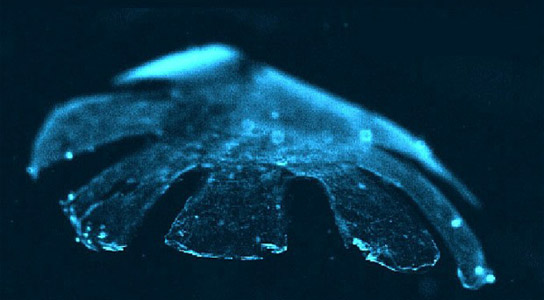
    A synthetic material capable of self-propulsion using cellular building blocks. Credit: Harvard University and Caltech

    Researchers have developed a lab-made material that can move itself using the building blocks found inside cells.

    The scientists published their findings in the journal Nature. They started by making a gel containing microtubules, which are stiff polymer filaments that act as guiding tracks for kinesin inside cells. Kinesin is propelled along the microtubule cables by ATP.

    They added a small polymer to the mix to encourage the microtubules to form bundles and create a moving network. Water droplets containing this gel moved continuously in oil emulsion and on flat surfaces, without the use of any external force.

    Each ATP molecule propels kinesin 8 nanometers forward along the track. A droplet that is 100 micrometers across can start spontaneously rolling when it touches a flat surface, thanks to the thousands of kinesins moving around inside of it along multiple microtubules.

    “It’s a startling advance because of the macro-scale movement that it produces,” says Raymond Goldstein, a biological physicist at the University of Cambridge, UK.

    The videos record the cyclic stages through which the microtubule bundles grow, bend, buckle, break, and grow again. The fluid’s movement increased with increasing concentrations of ATP.

    Theoretical physicists and biochemists who study active fluids are intrigued by the creation of a comparatively simple, real-life system that tests the theories that are usually confined to simulations.


    Self-propelled polymers:
    Powered by ATP, the biological motor protein kinesin makes microtubles move around and aggregate into bundles. Credit: Sanchez et al., Nature


    Ramping up the speed:
    Adding more ATP fuel to the mixture makes the microtubules jitter faster.

    Reference: “Spontaneous motion in hierarchically assembled active matter” by Tim Sanchez, Daniel T. N. Chen, Stephen J. DeCamp, Michael Heymann and Zvonimir Dogic, 7 November 2012, Nature.
    DOI: 10.1038/nature11591

    Never miss a breakthrough: Join the SciTechDaily newsletter.
    Follow us on Google and Google News.

    Biomedical Engineering Molecular Biology Movement
    Share. Facebook Twitter Pinterest LinkedIn Email Reddit

    Related Articles

    Watching SARS-CoV-2 Spread in Animal Models in Real Time Using New “Reporter Viruses”

    New DNA Technology Based on CRISPR Could Revolutionize Medical Diagnostics

    Coloring Tumors Reveals Their Bad Influence: Detecting the Very Initial Steps That Lead to Cancer Development

    Activating Genes With a Smartwatch to Control Insulin Production

    Scientists Shrink Pancreatic Cancer Tumors by Starving Their Cellular “Neighbors”

    NIRVANA: Fast, Portable Test Can Diagnose COVID-19 and Track Variants

    New Genetic Systems Created by Biologists to Neutralize Gene Drives

    Terahertz Radiation Can Disrupt Proteins in Living Cells – Contradicting Conventional Belief

    Researchers Use DNA Patterns in Blood to Identify Spastic Cerebral Palsy

    1 Comment

    1. ian on April 26, 2013 4:40 pm

      can this withstand high voltage gradients like chirals i’m trying to develop a new type nano transmission, any information would be much appriciated,. thanks ian.

      Reply
    Leave A Reply Cancel Reply

    • Facebook
    • Twitter
    • Pinterest
    • YouTube

    Don't Miss a Discovery

    Subscribe for the Latest in Science & Tech!

    Trending News

    Scientists Discover Cheap, Natural Remedy for High Blood Pressure

    Earth’s Upper Atmosphere Is Cooling Fast and Scientists Finally Know Why

    32,000 Olympic Pools of Magma Nearly Erupted Beneath Atlantic Island

    Exercise Changes the Heart in a Way Researchers Never Expected

    Too Much Sleep May Age Your Body Faster, New Study Warns

    Scientists Uncover Promising New Strategy To Stop Parkinson’s in Its Tracks

    Experts Reveal the Surprising Cancer Link Behind a Common Vitamin

    This Strange “Golden Orb” Found 2 Miles Deep Stumped Scientists for Years

    Follow SciTechDaily
    • Facebook
    • Twitter
    • YouTube
    • Pinterest
    • Newsletter
    • RSS
    SciTech News
    • Biology News
    • Chemistry News
    • Earth News
    • Health News
    • Physics News
    • Science News
    • Space News
    • Technology News
    Recent Posts
    • 19-Year Study Reveals the Surprising Truth About Sitting and Dementia
    • This Common Vitamin May Help Stop Prediabetes From Turning Into Diabetes
    • Canada’s Billion-Year-Old Rocks Could Hold the Future of Clean Energy
    • Climate Change Is Quietly Choking Rivers Across the Planet
    • Scientists Finally Solve the Mystery of “Clockwork” Earthquakes
    Copyright © 1998 - 2026 SciTechDaily. All Rights Reserved.
    • Science News
    • About
    • Contact
    • Editorial Board
    • Privacy Policy
    • Terms of Use

    Type above and press Enter to search. Press Esc to cancel.