
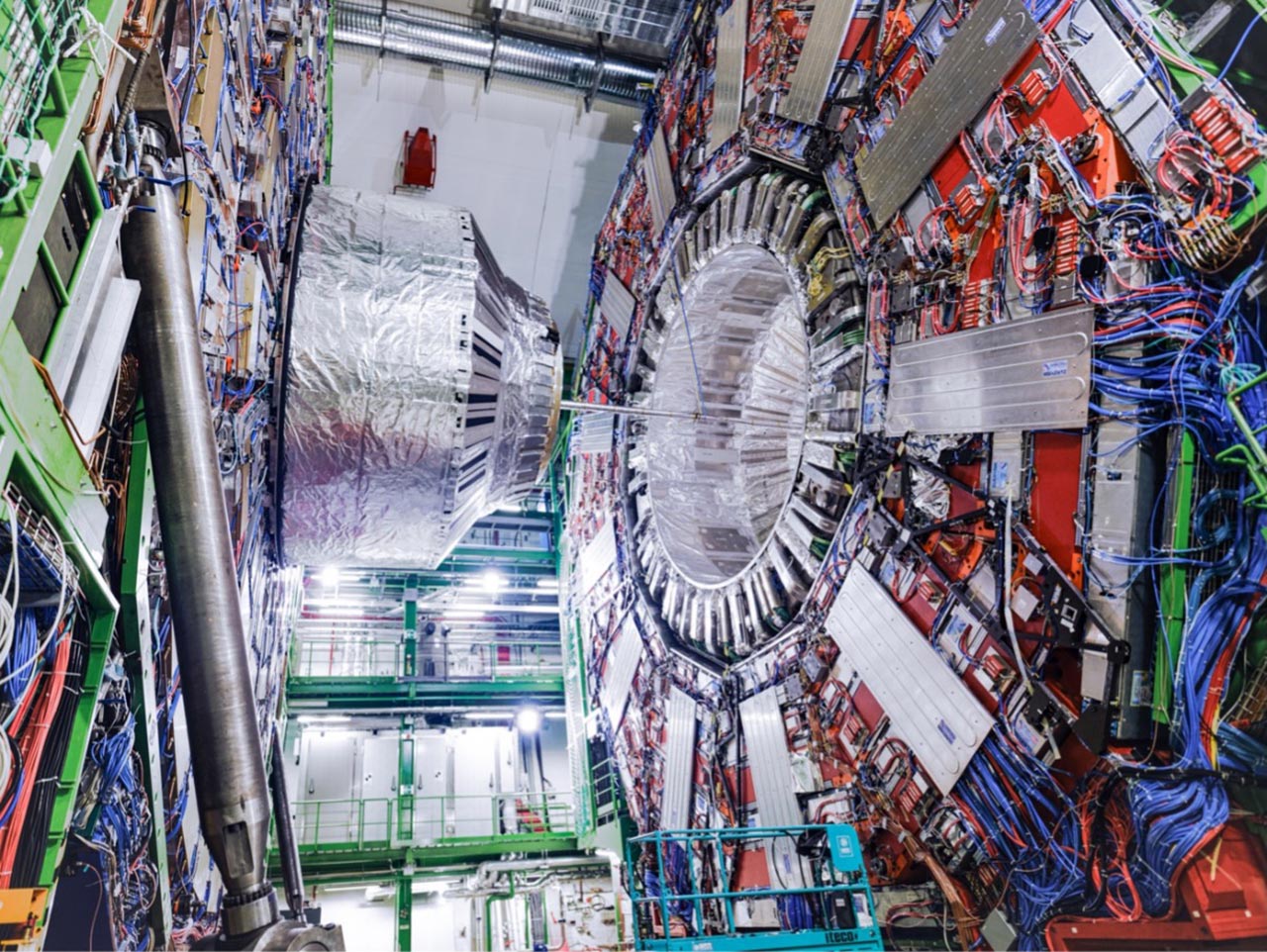
With this measurement, the Large Hadron Collider again demonstrated its ability to provide very high-precision measurements and bring new insights into an old mystery.
The CMS collaboration revealed a groundbreaking measurement of the electroweak mixing angle, confirming Standard Model predictions and addressing previous discrepancies with the most precise collider-based measurement to date. This achievement highlights the potential for precision physics in hadron colliders and prepares for more advanced studies at the High-Luminosity LHC.
Electroweak Mixing Measurement
At the annual Rencontres de Moriond conference, the Compact Muon Solenoid (CMS) collaboration presented a measurement of the effective leptonic electroweak mixing angle. The result is the most precise measurement performed at a hadron collider to date and is in good agreement with the prediction from the Standard Model.
Overview of the Standard Model
The Standard Model of Particle Physics is the most precise description to date of particles and their interactions. Precise measurements of its parameters, combined with precise theoretical calculations, yield spectacular predictive power that allows phenomena to be determined even before they are directly observed. In this way, the Model successfully constrained the masses of the W and Z bosons (discovered at CERN in 1983), of the top quark (discovered at Fermilab in 1995) and, most recently, of the Higgs boson (discovered at CERN in 2012).
Once these particles had been discovered, these predictions became consistency checks for the Model, allowing physicists to explore the limits of the theory’s validity. At the same time, precision measurements of the properties of these particles are a powerful tool for searching for new phenomena beyond the Standard Model – so-called “new physics” – since new phenomena would manifest themselves as discrepancies between various measured and calculated quantities.
Significance of Electroweak Mixing Angle
The electroweak mixing angle is a key element of these consistency checks. It is a fundamental parameter of the Standard Model, determining how the unified electroweak interaction gave rise to the electromagnetic and weak interactions through a process known as electroweak symmetry breaking. At the same time, it mathematically ties together the masses of the W and Z bosons that transmit the weak interaction. So, measurements of the W, the Z, or the mixing angle provide a good experimental cross-check of the Model.
Resolving Discrepancies in Measurements
The two most precise measurements of the weak mixing angle were performed by experiments at the CERN LEP collider and by the SLD experiment at the Stanford Linear Accelerator Center (SLAC). The values disagree with each other, which had puzzled physicists for over a decade.
The new result is in good agreement with the Standard Model prediction and is a step towards resolving the discrepancy between the latter and the LEP and SLD measurements.
Advancements in Collider Physics
“This result shows that precision physics can be carried out at hadron colliders,” says Patricia McBride, CMS spokesperson. “The analysis had to handle the challenging environment of LHC Run 2, with an average of 35 simultaneous proton-proton collisions. This paves the way for more precision physics at the High-Luminosity LHC, where five times more proton pairs will be colliding simultaneously.”
Challenges and Precision in Proton Collisions
Precision tests of the Standard Model parameters are the legacy of electron-positron colliders, such as CERN’s LEP, which operated until the year 2000 in the tunnel that now houses the LHC. Electron-positron collisions provide a perfect clean environment for such high-precision measurements. Proton-proton collisions in the LHC are more challenging for this kind of studies, even though the ATLAS, CMS and LHCb experiments have already provided a plethora of new ultra-precise measurements.
The challenge is mainly due to huge backgrounds from other physics processes than the one being studied and to the fact that protons, unlike electrons, are not elementary particles. For this new result, reaching a precision similar to that of an electron-positron collider seemed like an impossible task, but it has now been achieved.
Details of the CMS Measurement
The measurement presented by CMS uses a sample of proton-proton collisions collected from 2016 to 2018 at a center-of-mass energy of 13 TeV and corresponding to a total integrated luminosity of 137 fb−1, meaning about 11,000 million million collisions!
The mixing angle is obtained through an analysis of angular distributions in collisions where pairs of electrons or muons are produced. This is the most precise measurement performed at a hadron collider to date, improving on previous measurements from ATLAS, CMS, and LHCb.
Never miss a breakthrough: Join the SciTechDaily newsletter.
Follow us on Google and Google News.
9 Comments
Every collision, what you observe is only the surface and individual examples of things, and the natural essence of things needs to be refined and sublimated with scientific theories.
Don’t be fooled by the pseudo scientific theories of so-called academic journals (such as Physical Review Letters, Nature, Science, etc.) anymore. A minimal error or deviation may result in wide divergence. Scientific research guided by correct theories can help humanity avoid detours and failures. From cosmic accretion disks to quantum spins, topological vortices create everything and the world via self-organization.
If researchers are really interested in science and physics, you can browse https://zhuanlan.zhihu.com/p/463666584 and https://zhuanlan.zhihu.com/p/390071860.
Aaaaand Zhang is back. Do you ever give up spouting your own pseudoscience BS? Talk about the pot calling the kettle black.
Thank you. I appreciate your honesty.
You are using facts to prove that so-called academic journals (such as Physical Review Letters, Nature, Science, etc.) are highly toxic and harmful. The so-called academic journals firmly believe that two high-dimensional spacetime objects (such as two sets of cobalt-60) rotating in opposite directions can be transformed into two objects that mirror each other. Do they really not understand these things?
Please answer truthfully based on your understanding of science and pseudoscience:
1. What is science?
2. What is pseudoscience?
If you are really interested in science, you can browse https://zhuanlan.zhihu.com/p/693933588 and https://zhuanlan.zhihu.com/p/595280873.
I keep reading “Large HARDON Collider”…
Welcome to the internet in 2012
Good exercise on the theory and experimental results.Probability is there to explain some advanced astrophysics phenomena in future in the Particle Physics or new physics.
Please witness the exemplary collaboration between theoretical physicists and experimentalists (https://zhuanlan.zhihu.com/p/701032654).
Instead of measuring the particles
It’s much better and more easier to invent Cold Fusion”*;-” with a muonic particles and applying for the forthcoming future and the new updated Version of changing the best of the world conditions
Thank you.
All it’s doing is sucking up lots of money