
Close Menu
    Facebook X (Twitter) Instagram
    SciTechDaily
    • Biology
    • Chemistry
    • Earth
    • Health
    • Physics
    • Science
    • Space
    • Technology
    Facebook X (Twitter) Pinterest YouTube RSS
    SciTechDaily
    Home»Earth»Lava Lamp Tectonics: Giant Blobs of Subducted Sediment Float Up Through Deep Earth
    Earth

    Lava Lamp Tectonics: Giant Blobs of Subducted Sediment Float Up Through Deep Earth

    By University of WyomingAugust 16, 2021No Comments4 Mins Read
    Facebook Twitter Pinterest Telegram LinkedIn WhatsApp Email Reddit
    Share
    Facebook Twitter LinkedIn Pinterest Telegram Email Reddit
    Jay Chapman
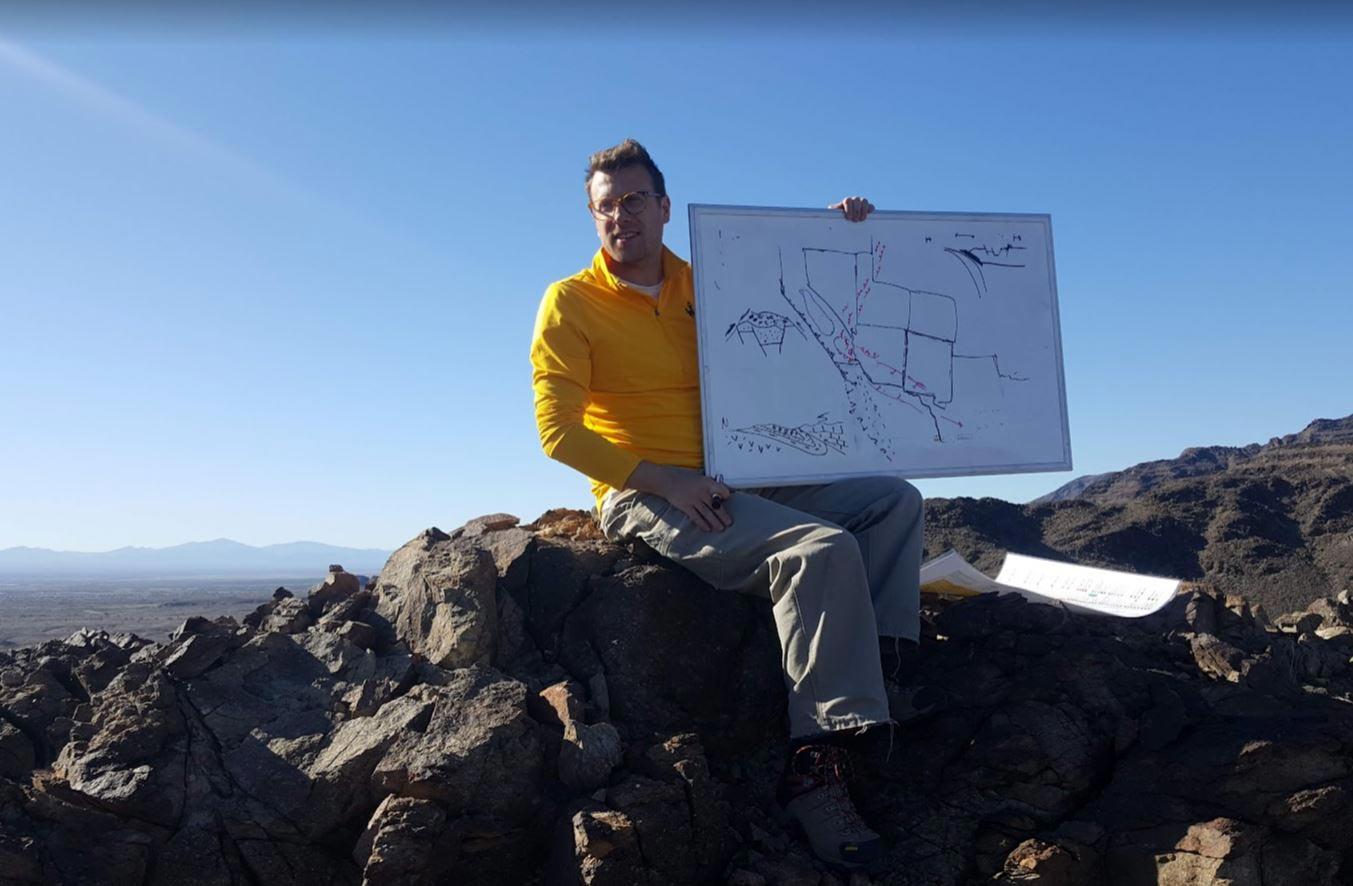
    UW Assistant Professor Jay Chapman teaches a winter-term field course in southern Arizona, during which students were able to investigate the Orocopia Schist in person. Chapman is the author of a new paper that suggests the rock originated as sand and mud subducted off the coast of California around 75 million years ago, then returned to the Earth’s crust by rising up through the mantle as enormous diapirs. Credit: University of Wyoming

    Computer models show that subducted sediments off California rose back up as massive “lava lamp” blobs, eventually surfacing far from the coast. This discovery could reshape our understanding of crust formation and mineral distribution.

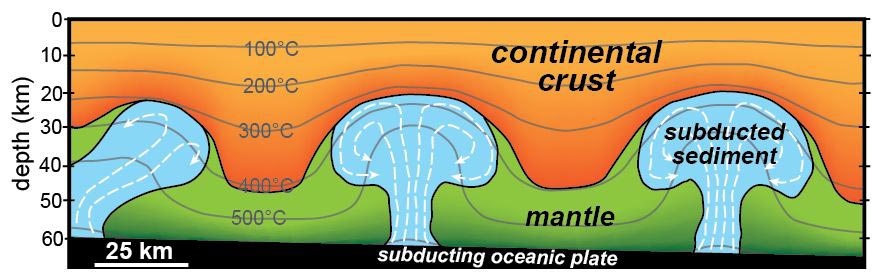
    A University of Wyoming professor has used computer modeling to propose that sand and mud subducted off the coast of California around 75 million years ago returned to the Earth’s crust by rising up through the mantle as enormous diapirs, like blobs in a lava lamp.

    These blobs are now found at the surface of the Earth, far inland from the coast, in places including the Mojave Desert and western Arizona.

    “These rocks aren’t the prettiest to look at, but they went on an extraordinary journey and have an incredible story to tell,” says Jay Chapman, an assistant professor in UW’s Department of Geology and Geophysics who focuses on tectonics.

    Chapman is the author of a new paper, titled “Diapiric relamination of the Orocopia Schist (southwestern U.S.) during low-angle subduction,” which was published in the August issue of the journal Geology. 
    Diapir Modeling
    Numerical modeling of sediment subducted beneath North American crust suggests that the sediment may buoyantly rise up through the mantle, like a lava lamp blob, and become attached to the base of the crust. Credit: Jay Chapman

    A Lava Lamp Model for Earth’s Mantle

    “The rocks started their lives as sediment eroded from the Sierra Nevada Mountains and carried by rivers and streams down to the ocean, where they ended up deposited in a subduction trench, similar to the modern-day Marianas trench,” Chapman says. “Then, they were carried about 20 miles deep into the Earth by a subducting oceanic plate, where the sediments were metamorphosed into a rock called schist. That in and of itself is pretty amazing, but the truly special thing about these rocks is that they didn’t stay subducted, but somehow made their way back up to the surface, where you can go stand on them today.”

    How the subducted sediments returned to the surface of the Earth and the distribution of the sediments in the subsurface are some of the questions Chapman is trying to answer with his research.

    “The prevailing theory is that the sediments were smeared against and plastered to the base of the North American tectonic plate, forming a sheet-like layer,” Chapman says. “However, the density of these sediments is much lower than rocks in the mantle or lower crust and, over millions of years, computer modeling predicts that the sediments will flow and buoyantly ascend, like hot wax in a lava lamp.”

    Redefining Subduction and Crust Formation

    The research has implications for understanding subduction zone processes and the distribution of natural resources.

    “Geoscientists around the world are working to understand what gives continental crust its unique composition, and subduction and reincorporation of sediment are a popular hypothesis,” Chapman says. “In addition, many researchers are now wondering whether fluids and elements released from the subducted sediments may have contributed to the concentration of economically important minerals and metals.”

    Reference: “Diapiric relamination of the Orocopia Schist (southwestern U.S.) during low-angle subduction” by James B. Chapman, 22 April 2021, Geology.
    DOI: 10.1130/G48647.1

    Never miss a breakthrough: Join the SciTechDaily newsletter.
    Follow us on Google and Google News.

    Geology Geophysics Popular University of Wyoming
    Share. Facebook Twitter Pinterest LinkedIn Email Reddit

    Related Articles

    New Findings Suggest That Many Geoscientists’ Understanding of the Earth’s Interior Is Too Simplistic

    Textbooks and Geoscientists May Be Wrong About How the Alps Were Formed

    Strange Precariously Balanced Rocks Provide Earthquake Forecasting Clues

    Deep-Earth Structures Discovered That May Signal Enormous Hidden Metal Lodes

    Geophysicist’s “Mind-Blowing” Discovery: Plato Was Right – Earth Is Made, on Average, of Cubes

    Mystery of Earth’s Vanishing Crust Solved by MagLab Geochemists – Prevailing Theories Contradicted

    Researchers Probe Materials at Extreme Deep-Earth Conditions to Decipher Earth’s Evolutionary Tale

    Arctic Sea Ice Loss is Impacting Atlantic Ocean Water Circulation System

    Study Reveals Ancient Impact of Massive Asteroid

    Leave A Reply Cancel Reply

    • Facebook
    • Twitter
    • Pinterest
    • YouTube

    Don't Miss a Discovery

    Subscribe for the Latest in Science & Tech!

    Trending News

    Scientists Discover 132-Million-Year-Old Dinosaur Tracks on South Africa’s Coast

    Scientists Uncover the Secret Ingredient Behind the Spark That May Have Started Life on Earth

    Physicists Observe Matter in Two Places at Once in Mind-Bending Quantum Experiment

    Stanford Scientists Discover Hidden Brain Circuit That Fuels Chronic Pain

    New Study Reveals Why Ozempic Works Better for Some People Than Others

    Climate Change Is Altering a Key Greenhouse Gas in a Way Scientists Didn’t Expect

    New Study Suggests Gravitational Waves May Have Created Dark Matter

    Scientists Discover Why the Brain Gets Stuck in Schizophrenia

    Follow SciTechDaily
    • Facebook
    • Twitter
    • YouTube
    • Pinterest
    • Newsletter
    • RSS
    SciTech News
    • Biology News
    • Chemistry News
    • Earth News
    • Health News
    • Physics News
    • Science News
    • Space News
    • Technology News
    Recent Posts
    • Python Blood Could Hold the Secret to Weight Loss Without Side Effects
    • Naturally Occurring Bacteria Completely Eradicate Tumors in Mice With a Single Dose
    • The Ideal Temperature for Storing Mangoes Isn’t What You Think
    • Groundbreaking Enzyme Atlas Rewrites Decades of Biology Research
    • New “Nanozyme Hypothesis” Could Rewrite the Story of Life’s Origins
    Copyright © 1998 - 2026 SciTechDaily. All Rights Reserved.
    • Science News
    • About
    • Contact
    • Editorial Board
    • Privacy Policy
    • Terms of Use

    Type above and press Enter to search. Press Esc to cancel.