
A bacterium from frog gut microbiota eliminated tumors in mice by selectively colonizing tumors and triggering both direct cell killing and immune-driven anticancer responses.
Researchers led by Prof. Eijiro Miyako at the Japan Advanced Institute of Science and Technology (JAIST) have identified a bacterium with striking anticancer potential. The microorganism, Ewingella americana, was isolated from the intestines of Japanese tree frogs (Dryophytes japonicus). Laboratory tests revealed that it can strongly suppress tumor growth, a discovery described in the international journal Gut Microbes.
Interest in the connection between gut microbes and cancer has grown rapidly over the past decade. Most studies have explored indirect strategies, such as altering the microbiome through diet, probiotics, or fecal microbiota transplantation. The new research takes a very different path. Instead of adjusting the overall microbial community, the scientists isolated individual bacterial strains, grew them in the lab, and delivered them directly into the bloodstream with the goal of targeting tumors.
To search for promising candidates, the team collected microbes from several amphibians and reptiles. They isolated 45 bacterial strains from the intestines of Japanese tree frogs, Japanese fire belly newts (Cynops pyrrhogaster), and Japanese grass lizards (Takydromus tachydromoides). Each strain was then carefully tested for anticancer properties. Nine of them showed measurable tumor-suppressing activity, but one stood out. E. americana produced the strongest therapeutic effect among all the candidates examined.
Remarkable Therapeutic Efficacy
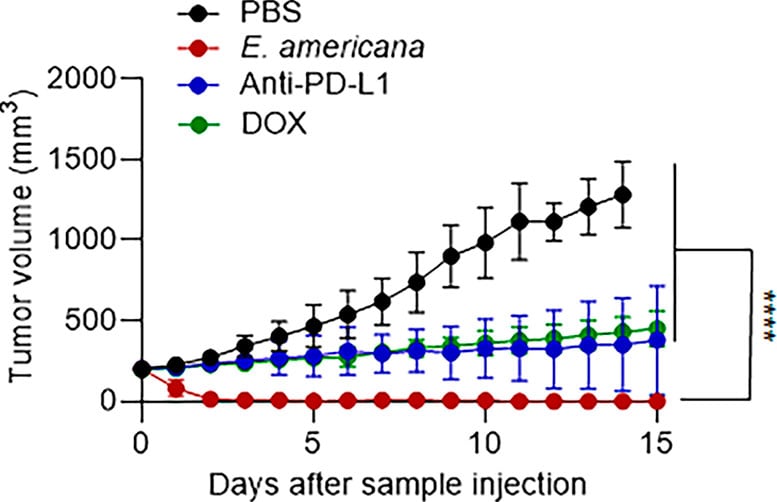
In experiments using a mouse model of colorectal cancer, researchers observed an extraordinary outcome after administering E. americana through a single intravenous injection. The treatment completely eliminated tumors in every case, resulting in a 100% complete response (CR) rate. This level of effectiveness was far greater than what is typically seen with established cancer therapies such as immune checkpoint inhibitors (anti-PD-L1 antibody) and the chemotherapy drug liposomal doxorubicin (chemotherapy agent).
A single bacterial dose eliminates tumors in mice
Further analysis revealed that E. americana targets cancer through two coordinated biological actions that work together to suppress tumor growth.
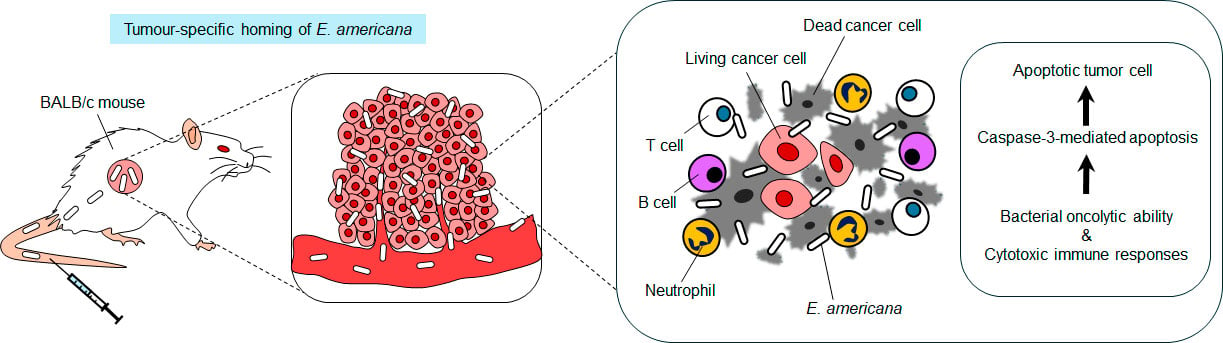
- Direct Cytotoxic Effect: As a facultative anaerobic bacterium, E. americana preferentially accumulates in the low oxygen tumor microenvironment, where it directly damages cancer cells. Within 24 hours after administration, bacterial levels inside tumors rise by about 3,000 times, enabling the bacteria to efficiently attack tumor tissue.
- Immune Activation Effect: The bacteria also trigger a strong immune response. Their presence attracts T cells, B cells, and neutrophils to the tumor. These immune cells release pro-inflammatory cytokines (TNF-α, IFN-γ), which strengthen immune activity and promote apoptosis in cancer cells.
Tumor-Specific Accumulation Mechanism
E. americana shows a strong preference for tumor tissue, building up in cancerous areas while remaining absent from healthy organs. This highly selective targeting of tumors appears to result from several biological factors that work together to guide the bacteria toward cancer sites.
- Low oxygen tumor environment: Tumor tissues commonly contain areas with very little oxygen. These hypoxic conditions create an ideal setting for anaerobic bacteria to grow, allowing E. americana to multiply more easily inside tumors than in healthy tissues.
- Local immune suppression: Many cancer cells produce the protein CD47, which helps them avoid detection by the immune system. This creates an immunosuppressive environment around the tumor that also allows bacteria to survive and persist in the same area.
- Leaky tumor blood vessels: Blood vessels that feed tumors are often poorly structured and unusually permeable. Because of this leakage, circulating bacteria can more easily exit the bloodstream and enter tumor tissue.
- Distinct tumor metabolism: Cancer cells produce unique metabolic byproducts that differ from those found in normal tissues. These tumor-associated metabolites can support the selective growth of bacteria such as E. americana within the tumor environment.
Excellent Safety Profile
Comprehensive safety testing showed that E. americana has several favorable safety characteristics:
- Rapid removal from the bloodstream (half-life ~1.2 hours, completely undetectable at 24 hours)
- No bacterial presence detected in normal organs, including liver, spleen, lung, kidney, and heart
- Only short-lived mild inflammatory responses, which return to normal within 72 hours
- No signs of long-term toxicity during a 60-day extended observation period
Future Directions
This research provides proof of concept for a new cancer treatment strategy that uses naturally occurring bacteria. Future studies and development will focus on several key directions:
- Expansion to other cancer types: Testing effectiveness in breast cancer, pancreatic cancer, melanoma, and other malignancies
- Improving delivery methods: Developing safer and more effective administration strategies, including dose fractionation and intratumoral injection
- Combination therapy development: Studying how the approach may work together with existing immunotherapy and chemotherapy treatments
The findings also highlight the untapped potential of biodiversity as a source of new medical technologies. Discoveries like this may eventually lead to additional treatment options for patients with cancers that do not respond well to current therapies.
Reference: “Discovery and characterization of antitumor gut microbiota from amphibians and reptiles: Ewingella americana as a novel therapeutic agent with dual cytotoxic and immunomodulatory properties” by Seigo Iwata, Nagi Yamasita, Kensuke Asukabe, Matomo Sakari and Eijiro Miyako, 10 December 2025, Gut Microbes.
DOI: 10.1080/19490976.2025.2599562
This research was supported by:
- Japan Society for the Promotion of Science (JSPS) KAKENHI Grant-in-Aid for Scientific Research (A) (Grant No. 23H00551)
- JSPS KAKENHI Grant-in-Aid for Challenging Research (Pioneering) (Grant No. 22K18440)
- JSPS Program for Forming Japan’s Peak Research Universities(J-PEAKS) (Grant No. JPJS00420230006)
- Japan Science and Technology Agency (JST) Program for Co-creating Startup Ecosystem (Grant No. JPMJSF2318)
- JST SPRING (Grant No. JPMJSP2102)
Never miss a breakthrough: Join the SciTechDaily newsletter.
Follow us on Google and Google News.
9 Comments
Meanwhile, climate change is driving a pandemic to the point that there’s an effort to create bioregional arcs so save them.
Thank God the Japanese are still doing medical research. Thank you.
Brilliant team doing great work!
Please confirm if any strain has been found for clearing arterial plaque. This will revolutionalise heart disease treatment? ?
Statins like Lipitor and Creator break down Amyloid plaques in human blood vessels
Statins like Lipitor and Creator break down Amyloid plaques in human blood vessels.
Statins like Lipitor and Crestor
break down Amyloid plaques in human blood vessels.
Ben 10 reboot
🙄