

Python-derived pTOS shows promise as a side-effect-free appetite suppressant, offering a new path for weight loss and metabolic therapies.
Researchers at the University of Colorado Boulder have identified a compound in python blood that allows these snakes to eat massive meals and then go for months without food while staying metabolically healthy.
The study, conducted in partnership with scientists from Stanford and Baylor universities, suggests this compound could lead to new therapies that help people feel full without causing nausea or muscle loss, which are common issues with existing medications.
The results were published in the journal Natural Metabolism on March 19.
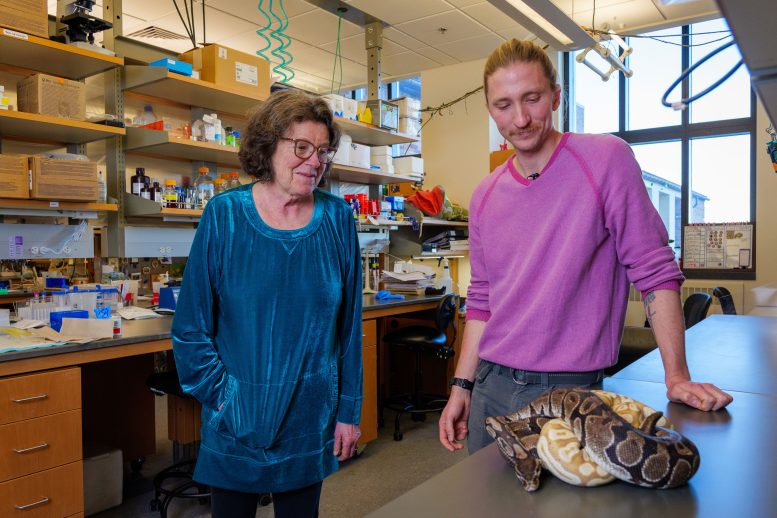
“This is a perfect example of nature-inspired biology,” said senior author Leslie Leinwand, a distinguished professor of molecular, cellular, and developmental biology who has been studying pythons in her lab for two decades. “You look at extraordinary animals that can do things that you and I and other mammals can’t do, and you try to harness that for therapeutic interventions.”
Extreme Metabolism in Pythons
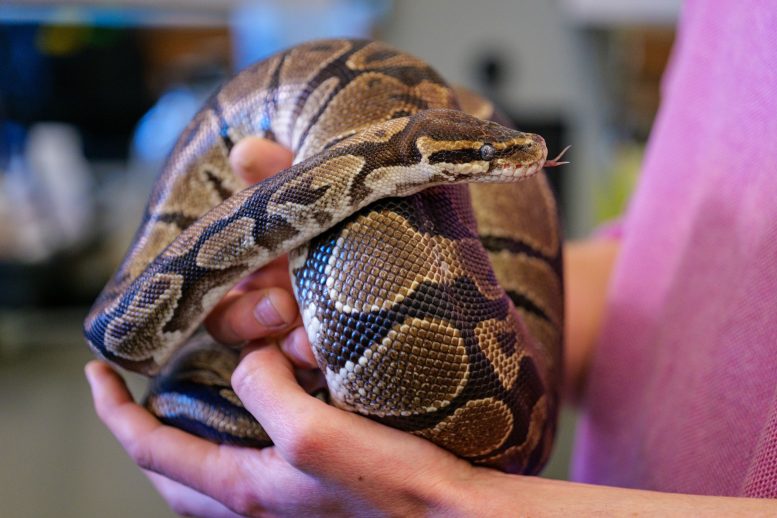
Pythons are capable of reaching the size of a telephone pole, consuming prey as large as an antelope, and then surviving for months or even years without another meal — all while keeping their hearts healthy and maintaining muscle mass. After feeding, their bodies undergo dramatic changes. Within hours, their heart enlarges by about 25% and their metabolism accelerates by as much as 4,000 times to process the meal.
To understand how these extreme adaptations work, Leinwand collaborated with Jonathan Long, an associate professor of pathology at Stanford University who focuses on metabolites, the chemical byproducts in blood that reflect how the body uses and stores energy.

Long’s research group has also studied racehorses to understand how these animals sustain intense bursts of speed, providing another example of extreme metabolic performance in nature.
Metabolite Discovery and pTOS Effects
“If we truly want to understand metabolism, we need to go beyond looking at mice and people and look at the greatest metabolic extremes nature has to offer,” said Long.
In this study, the team analyzed blood samples from ball pythons and Burmese pythons that were fed once every 28 days. Samples were collected immediately after feeding. They identified 208 metabolites that rose sharply after feeding. Among them, para-tyramine-O-sulfate (pTOS) increased by about 1,000 times.
Follow-up experiments conducted with Baylor University researchers showed that administering high doses of pTOS to both obese and lean mice influenced the hypothalamus, the region of the brain that regulates appetite. The treatment led to weight loss without triggering gastrointestinal issues, muscle loss, or reduced energy levels.
pTOS and Implications for Human Health
The researchers found that pTOS is produced by bacteria in the python gut and does not naturally occur in mice. In humans, it is present at low levels in urine and rises slightly after eating.
Because most metabolic research relies on mice and rats, this compound has largely been overlooked until now.
“We’ve basically discovered an appetite suppressant that works in mice without some of the side-effects that GLP-1 drugs have,” said Leinwand, referring to drugs like Ozempic and Wegovy, which act on the hormone glucagon-like petide-1 (GLP-1).
Nature-Inspired Drugs and Market Opportunity
Leinwand pointed out that current GLP-1 drugs were themselves inspired by nature, specifically the Gila monster. The venom of this reptile contains a hormone similar to human GLP-1.
While these drugs are widely used, studies indicate that up to half of patients stop taking them within a year.
“We believe there is still room for therapeutic growth in this market,” said Leinwand.
Startup and Future Therapeutic Applications
Leinwand, Long, and their colleagues at CU Boulder have launched a startup called Arkana Therapeutics to translate their findings into real-world treatments. They envision creating synthetic versions of the unique metabolites found in pythons to develop new therapies.
Their goals extend beyond weight loss.
Sarcopenia and Broader Medical Potential
Age-related muscle loss, known as sarcopenia, affects most people as they age, especially those who cannot exercise due to health conditions. Currently, there are no approved treatments to stop or reverse this condition.
According to Leinwand, studying pythons may also provide clues for addressing muscle loss.
Future studies will focus on understanding how pTOS functions in humans and mapping the roles of other metabolites that rise after feeding. Some of these compounds increase between 500 and 800%.
“We’re not stopping with just this one metabolite,” said Leinwand. “There’s a lot more to be learned.”
Reference: “Python metabolomics uncovers a conserved postprandial metabolite and gut–brain feeding pathway” by Shuke Xiao, Mengjie Wang, Thomas G. Martin, Barry Scott, Xing Fang, Xinming Liu, Yongjie Yang, Sipei Fu, Steven D. Truong, Jack F. Gugel, Gregory L. Maas, Marcus P. Mullen, Jennifer Hampton Hill, Veronica L. Li, Andrew L. Markhard, Mingming Zhao, Wei Qi, Saranya C. Reghupaty, Meng Zhao, Jan Spaas, Wei Wei, Trine Moholdt, John A. Hawley, Christian T. Voldstedlund, Erik A. Richter, Xiaoke Chen, Katrin J. Svensson, Daniel Bernstein, Leslie A. Leinwand, Yong Xu and Jonathan Z. Long, 19 March 2026, Nature Metabolism.
DOI: 10.1038/s42255-026-01485-0
This study was funded by the NIH/National Institutes of Health.
Never miss a breakthrough: Join the SciTechDaily newsletter.
Follow us on Google and Google News.
2 Comments
Excellent. Now get an AI working on extending this research 24 x 7, while humans are sleeping and eating so it can be brought to market ASAP, instead of decades down the road.
That’s a good idea 👍