
A team of researchers has discovered a new molecule with anti-cancer and anti-metastatic properties that targets the multiplication of cells and their mobility, possibly preventing the formation of metastases.
A new molecule with anti-cancer and anti-metastatic properties has been discovered by teams from CNRS, CEA, the Institut Curie, and Inserm,[1] in collaboration with Australian and British researchers. This anticancer drug acts on cells resistant to conventional chemotherapy thanks to an entirely novel action mechanism. It targets not only the multiplication of cells but also their mobility and thus could prevent the formation of metastases. Published in Cancer Research, the results obtained in vitro and on animals could, in the medium term, lead to the development of alternative anti-cancer treatments.
The appearance of resistant tumors considerably limits the efficacy of conventional chemotherapy treatments. In addition, the dissemination of metastases is the most frequent cause of death of patients suffering from cancer. It is for this reason that the researchers explored various therapeutic approaches, particularly the development of novel drugs that are active on resistant cancers and which prevent the formation of metastases.
It took nearly ten years for a group of biologists and chemists from CNRS, CEA, the Institut Curie and Inserm, in collaboration with Australian and British scientists, to succeed in their quest to discover and characterize a new anti-cancer and anti-metastatic molecule. To do so, the researchers used a robotic high-throughput screening platform: nearly 30,000 molecules were tested until one from the chemical library of the Institut Curie exhibited the sought-after activity on tumorous cells and was thus selected. Known as Liminib (or Pyr1), this new molecule has been identified as an inhibitor of LIM Kinase (LIMK). Overexpressed in invasive carcinoma,[2] LIMK represents a relevant therapeutic target that is generating considerable interest in numerous laboratories. This kinase is known to regulate the dynamic of the internal skeleton of the cell, constituted of a network of fibers, including filaments of actin and microtubules that allow the cells to move and multiply, two properties actively used by cancerous cells.
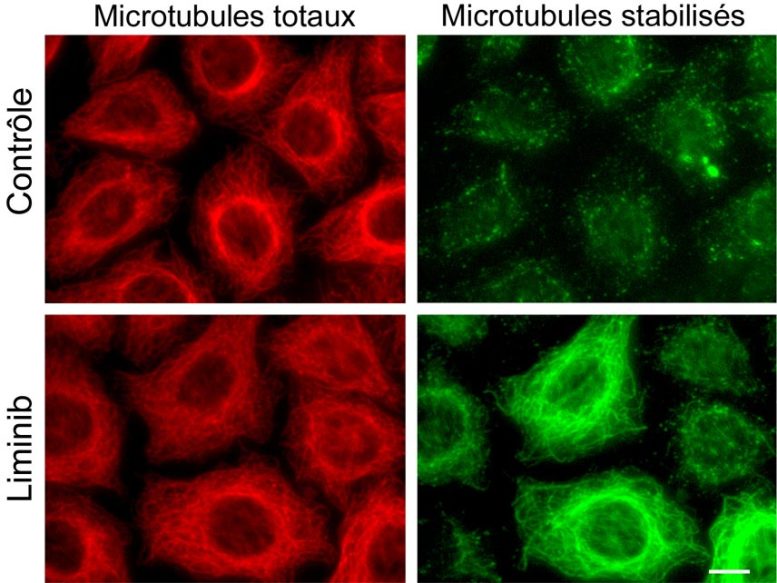
Liminib is thus the first LIMK inhibitor discovered that exhibits anti-cancer properties. This molecule blocks the mobility of the cells by disorganizing the cytoskeleton of actin and also brings about a stabilization of the microtubular network, thereby preventing the cells from multiplying, through a mechanism different to that of Taxol®,[3] a widely used anti-cancer drug. The researchers show that Liminib is toxic to several cancerous cell lines in vitro, including cell lines resistant to chemotherapy. In addition, the results of a “pilot” preclinical study conducted on a mouse model are encouraging: they reveal not only good efficacy but also good tolerance to the new molecule. In the medium term, this work could lead initially to the development of alternative treatments for patients for whom therapy is no longer an option.
Notes:
- The main teams involved in this work are: the Center de Criblage pour Molécules Bio-Actives of the Institut iRTSV of CEA (CEA/CNRS/INSERM/Université Joseph Fourier, Grenoble), the Institut Albert Bonniot (INSERM/Université Joseph Fourier), the Laboratoire Conception, Synthèse et Vectorisation de Biomolécules (CNRS/Institut Curie), the Center de Recherche en Oncologie Biologique et Oncopharmacologie (Inserm/Université de la Méditerrannée) in Marseilles, the Center de Recherche en Cancérologie de Lyon (CNRS/Inserm/Université Claude Bernard-Lyon 1/Center Anticancéreux Léon Bérard), the Laboratoire Bases Moléculaires et Structurales des Systèmes Infectieux (CNRS/Université Claude Bernard-Lyon 1).
- Malignant epithelial or glandular tumors.
- Molecules of the Taxol® family (taxanes) are drugs widely used in chemotherapy but which cause numerous undesirable side effects and, often, a habituation of the treated cells, thereby diminishing their efficacy. Taxanes act directly on tubuline, a constituent protein of microtubules.
Reference: “Pharmacological Inhibition of LIM Kinase Stabilizes Microtubules and Inhibits Neoplastic Growth” by Renaud Prudent, Emilie Vassal-Stermann, Chi-Hung Nguyen, Catherine Pillet, Anne Martinez, Chloé Prunier, Caroline Barette, Emmanuelle Soleilhac, Odile Filhol, Anne Beghin, Glaucio Valdameri, Stéphane Honoré, Samia Aci-Sèche, David Grierson, Juliana Antonipillai, Rong Li, Attilio Di Pietro, Charles Dumontet, Diane Braguer, Jean-Claude Florent, Stefan Knapp, Ora Bernard and Laurence Lafanechère, 30 August 2012, Cancer Research.
DOI: 10.1158/0008-5472.CAN-11-3342
Never miss a breakthrough: Join the SciTechDaily newsletter.
Follow us on Google and Google News.